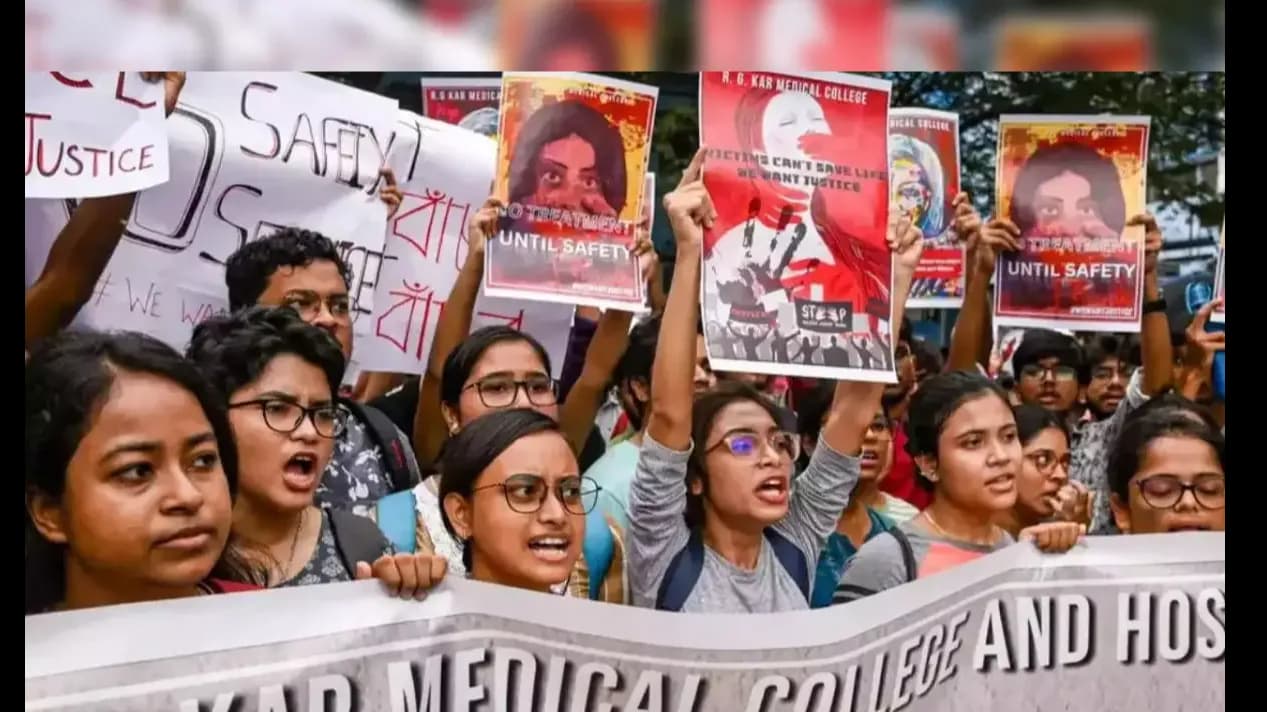
The protestors also involved people from different backgrounds, who initially demanded enhanced measures for the safety of women besides justice for the victim and sacking of senior officials allegedly responsible for the incident have off late “forgotten women's safety,” female doctors alleged.
Echoing Seth’s concerns, a female MBBS graduate at City Medical College was quoted as saying that male doctors “with savior complexes” have occupied the frontlines of the protests and also leadership positions in Resident Doctors’ Associations across Kolkata.
“We just need the men to listen to us. Let us express what makes us feel unsafe and insecure in our workplace, as well as what we need as a solution to address the issues,” she said.
Radhikaa Sharma, a postgraduate trainee doctor while expressing her disappointment over the prevailing scenario said, “Nurses and female hospital staff face even more violence than the average female doctor. Unfortunately, they are not mentioned anywhere in the ongoing discourse."
Kavita Krishnan, a female rights activist claimed that “women's safety” which was the larger issue initially has now become irrelevant amid other narratives. “What happened to the victim was because she was a woman, not because she was a doctor. That is something that must be kept in mind,” she was quoted as saying.
Satabdi Das, convener of the ‘Reclaim the Night, Reclaim the Rights’ movement, and a gender rights activist, who played a crucial role in facilitating the participation of feminist and queer activists in the protests, noted that many protesters no longer view the rape and murder of the doctor as a gender crime due to the larger political nexus allegedly behind the gruesome incident.
“Many believe that if a man had opposed the political nexus, the same would have happened to him. However, rape is a tool of domination which is rarely used against men. Sadly, there is a lack of understanding about rape not being a crime of lust but a tool to exercise domination over women,” she was quoted as saying.
Das also wondered about the lack of female, queer, and transgender faces in the doctors’ agitation. “While I understand that the agitating doctors’ five-point agenda is chiefly based on the health infrastructure and safety of health workers, they could have created a more compelling picture if more women were part of the protest,” she added.