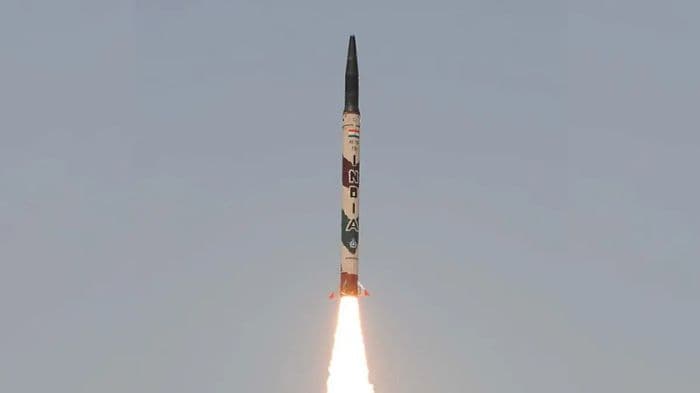
India on May 22 successfully test-fired the nuclear-capable Agni-1 ballistic missile from the Integrated Test Range at Chandipur in Odisha, adding another successful launch to the country’s steadily expanding strategic missile programme.
The launch was conducted under the supervision of the Strategic Forces Command (SFC), with the Ministry of Defence confirming that all operational and technical parameters were successfully validated.

The Agni-1 is a short-range ballistic missile capable of carrying nuclear warheads, with a strike range of around 700 to 900 kilometres. Developed by the Defence Research and Development Organisation (DRDO), the missile is designed for rapid mobility and deployment through road and rail launch systems.
India’s expanding Agni missile programme
The latest Agni-1 test is part of a much larger evolution of India’s missile capabilities over the past three decades.
India’s Agni missile programme began in the late 1980s under the Integrated Guided Missile Development Programme and has since grown into the backbone of the country’s strategic deterrence architecture. Since the first Agni test in 1989, India has developed multiple missile variants across different strike ranges.
The Agni series now includes Agni-1, Agni-2, Agni-3, Agni-4 and Agni-5, covering short-range, medium-range, intermediate-range and near intercontinental strike capability. India has conducted dozens of successful missile tests across these platforms over the years, including multiple user trials and operational validations by the armed forces.
In recent years, India’s missile programme has accelerated significantly. Earlier this year, India also tested an advanced Agni-5 variant reportedly equipped with MIRV (Multiple Independently Targetable Re-entry Vehicle) capability, allowing a single missile to carry multiple warheads aimed at different targets. Defence analysts described it as a major leap in India’s strategic capability.
Why the Agni-1 missile matters strategically
While Agni-5 often attracts more international attention because of its long range, Agni-1 remains strategically important for India’s regional deterrence posture.
The missile is designed for quick deployment and operational flexibility, particularly in scenarios requiring rapid response capability. Experts say short-range systems like Agni-1 play a critical role in maintaining tactical deterrence in South Asia.
Its mobility also makes it harder to track during deployment, strengthening survivability under conflict conditions.
India maintains a doctrine of “credible minimum deterrence”, which focuses on ensuring sufficient retaliatory capability rather than pursuing large-scale offensive nuclear expansion. The Agni missile family forms the core of that doctrine.
How the world views India’s growing missile capability
India’s repeated missile tests are increasingly shaping global perceptions of the country as a rising military and technological power.
The success of indigenous missile systems demonstrates India’s growing self-reliance in advanced defence manufacturing under the government’s “Atmanirbhar Bharat” initiative. Over the past decade, India has focused heavily on reducing dependence on imported military systems while building domestic strategic capability.
The missile programme is also closely watched internationally because of rising geopolitical tensions in the Indo-Pacific region. China and Pakistan continue to modernise their own missile and nuclear capabilities, making strategic deterrence a key element of regional security calculations.
Each successful Agni test sends a signal not only about military preparedness, but also about India’s technological maturity and operational readiness. India is increasingly being viewed globally as a country capable of sustaining long-term strategic deterrence alongside major military powers.
At the same time, India continues to officially maintain its “No First Use” nuclear policy, emphasising deterrence and strategic stability rather than aggressive deployment.
The Ministry of Defence did not release additional operational details regarding May 22 launch, but officials described the test as another successful validation of India’s strategic preparedness and missile reliability.
How the world views India’s growing missile capability
India’s continued missile testing comes amid broader efforts to strengthen indigenous defence manufacturing and strategic preparedness.
The Agni missile programme is part of India’s long-term push to develop domestic defence capabilities under the government’s “Atmanirbhar Bharat” initiative, which aims to reduce dependence on imported military systems.
The programme is also being closely watched internationally amid ongoing geopolitical tensions in the Indo-Pacific region and continued military modernisation by China and Pakistan.
India maintains that its missile programme is guided by its policy of “credible minimum deterrence” and its stated “No First Use” nuclear doctrine, which focuses on deterrence and strategic stability.
The Ministry of Defence did not release additional operational details regarding the May 22 launch, but said the test successfully validated operational and technical parameters of the Agni-1 system.






.png&w=256&q=75)