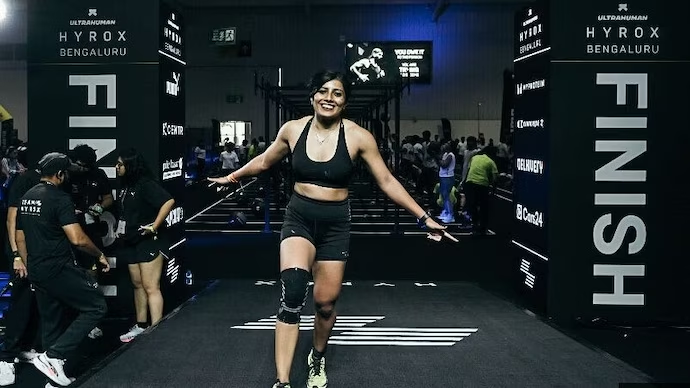
Around 9,000 fitness enthusiasts gathered at the Bangalore International Exhibition Centre over the weekend for Hyrox Bengaluru, an event that has now ignited a nationwide debate on the growing commercialization of fitness culture in India.
Participants paid nearly ₹9,325 each to compete in the globally popular fitness race held on April 11 and 12. With registrations alone, organizers are estimated to have generated more than ₹8.3 crore from the Bengaluru edition.

But beyond the crowds, medals and social media buzz, the event has divided opinion. Supporters call it a transformative test of endurance and discipline. Critics dismiss it as a premium-priced workout packaged for Instagram.
What exactly is Hyrox?
Hyrox describes itself as the “World Series of Fitness Racing” — a standardised indoor competition that combines running with functional strength workouts.
The challenge follows a demanding format: participants complete eight rounds of a 1 km run, each followed by a workout station.
Typical stations include:
- 1,000m SkiErg
- 50m sled push
- 50m sled pull
- 80m burpee broad jumps
- 1,000m rowing
- Farmers carry
- Sandbag lunges
- Wall balls
The same format is used globally, whether in Bengaluru, Berlin or Boston, allowing competitors to compare timings and performance internationally.
Hyrox also offers multiple categories — individual Open and Pro divisions, doubles, mixed doubles and relay teams — making it accessible to both seasoned athletes and everyday fitness enthusiasts.
Why Bengaluru became the biggest talking point
Although Hyrox has held earlier events in Mumbai and Delhi, the Bengaluru edition created unprecedented buzz.
It marked the first two-day Hyrox race in India and sold out quickly, highlighting the surging appetite for organised fitness competitions among urban Indians.
Globally, Hyrox is hosted in more than 85 cities across 30 countries and is considered one of the fastest-growing fitness racing formats worldwide.
‘I wanted to test my limits’
Among those who travelled for the event was Goa-based journalist Prathik Desai, who came to Bengaluru specifically to compete.
“I did it to know my endurance level and understand what areas of fitness I need to work on further,” he said.
Desai trained for four months through general strength and conditioning sessions because his local gym lacked Hyrox-specific equipment.
“It gave me the adrenaline rush that comes with any high-intensity sport. But it also gave me a reality check about how difficult it really is and the level of fitness I still need to reach,” he added.
For many participants, that appears to be the real attraction — a structured, public challenge that pushes physical and mental boundaries in a way solo workouts often cannot.
Fitness revolution or expensive validation?
Not everyone is convinced.
A viral post on X by user Ankit Kedia questioned the economics of the event.
“Being fit is good. But why are people spending this much on a one-day event? It feels less about fitness and more about validation,” he wrote.
The criticism also reflects wider frustration over rising costs of organised fitness events, with marathon entry fees often ranging between ₹3,000 and ₹5,000, excluding travel, gear and accommodation.
For some outstation participants, attending Hyrox Bengaluru reportedly pushed the total spend beyond ₹20,000 — roughly the cost of a six-month gym membership.
That led many online users to ask a blunt question: why pay so much for workouts that could be done in a park or gym for free?
Why many still see value in it
Supporters argue the fee pays for far more than access to exercise equipment.
Bengaluru-based lawyers Amrita Pratap and Anjana Satish, who are considering competing next year, believe such events create accountability, motivation and measurable progress.
“These fitness events provide a standardised benchmark for physical progress and create a strong sense of community energy that often pushes people beyond their normal limits,” Pratap said.
Satish described it as a positive cultural shift.
“What’s wrong with paying to get fit? We Indians are already at a genetic disadvantage when it comes to physical fitness. When you participate in events like Hyrox, you realise how they can completely change your outlook towards health and exercise,” she said.
More than a trend
At its core, Hyrox packages running, lifting, pushing and pulling — exercises athletes have always done — into a polished, competitive, crowd-driven experience with timing chips, rankings and medals.
To critics, that makes it an overpriced spectacle.
To believers, it is the future of fitness.
Either way, Bengaluru has shown one thing clearly: a growing number of Indians are no longer content with watching sport from the sidelines. They are willing to pay to become part of it.



.jpg&w=256&q=75)



.jfif&w=256&q=75)