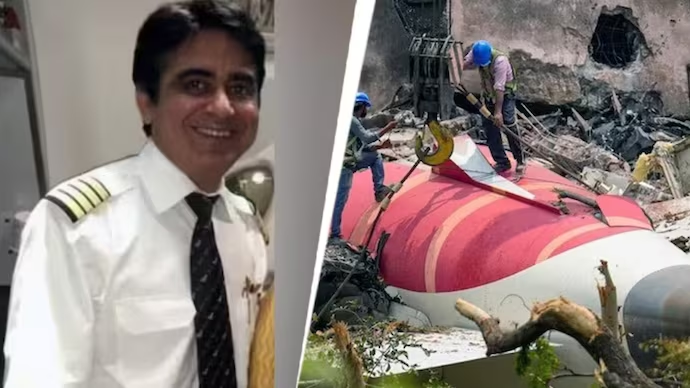
Nearly eight months after one of India’s deadliest aviation disasters, the father of Captain Sumeet Sabharwal has called for a fresh, court-monitored style investigation into the Ahmedabad Air India crash, alleging that “selective leaks” and insinuations have tarnished his son’s reputation.
Pushkaraj Sabharwal, 91, has written to the Civil Aviation Secretary and the Director General of the Aircraft Accident Investigation Bureau (AAIB), demanding that the Centre institute a formal inquiry under Rule 12 of the Aircraft (Investigation of Accidents and Incidents) Rules, 2017 — a provision that empowers the government to order an additional, independent probe if deemed necessary.

Captain Sumeet Sabharwal, 56, was among the pilots of Air India’s Boeing 787-8 Dreamliner operating flight AI171 to London Gatwick, which crashed shortly after takeoff from Ahmedabad on June 12, killing 260 people, including 241 passengers.
‘Innuendos have harmed his reputation’
In his letter dated August 29, Pushkaraj Sabharwal expressed anguish over what he described as speculative narratives surrounding the crash following the AAIB’s preliminary report released on July 12.
He alleged that selective details from the investigation — including references to cockpit voice recordings — had entered the public domain, fuelling speculation that his son was under psychological distress and may have contemplated suicide.
“These innuendos have very adversely affected my health and mental setup and the reputation of Captain Sumeet Sabharwal. They tarnish Captain Sabharwal’s reputation, which is a fundamental right guaranteed to a citizen of India under Article 21 of the Constitution of India,” the letter stated.
He termed the preliminary report “deficient, diversionary and discrepant”, arguing that it failed to clearly establish what happened while appearing to exonerate the aircraft manufacturer.
“The preliminary report… does not allude to the ‘what’ happened or the bare facts of the crash, instead resorting to insinuations on the one hand and offering copious clean chits to the manufacturer/s on the other,” the letter said.
AAIB’s position and cockpit details
In its preliminary findings, the AAIB had stated that fuel supply to both engines was cut off within a one-second gap soon after takeoff, leading to confusion in the cockpit.
“In the cockpit voice recording, one of the pilots is heard asking the other why did he cut off. The other pilot responded that he did not do so,” the report noted.
However, the bureau had cautioned that it was too early to draw “definite conclusions” and urged the public to refrain from premature narratives, stressing that the final report would determine the root cause.
There has been no immediate response from the Civil Aviation Ministry or the AAIB to Sabharwal’s latest letter.
‘Flawless career, no history of distress’
Strongly rebutting speculation about his son’s mental health, Pushkaraj Sabharwal pointed out that references to Captain Sabharwal’s divorce and his mother’s death were misleading and irrelevant.
He noted that the divorce had taken place nearly 15 years ago, and that the pilot had operated more than 100 flights after his mother’s death three years ago — without incident.
“It is most pertinent to note that in over 25 years of flying, Captain Sabharwal had not had a single incident or accident-causing fatalities or otherwise,” the letter said.
Captain Sabharwal had logged 15,638.22 flying hours, including 8,596 hours on the Boeing 787-8. He was a designated Line Training Captain and held a DGCA licence to train other pilots — credentials his father cited as proof of professional excellence.
Call for formal inquiry
Under Rule 12, the central government can institute a formal investigation into the circumstances of an accident involving an Indian-registered aircraft if it considers such a probe expedient. This would run in addition to the ongoing AAIB investigation.
For Pushkaraj Sabharwal, the issue goes beyond procedure. He argues that the absence of a formal inquiry, coupled with alleged selective disclosures to the media, has compounded his grief and infringed upon his deceased son’s right to reputation.
As the country awaits the final accident report, the grieving father’s plea adds a fresh layer of scrutiny to an investigation already shadowed by public speculation, unanswered questions and the immense human cost of the June 12 tragedy.