


As Election Commission’s electoral roll revision faces flak for allegedly vetting citizenship, Assam urges its NRC be treated as valid proof — despite its contested status and pending final notification.
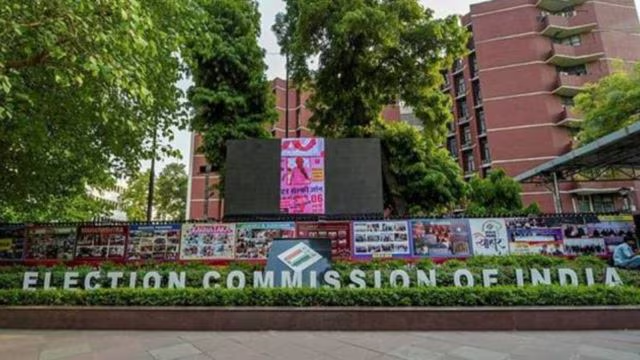
Amid growing controversy over the Election Commission’s (EC) move to conduct a Special Intensive Revision (SIR) of electoral rolls — starting with Bihar — Assam has urged the poll panel to factor in its own National Register of Citizens (NRC) when deciding eligibility for voters.
Government officials in Assam, the only state to have completed an NRC exercise, told the EC that this document — once formally notified — should be considered one of the admissible proofs of citizenship during the revision process, sources were quoted as saying. The request, however, comes at a time when the NRC’s legal status remains unresolved and its accuracy fiercely contested.

The push from Assam adds a new layer of complexity to a nationwide exercise already drawing sharp political criticism. Opposition parties have slammed the Bihar SIR as an “NRC through the backdoor,” alleging it amounts to a covert citizenship verification campaign that oversteps the EC’s constitutional remit.
Sources in Assam’s government argue that if the EC is allowing citizenship-linked documentation to determine voter eligibility, the state’s own NRC—which underwent a massive verification effort under Supreme Court monitoring — should logically be included.
Yet this move could further delay Assam’s own voter roll revision. The NRC, published in August 2019, excluded 19.6 lakh out of 3.3 crore applicants but has not been officially notified by the Registrar General of India.
The BJP-led government in Assam, under Chief Minister Himanta Biswa Sarma, has consistently refused to accept the NRC in its current form, citing large-scale inaccuracies. The state claims that the process excluded many indigenous people while erroneously including a significant number of undocumented migrants.
Sarma, who has long been critical of the final NRC draft, reiterated in a special Assembly session last month that the government was still pursuing 20% reverification in border districts and 10% in others.
“The NRC is about to be released. It will be out in a month or two, most likely by October,” a senior official said. “We feel the NRC data, with its extensive verification and pending reverification, will be a perfect document for proving citizenship.”
However, when contacted, Chief Minister Sarma denied any formal communication with the EC on this matter.
The broader national issue has reached the Supreme Court, where petitioners have challenged the EC’s authority to verify citizenship while revising voter rolls. They argue that such power lies outside the poll body’s jurisdiction and must follow due process. The court declined to stay the Bihar exercise but asked the EC to consider additional documents like Aadhaar, voter ID, and ration cards for voter verification.
At the center of the controversy is the EC’s directive asking Bihar residents registered after 2003 to furnish documents proving their age and citizenship. Critics say this turns what should be a routine electoral update into a shadow NRC.
The EC currently accepts 11 documents for proof of eligibility, including passports, government-issued IDs predating 1987, land allotment certificates, and—where applicable—the NRC. Assam’s request, if accepted, would give the still-uncertified NRC fresh legal weight, even as questions around its fairness and completeness continue to simmer.
As the EC presses ahead with its revisions ahead of upcoming elections, the shadow of the NRC — disputed, delayed, and divisive — looms large over India’s voter roll cleanup.

Odisha Cabinet Approves Free Textbooks for 28.7 Lakh Students in Classes 9 and 10

Austria university funding cuts trigger student protests as thousands demand secure funding

French students stage fresh protests as thousands march across major cities

Cornell suspends fraternity parties for academic year after sexual assault case

University of Saarland loses students as HTW Saarland enrolment rises

‘Dear Italy, how much do you cost us?’ Students pitch tents over soaring rents

Australia passes bill to expand university access and support disadvantaged students

HBKU’s PlasmaPure advances to semifinals in global water desalination competition
Karnataka student elections return after 37 years: Why political restrictions and university polls remain contentious

Global education is shifting from simply going abroad to creating more flexible routes to opportunity

Odisha Cabinet Approves Free Textbooks for 28.7 Lakh Students in Classes 9 and 10
Austria university funding cuts trigger student protests as thousands demand secure funding
French students stage fresh protests as thousands march across major cities
Cornell suspends fraternity parties for academic year after sexual assault case
University of Saarland loses students as HTW Saarland enrolment rises
‘Dear Italy, how much do you cost us?’ Students pitch tents over soaring rents
Australia passes bill to expand university access and support disadvantaged students
HBKU’s PlasmaPure advances to semifinals in global water desalination competition
Karnataka student elections return after 37 years: Why political restrictions and university polls remain contentious
Global education is shifting from simply going abroad to creating more flexible routes to opportunity
Copyright© educationpost.in 2026 All Rights Reserved.