India’s AI Healthcare Boom Is Catching Diseases Early—But Who’s Watching the System?
From crores lost in government schemes to fake prescriptions and unchecked AI tools, India’s healthcare digitisation is exposing a parallel system of misuse and weak oversight
Prabhav Anand06 May 2026 06:19
India’s healthcare digitisation drive is being projected as a model for scale, but beneath the expansion lays a pattern that has surfaced repeatedly in audits, investigations and enforcement actions—systems are growing faster than they can be monitored.
Flagship programmes like Ayushman Bharat and digital platforms such as eSanjeevani have brought millions into formal healthcare access. But as these systems scale, oversight mechanisms are struggling to keep pace with both volume and complexity.
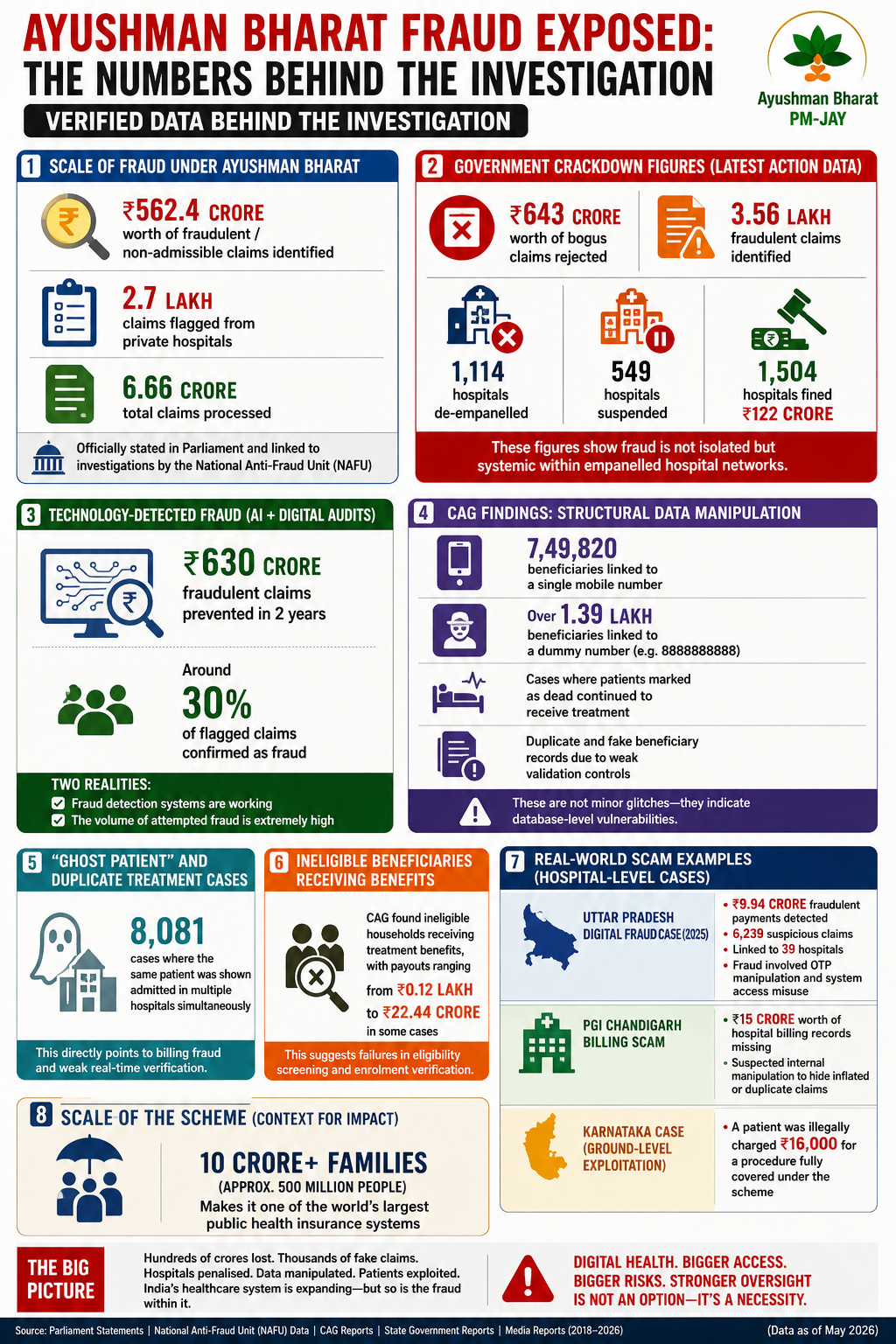
The Comptroller and Auditor General (CAG) has, in multiple reviews of public health schemes and insurance-based models, flagged issues such as duplicate beneficiaries, ghost entries, and hospitals billing for procedures that were never performed. In some instances, audit observations pointed to weak verification systems and poor data integration between states, creating loopholes that could be exploited at scale.
The scale of fraud emerging under Ayushman Bharat is no longer anecdotal—it is quantifiable.
Government data shows that over ₹630 crore worth of fraudulent or suspicious claims were blocked in just two years, with nearly 30 percent of flagged cases confirmed as fraud. These include inflated billing, unnecessary procedures and fabricated patient records.
In several state-level crackdowns, hospitals have been blacklisted for performing surgeries on non-existent patients or exaggerating treatment costs. Investigations in states like Uttar Pradesh, Jharkhand and Chhattisgarh have uncovered networks where intermediaries allegedly recruited patients or created fake identities to claim insurance payouts.
In one widely reported pattern, hospitals billed for high-value procedures such as cardiac interventions or oncology treatments, while patients either received minimal care or none at all. The lack of real-time verification allowed such claims to pass through initial checks.
The findings point to a deeper structural issue: the system incentivises volume, but accountability mechanisms remain reactive rather than preventive.
Hospital-level scams expose ground realities
Beyond aggregated data, individual cases highlight how fraud operates at the ground level.
Authorities have repeatedly uncovered instances where private hospitals empanelled under government schemes:
Admitted patients unnecessarily to inflate claims
Conducted diagnostic tests that were not clinically required
Used a single patient identity to generate multiple claims
In some raids, officials found identical medical records used across multiple patients, suggesting template-based fraud rather than isolated malpractice.
These are not one-off violations. They reflect a pattern where digital systems are used to legitimise fraudulent activity, rather than eliminate it.
AI enters the system—without clear accountability
Into this already complex ecosystem, artificial intelligence is now being introduced as a force multiplier.
AI tools are being deployed for disease screening, diagnostic support and even fraud detection. In theory, they are meant to reduce human error and improve efficiency. In practice, they are adding another layer of opacity.
There is little public disclosure on how these systems are trained, how they perform across diverse populations, or how errors are handled. Unlike traditional medical devices, many AI tools fall into regulatory grey zones, especially when classified as advisory systems.
This creates a situation where clinical decisions may increasingly rely on algorithms that are neither fully transparent nor independently audited.
Fake prescriptions and digital misuse add a new threat layer
Even as authorities attempt to plug existing leakages, new forms of misuse are emerging.
Pharmacy groups and healthcare associations have raised alarms over AI-generated fake prescriptions, which can mimic legitimate medical documents with high accuracy. These prescriptions can be used to obtain restricted drugs, bypassing traditional checks.
In a country already grappling with antibiotic misuse, this trend could have far-reaching consequences, including accelerating antimicrobial resistance.
The problem is compounded by the ease of access to generative AI tools, making enforcement significantly more difficult.
Health data boom without proportional safeguards
India’s push toward digital health records under the Ayushman Bharat Digital Mission is creating one of the largest health data ecosystems globally.
But with scale comes risk. Experts have repeatedly flagged concerns over:
Absence of a unified health data protection law specific to medical records
Limited awareness among patients about consent and data sharing
Potential misuse of data by third-party vendors
The lack of clarity on data ownership and accountability creates a situation where sensitive medical information could be exposed or exploited without adequate recourse.
India’s healthcare transformation is real—but so are its contradictions.
On one hand, digital platforms and AI tools are expanding access, enabling early diagnosis and bringing millions into the healthcare net. On the other, audits and investigations reveal a parallel system marked by fraud, weak oversight and regulatory gaps.
The numbers tell the story: hundreds of crores in fraudulent claims, repeated audit flags, blacklisted hospitals and emerging digital misuse—all within systems designed to improve efficiency and transparency.
India is building one of the world’s largest digital healthcare ecosystems in real time.
But the foundation is uneven.
Without stronger auditing, stricter regulation and transparent accountability, the same systems designed to deliver healthcare at scale risk becoming conduits for misuse at scale.
The promise of AI and digital health is undeniable.



.jpg&w=3840&q=75)

.png)


.jpg&w=256&q=75)