


Higher education leaders have called for transnational education and research collaborations that reflect the priorities of local institutions and economies, as the UK and Southeast Asian countries seek to deepen academic ties.
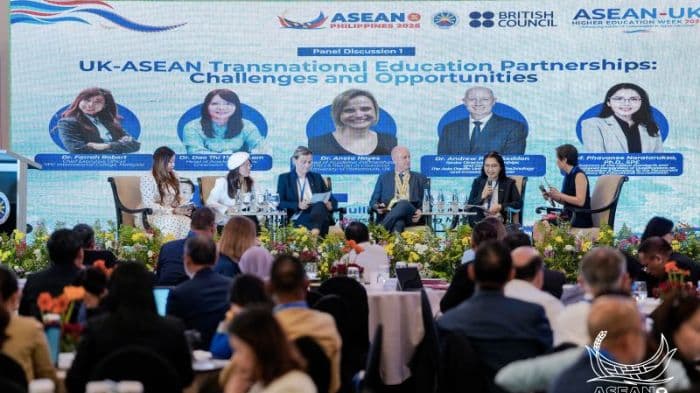
Universities in the United Kingdom and Southeast Asia should develop international partnerships around local education and economic priorities rather than simply transferring British higher education models to the region, sector leaders have said.
The discussions took place during the British Council-led ASEAN-UK Education Week in Manila, held from Nov 3 to 4. The event brought together policymakers, university leaders and researchers to discuss cooperation in transnational education, research, innovation, skills development and artificial intelligence.

Michelle Aguilar-Ong, commissioner of the Philippines' Commission on Higher Education, said the country was preparing to launch a national strategy for transnational higher education, with digital transformation, renewable energy and the blue economy identified as priority areas for international cooperation.
She also highlighted the changing requirements of the global workforce, warning that 39% of the skills used today would no longer be relevant by 2030.
Partnerships must reflect local priorities
Speakers emphasised that international university partnerships should be designed jointly by institutions and deliver practical benefits for both sides.
Kostantino Kontis, chair of the Universities UK International Asia Network and dean for global engagement in China and East Asia at the University of Glasgow, said universities should develop programmes that partner institutions identify as valuable, instead of transplanting existing UK models into local settings.
He also pointed to the role of seed funding in bringing academics together and establishing the foundations for longer-term research and institutional partnerships.
Daley Middleton, head of trade at the UK Department for Education, highlighted the UK's experience in transnational education and the quality of its higher education system. However, he acknowledged that Southeast Asian countries have several potential international partners and should be able to pursue collaborations that meet their own requirements.
More than 39,000 students from Southeast Asia studied at UK higher education institutions during the previous academic year, Middleton said. In addition, more than 96,000 students across the region were involved in UK transnational education programmes.
He said these figures reflected longstanding institutional partnerships, research collaborations and people-to-people links between the UK and Southeast Asia.
Philippines outlines transnational education plans
The event also provided a platform for the Philippines to set out its plans for international higher education partnerships.
The country's Commission on Higher Education launched the Philippines Transnational Higher Education Strategy during the week. The strategy is intended to guide how Philippine institutions collaborate with overseas universities.
The British Council's programme also included discussions on research and innovation partnerships, future skills, digital transformation and AI in higher education. An ASEAN Universities Partnership Exchange brought together institutions from the UK, the Philippines and other Southeast Asian countries to explore joint programmes, research collaboration and student and staff mobility.
Universities including the University of Reading, University of Leeds, University of Liverpool, Newcastle University, Goldsmiths and Liverpool Hope University are already working with partners in the region to develop joint programmes.
UK International Education Champion Sir Steve Smith said successful transnational education partnerships should strengthen both institutions involved. He also emphasised the importance of ensuring that students receive quality teaching, appropriate support and clear information about their qualifications.
The discussions reflect a broader shift in international higher education cooperation towards partnerships that extend beyond student recruitment and focus on research, skills development, joint programmes and institutional capacity-building.

University of Sharjah deepens UAE-Australia ties through cultural and academic exchange

Chhath Puja 2026: Delhi Declares November 16 Holiday, Bihar Schools to Reopen on November 18

Abu Dhabi to train 250 Emiratis annually for inclusive education roles

National Education Day 2026: History, Significance, Celebrations and Maulana Abul Kalam Azad’s Legacy

French students block 49 schools in renewed protest over learning conditions

UK regulator warns universities to protect degree standards as AI reshapes student assessments

Assam clears key education reforms, healthcare funding and employee welfare measures

India-Japan MIRAI-Setu program connects IIT students with Japanese universities and industries

Indian Railways Announces 31 Special Trains from Delhi Amid Chhath Puja Rush; Bihar and UP Passengers Get Relief

Fewer children, more university aspirants: China plans major education system overhaul

University of Sharjah deepens UAE-Australia ties through cultural and academic exchange
Chhath Puja 2026: Delhi Declares November 16 Holiday, Bihar Schools to Reopen on November 18
Abu Dhabi to train 250 Emiratis annually for inclusive education roles
National Education Day 2026: History, Significance, Celebrations and Maulana Abul Kalam Azad’s Legacy
French students block 49 schools in renewed protest over learning conditions
UK regulator warns universities to protect degree standards as AI reshapes student assessments
Assam clears key education reforms, healthcare funding and employee welfare measures
India-Japan MIRAI-Setu program connects IIT students with Japanese universities and industries
Indian Railways Announces 31 Special Trains from Delhi Amid Chhath Puja Rush; Bihar and UP Passengers Get Relief
Fewer children, more university aspirants: China plans major education system overhaul
Copyright© educationpost.in 2026 All Rights Reserved.