


Students at several US universities are campaigning against Flock Safety cameras, arguing that the technology could expose personal data to law enforcement agencies and discourage students from attending campus activities. Some institutions have already ended their contracts.
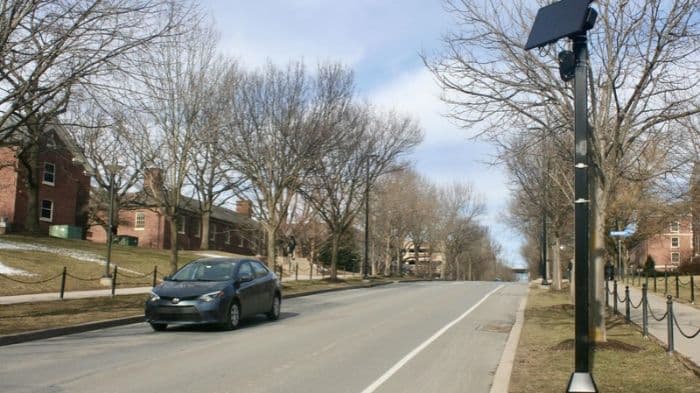
Image for Representation.
Students at universities across the United States are urging institutions to remove surveillance cameras operated by Flock Safety, raising concerns about student privacy, immigration enforcement and the monitoring of campus protests.
The campaign, known as the DeFlock movement, has gained momentum at institutions including Emory University, Indiana University Bloomington, the University of Florida and the University of North Georgia.

The cameras use automated licence plate recognition (ALPR) technology to capture images of vehicles entering and leaving campuses. While universities and the company say the systems can help police investigate crimes, students have questioned how the collected information is stored, shared and accessed.
Several universities have begun ending their arrangements with Flock Safety following student campaigns and growing scrutiny of surveillance practices.
Universities begin removing Flock cameras
Emory University in Atlanta removed 12 licence plate-reading cameras in September and decided not to renew its contract with Flock Safety.
The decision followed months of campaigning by DeFlock Emory, a coalition of students and university employees. Its members argued that the cameras were unnecessary and could expose students to surveillance without adequate safeguards.
Cornell University also announced that it would not renew its contract with the company. The university confirmed that its seven cameras would be removed after the agreement expired on Oct 14.
Pennsylvania State University officials have also announced plans to end their contract with Flock.
The developments indicate that the debate is moving beyond student protests to institutional decisions about whether surveillance technology should remain part of campus security systems.
Why students are opposing the technology
Students involved in the campaigns have raised concerns about who can access vehicle data and whether it could be shared with external law enforcement agencies.
These concerns are particularly significant for undocumented students and those involved in campus activism. Students fear that information collected on university premises could be used to identify or track individuals, including those participating in protests.
The concerns intensified after investigative reporting revealed that Immigration and Customs Enforcement (ICE) agents had obtained access to Flock data through local and state law enforcement networks.
Flock has said it does not contract directly with ICE or other Department of Homeland Security agencies. However, researchers have pointed out that police departments and other customers can share information with external agencies, potentially allowing data to move through interconnected networks.
At Emory, students also argued that surveillance could make people less comfortable attending classes, socialising on campus or seeking medical assistance.
Universities and Flock defend the cameras
Flock Safety maintains that its licence plate readers help improve public safety and assist investigations into crimes, missing persons and vehicle theft.
The company says the cameras capture images of vehicle number plates and do not use facial recognition to identify people inside vehicles. It also says customers control their data and decisions about sharing it.
Some universities have cited the technology's role in police investigations. The University of Illinois Urbana-Champaign, for example, said its 20 licence plate readers had supported investigations involving missing persons, sexual assault, aggravated battery and vehicle theft.
University officials have also argued that campus police policies govern how information is accessed, retained and shared.
Surveillance expanded after campus protests
The spread of Flock cameras at universities accelerated after pro-Palestinian student protests and encampments in 2024.
Torin Monahan, a professor of media and technology studies at the University of North Carolina at Chapel Hill, told Inside Higher Ed that universities had invested in surveillance systems partly to monitor and respond to future campus protests.
His research examined how campus police departments use Flock technology. He also raised concerns about the wider expansion of surveillance infrastructure, including drones, facial recognition systems and real-time crime centres.
A study he conducted identified at least 150 higher education institutions using the technology as of May 2026.
For student campaigners, removing Flock cameras is also part of a broader demand for greater transparency and limits on institutional surveillance.

Syria school curriculum changes spark backlash over altered images, historical figures

University of Lincoln makes lecture recordings compulsory, sparking staff union dispute

11-year-old Egyptian girl beats 40 million students to win Dh500,000 in Dubai

UN highlights need for media literacy as AI reshapes how young people access information

Canadian university graduates retain wage advantage as full-time job prospects soften
11-year-old Egyptian girl beats 40 million students to win Dh500,000 in Dubai

South Korea's student suicide toll nears 1,000 in four years, with India's figures also drawing attention
Want to explore the world without leaving your classroom? Seoul students show how

When smart glasses become cheating tools: South Korea draws tougher exam rules

Jeans out, formals in: Bihar rolls out stricter rules for government school staff

Syria school curriculum changes spark backlash over altered images, historical figures
University of Lincoln makes lecture recordings compulsory, sparking staff union dispute
11-year-old Egyptian girl beats 40 million students to win Dh500,000 in Dubai
UN highlights need for media literacy as AI reshapes how young people access information
Canadian university graduates retain wage advantage as full-time job prospects soften
11-year-old Egyptian girl beats 40 million students to win Dh500,000 in Dubai
South Korea's student suicide toll nears 1,000 in four years, with India's figures also drawing attention
Want to explore the world without leaving your classroom? Seoul students show how
When smart glasses become cheating tools: South Korea draws tougher exam rules
Jeans out, formals in: Bihar rolls out stricter rules for government school staff
Copyright© educationpost.in 2026 All Rights Reserved.