


Demonstrations over overcrowded classrooms, teacher shortages and deteriorating school facilities have spread nationwide, with police conduct and accusations of political exploitation adding to tensions ahead of the 2027 presidential election.
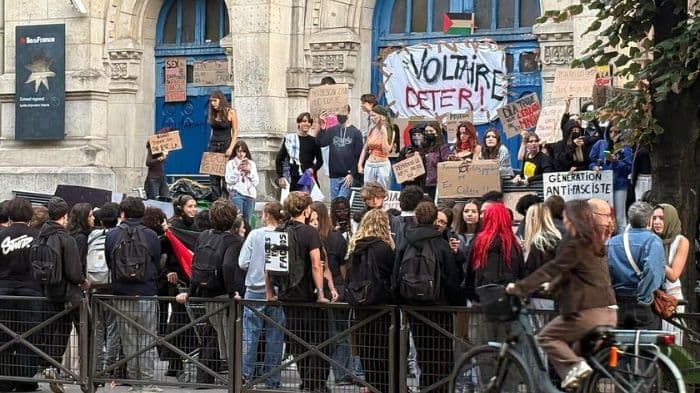
A student protest movement that began in the suburbs of Paris has developed into a nationwide challenge for France's government, bringing long-standing concerns about public education into the political debate ahead of the country's 2027 presidential election.
The demonstrations, which began in mid-September, have drawn high school and university students, teachers and trade unions. Protesters are demanding better-maintained school buildings, more teachers, less crowded classrooms and greater equality in access to education.

The unrest has also raised questions about the government's response to demonstrations involving minors, after confrontations with police left students and security personnel injured. Political parties have increasingly weighed in, turning the protests into another point of contention in an already divided political landscape.
School conditions at the centre of protests
Students have cited staff shortages, lengthy school days, overcrowded classrooms and outdated facilities among their principal grievances. Some have blockaded school entrances, while demonstrations have spread beyond the Paris suburbs to other parts of the country.
The movement has attracted support from teaching unions, parents and other groups concerned about the state of public education. Students from different types of schools have participated, including institutions outside the areas where the protests first emerged.
Teachers' representatives have argued that the problems extend beyond individual schools. They point to difficulties replacing absent teachers, inadequate facilities during heatwaves and pressure on staff working in crowded classrooms.
Education Minister Édouard Geffray has announced plans to deploy 3,000 substitute teachers to schools facing staffing shortages. The measure is expected to cost tens of millions of euros in 2026. However, union representatives have questioned whether the available substitutes will match schools' requirements in terms of subject specialisation and location.
Police response becomes a major source of anger
Although many demonstrations have remained peaceful, some have been accompanied by clashes, vandalism and damage to school buildings. Police actions have become a separate source of public anger following reports of serious injuries among young demonstrators.
Figures released by France's Justice Ministry showed that 6,877 people had been arrested since the movement began, with minors accounting for 86% of those arrested.
Several teenagers have suffered serious injuries during confrontations involving police weapons. The reported cases include a 15-year-old who lost his left hand after picking up a stun grenade, a 16-year-old who suffered partial loss of sight after being struck by a rubber projectile, and a 14-year-old who sustained severe facial injuries.
The incidents have prompted investigations by the police disciplinary authorities. Rights groups have criticised the use of force, while a United Nations spokesperson has called for peaceful demonstrations and proportionate policing.
Authorities have also reported injuries among police officers and gendarmes, as well as damage to schools. The government has condemned violence against students and staff, attacks on security personnel and the destruction of public property.
Government accuses politicians of exploiting unrest
The protests have unfolded as France's government faces difficulties securing parliamentary support for its 2027 budget. Proposed spending restraint, pressure on household finances and divisions among political parties have added to the wider climate of discontent.
Prime Minister Sébastien Lecornu has criticised political leaders whom he accuses of using the demonstrations for electoral purposes. His government and right-wing and far-right opponents have accused Jean-Luc Mélenchon, leader of the left-wing France Unbowed party, of exploiting the unrest.
Mélenchon has welcomed the demonstrations and expressed support for students' demands, but has denied that his party is organising the protests. His comments have included references to the French Revolution, as demonstrators gathered at Paris's Place de la Bastille, a site associated with the 1789 uprising.
The dispute reflects a wider question over whether political parties are amplifying an existing student movement or attempting to direct it towards their own electoral objectives. Researchers studying youth mobilisation have cautioned against treating students as a single political bloc, noting that their motivations and views differ.
Presidential candidates respond to youth concerns
With France due to hold a presidential election in 2027, the demonstrations have become part of the debate over education, public spending and the country's social inequalities.
The pressure on the government has prompted political figures to address young people's concerns. Gabriel Attal, the centrist Renaissance party's presidential candidate, has proposed a youth-focused programme that includes better teacher pay, changes to educational transitions and stronger mental-health support.
Other political figures have used the unrest to criticise government policy or argue for different approaches to public services and spending. The protests have therefore become relevant to a campaign in which education and economic pressures are likely to remain contested issues.
However, the demonstrations' effect on the election remains uncertain. Their immediate demands concern school conditions and educational opportunity, and participation in protests does not necessarily translate into support for any particular party or candidate.
Social media helps spread the movement
Online platforms have played a role in circulating footage of demonstrations, helping students share information and document events as they unfold. Videos from early protests in the Paris suburbs reached wider audiences, while recordings of clashes have intensified scrutiny of police conduct.
Researchers say social media can help young people coordinate demonstrations and build a shared sense of identity. Images and recordings may also become relevant to investigations into alleged misconduct.
At the same time, online visibility alone does not determine whether a protest movement will grow. Its future depends on whether students continue to mobilise, whether other groups join their demands and how authorities respond.
A nationwide protest backed by student and trade unions was scheduled for Oct 13, while a separate demonstration over the cost of living and fuel prices was planned for Oct 17. Whether the different movements converge remains to be seen.
Movement faces a test in the coming weeks
The protests have exposed persistent concerns about school resources and unequal educational conditions, while the response to demonstrations has raised further questions about the treatment of young people and the limits of policing.
The government has announced staffing measures, but unions have questioned whether these will address shortages in practice. Students' demands also extend beyond immediate staffing decisions to the condition of school buildings, classroom capacity and disparities in educational opportunity.
The coming weeks will show whether the movement maintains momentum through the next round of demonstrations and after France's school holidays. For now, the protests have brought education policy, police accountability and youth participation into a national debate that is unfolding alongside preparations for the 2027 presidential election.
.jfif&w=256&q=75)
AI Emerges as a Research Collaborator in Biology, Opening New Possibilities for Medical Science
Karnataka High Court Upholds SOP for Pregnancy Cases Involving Minor Sexual Assault Survivors
.png&w=256&q=75)
SC Bar Association Seeks CJI’s Intervention Over Detention of Lawyers During Protest
US Midterm Elections 2026: Indian-American Voters Could Influence Key Races

Nobel Prize in Economics 2026: Robert Hall and Michael Woodford Recognised for Research on Economic Policy
UNESCO flags India’s rural education gap: 59 girls for every 100 boys

UK student visa applications fall as universities withdraw offers amid stricter rules
Madurai Kamaraj University seeks grants for college struggling to pay salaries amid ₹2 crore annual deficit
IISc Study Challenges Chandrasekhar Limit, Finds White Dwarfs Could Grow Far Beyond Expected Mass

Surat medical college ragging case: Two senior doctors arrested after PG student’s death

AI Emerges as a Research Collaborator in Biology, Opening New Possibilities for Medical Science
Karnataka High Court Upholds SOP for Pregnancy Cases Involving Minor Sexual Assault Survivors
SC Bar Association Seeks CJI’s Intervention Over Detention of Lawyers During Protest
US Midterm Elections 2026: Indian-American Voters Could Influence Key Races
Nobel Prize in Economics 2026: Robert Hall and Michael Woodford Recognised for Research on Economic Policy
UNESCO flags India’s rural education gap: 59 girls for every 100 boys
UK student visa applications fall as universities withdraw offers amid stricter rules
Madurai Kamaraj University seeks grants for college struggling to pay salaries amid ₹2 crore annual deficit
IISc Study Challenges Chandrasekhar Limit, Finds White Dwarfs Could Grow Far Beyond Expected Mass
Surat medical college ragging case: Two senior doctors arrested after PG student’s death
Copyright© educationpost.in 2026 All Rights Reserved.