Bangladesh’s street children learn to survive, but formal education remains out of reach
Student-led initiatives in Dhaka are bringing basic literacy to working children, but poverty, lost wages and unstable living conditions continue to keep them away from classrooms.
By Amin Masoodi · Updated
At Dhaka University’s bustling Teacher-Student Centre (TSC), nine-year-old Yasin Ali carries two very different symbols of his childhood: a bunch of jasmine garlands to sell and a worn-out primer that offers a glimpse of another life.
Like hundreds of other children surviving on the university campus by selling flowers, clearing tables and washing dishes in canteens, Yasin spends much of his day working. But he is an exception among them. He is currently the only child in the group enrolled in a formal, accredited school. For most of these children, education remains a distant aspiration, constantly competing with the immediate demands of hunger and earning a living. Every hour spent in a classroom can mean an hour without income, making even basic schooling a difficult choice for children and their families.
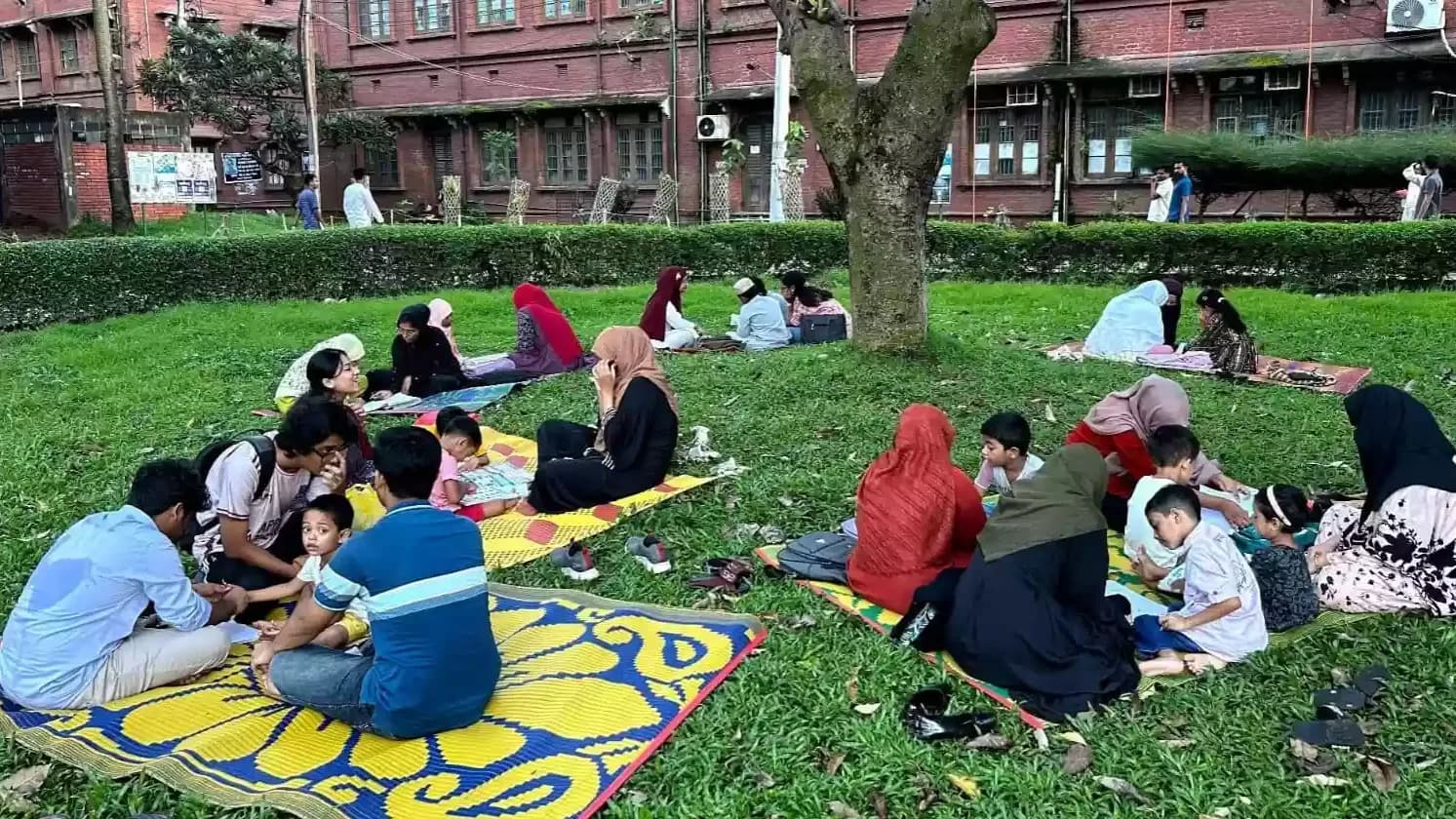
Two student-led initiatives, School of Ghashful and Tori School, are trying to change that reality by bringing lessons directly to the streets. Through informal classes and weekend learning camps, volunteers are helping children acquire basic reading, writing and numeracy skills. But moving them from makeshift classrooms into the formal education system remains a formidable challenge.
The situation at Dhaka University reflects a much wider crisis across Bangladesh. According to the Survey on Street Children 2022, conducted by the Bangladesh Bureau of Statistics (BBS) and UNICEF, 71.8% of street children in the country cannot read or write, while more than 36% have never attended school. For children growing up on the streets, survival often takes precedence over education, leaving little room for regular attendance or long-term learning. “Very few of our students ever make it to the formal schooling system,” said Newaz Sharif Arman, president of the School of Ghashful.
The initiative has previously helped enrol several children at Nilkhet Primary School, but many dropped out within weeks. The reason was painfully simple: attending regular classes meant losing a day's earnings. “Since they have to earn, whether willingly or under family pressure, neither the child nor the family wants to sacrifice that income for school,” Arman said.
Learning competes with livelihood
Even organising an hour of uninterrupted learning requires considerable effort. Volunteers frequently face resistance from TSC security guards, who prevent street children from gathering on the premises. They are often forced to negotiate for access or shift classes to nearby locations such as Bot-tola and Hakim Chattar.
For children employed at food stalls and university canteens, finding time to study is equally difficult. Their employers release them for lessons only in turns, usually when business slows down. “During rush hours, owners cannot spare them at all,” Arman said. Flower sellers face a different financial dilemma. To persuade them to spend an hour learning instead of selling garlands, volunteers sometimes compensate them between Tk 10 and Tk 30 for the income they might lose. Lessons are often accompanied by hot tea and snacks, making the learning experience more welcoming.
Yet, despite the obstacles, the desire to learn has not disappeared. At the TSC, Rabeya, a woman who sells flowers to evening visitors, sits on the pavement with her young daughter, helping her sound out the Bangla alphabet. The small lesson offers a glimpse of how the aspiration for education persists even among families whose daily lives revolve around survival.
Survival literacy becomes the immediate goal
Founded in 2012 with funding from Dhaka University, School of Ghashful has gradually adapted its teaching model to the unstable lives of the children it serves.
Many canteen workers change jobs every two to six months, while some children do not own mobile phones, making it difficult for volunteers to maintain contact or ensure consistent attendance.
With around 50 student volunteers spread across nine residential halls, the initiative has therefore shifted its focus towards what it describes as rapid survival literacy. “However long a child stays, even two months, we try to ensure they can write their names in Bangla and English and perform basic addition and subtraction,” Arman said. “We do not want them to spend their entire lives illiterate.”
The approach recognises a difficult reality: when sustained schooling is not immediately possible, even a few weeks of learning can equip children with skills they might otherwise never acquire. Tori School, launched in July, is pursuing a similar mission. Supported by around 200 volunteers, it organises weekend learning camps at the High Court premises and Central Shaheed Minar for nearly 60 street children. The initiative also conducts separate learning sessions for the children of university staff.
“Our volunteers bear the costs out of pocket to keep classes consistent,” said Prottoy Mohiuddin, joint convener of Tori School.
Beyond volunteer-led classrooms
As darkness descends on the Teacher-Student Centre, the day's lessons come to an end. Primers disappear into backpacks, and the children return to the familiar rhythm of campus life, selling flowers beneath the streetlights and looking for customers among the evening crowds.
For a brief while, they have been students rather than workers. But the transition from pavement lessons to recognised schooling remains uncertain. The efforts of School of Ghashful and Tori School are creating opportunities where formal institutions have struggled to reach. However, volunteer-driven classes alone cannot address the deeper barriers that keep children out of education.
Without sustained institutional support, flexible schooling arrangements and measures that ease the financial burden on working families, literacy may remain a short-lived opportunity rather than a route out of poverty. For Yasin and hundreds of children like him, learning to read and write is an important first step. The larger challenge is ensuring that they do not have to choose between earning enough to survive today and getting an education that could transform their tomorrow.
Also read