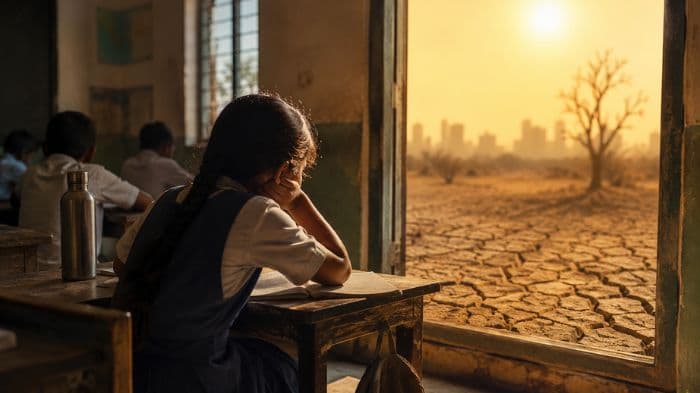
As the world marks World Environment Day, discussions around climate change often focus on rising temperatures, melting glaciers and extreme weather. Less attention is paid to another growing consequence of climate change: its impact on education.
In 2024, at least 242 million students across 85 countries saw their schooling interrupted by climate-related events such as heatwaves, floods, storms, tropical cyclones and droughts, according to a UNICEF analysis released earlier this year.

The figure represents roughly one in every seven students worldwide, making climate change not just an environmental challenge but an increasingly significant education issue.
The disruption is no longer limited to isolated disasters. According to UNICEF, climate-related school closures occurred across multiple regions in 2024, with South Asia emerging as the most affected region.
An estimated 128 million students in South Asia experienced disruptions to their education due to climate hazards. Heatwaves alone affected around 171 million students globally, making them the single biggest cause of climate-related interruptions to schooling.
For countries such as India, the trend is becoming difficult to ignore. In recent years, several states have repeatedly altered school schedules, advanced summer vacations or temporarily shut educational institutions as temperatures climbed to dangerous levels.
During the intense heatwave conditions witnessed across South and Southeast Asia in April 2024, millions of students were affected as governments attempted to reduce the risk of heat-related illnesses among children.
The impact extends beyond missed school days. Educational researchers have long found a connection between extreme heat and learning outcomes.
High temperatures can reduce concentration, impair memory and make classrooms physically uncomfortable, particularly in schools lacking adequate cooling systems. In many developing countries, where air-conditioned classrooms remain uncommon, prolonged exposure to heat can directly affect students' ability to learn.
Climate events also damage the infrastructure that supports education. Floods can destroy classrooms, learning materials and transport networks.
Storms and cyclones can leave schools unusable for weeks. UNICEF notes that climate hazards frequently interrupt academic calendars, delay examinations and force education authorities to divert resources towards emergency response and reconstruction.
The consequences are often most severe for vulnerable communities. Prolonged disruptions increase the risk of students dropping out, particularly in low-income regions.
International studies have shown that girls can face disproportionate impacts during extended school closures, including a greater risk of early marriage and reduced educational attainment.
Children from economically disadvantaged households are also less likely to recover lost learning opportunities once schools reopen.
The challenge is expected to intensify. According to UNICEF's State of the World's Children report, far more children are projected to experience extreme heatwaves, floods and other climate-related hazards by the middle of this century.
As climate events become more frequent and severe, education systems will increasingly be required to adapt.
Governments and institutions are already exploring measures such as climate-resilient school infrastructure, heat action plans, revised academic calendars and improved disaster preparedness.
However, experts argue that adaptation efforts remain uneven, particularly in countries where education systems are already under strain.
The climate crisis is often discussed in terms of rising sea levels, shrinking glaciers or extreme weather events. Yet its effects are also being felt in classrooms.
As schools face more frequent disruptions and students lose valuable learning time, climate change is emerging as a challenge that education systems can no longer afford to treat as a distant concern.
For millions of children, the consequences of climate change are not measured only in degrees Celsius. They are increasingly measured in lost lessons, interrupted school years and uncertain educational futures.