The Siang battleground: Inside the noise, the nerves and the narrative war over a dam?
Even before its pre-feasibility report is public, the Siang Upper Multipurpose Project has triggered protests, political caution, and narrative battles, exposing a high-stakes struggle over public consent and control of the story.
Rohit Wadhwaney26 February 2026 14:54
The Siang Upper Multipurpose Project (SUMP) is a familiar story: a large hydropower-cum-flood-control proposal in Arunachal Pradesh, expected to generate massive electricity, provide water storage, and buttress India’s northeastern frontier with development.
But outside the neat columns of feasibility reports and committee minutes, the story is more complicated. It’s messier, louder, and spread across angry protests, quiet negotiations, political anxieties, and a new, carefully constructed narrative campaign that is only just beginning to take shape.
Over the last few months, the question at the center of SUMP has changed. It is no longer simply about whether a dam should be built here or not. Instead, it has evolved into something politically sharper and socially deeper. Who gets to shape what the people believe about the dam?
And this shift owes much to the National Hydroelectric Power Corporation’s decision to bring in one of India’s top Public Relations advisory groups, a Mumbai-headquartered strategic communications firm widely known for reputation management campaigns, corporate positioning, and public sentiment engineering.
What emerges is a landscape where trust is fragile, emotions are charged, and every statement – from a protest placard to an official press note – carries the weight of decades of developmental promises and disappointments.
More than just water
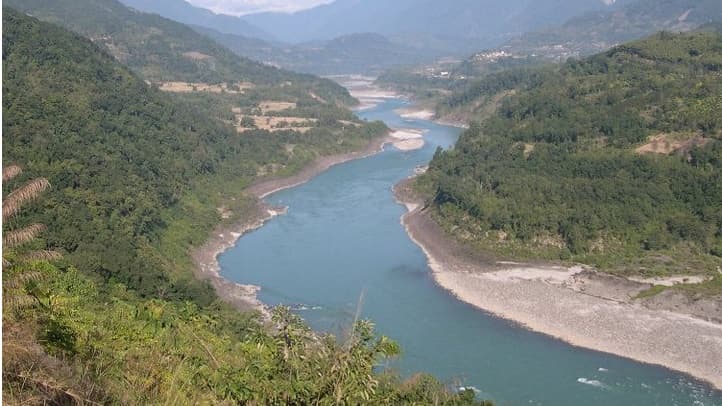
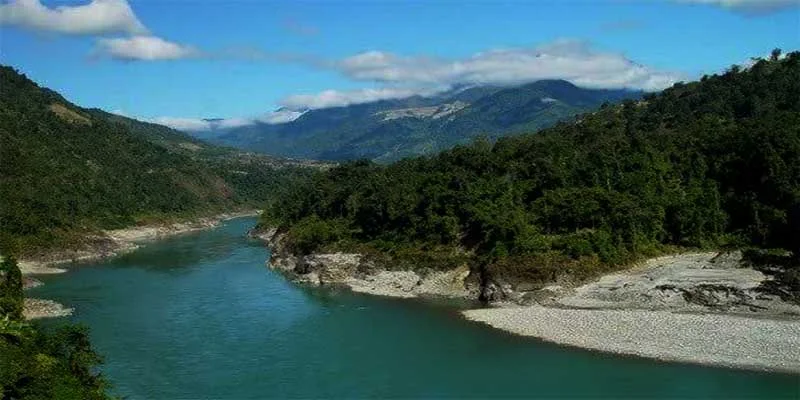
For the Adi tribe communities living along the Siang, the river is more than a geographical feature. It is cultural heritage, identity, and in many ways, a living relative. This emotional thread is precisely why hydropower proposals in the Siang basin have always been met with skepticism, and even fear.
For many villagers, the anxiety runs deeper than displacement or environmental damage. It is the fear of losing the river itself. In a region where rivers shape livelihoods, memory, and meaning, any attempt to re-engineer the Siang is seen not as a technical intervention, but as an intrusion into the natural order they have lived with for generations.
This deep-rooted sentiment has shaped the resistance. But this time, the resistance has matured, become organized, and grown louder. It is not driven only by cultural anxieties. It is driven by educated youth networks, civil society groups, and environmental researchers who know the language of both local sentiment and global climate concerns.
Protests are intensifying
Protests against the SUMP have taken various forms – rallies, public meetings, student group statements, and petitions. But what stands out is the timing. The strongest resistance has come at the PFR (Pre-Feasibility Report) stage itself.
A PFR is merely a preliminary study that examines whether the project is even worth pursuing. But to the protestors, it represents the first domino. They know from recent experiences in the Northeast that once a PFR is completed and accepted, the project begins to acquire bureaucratic momentum. Clearances, public hearings, detailed project reports (DPRs), and tendering follow. And by the time the people realize what is happening, the project has already crossed the point of no return.
For protestors, blocking the PFR is the only real chance of stopping the project altogether. Their argument is straightforward. “If the project itself is unacceptable, why allow even the first step?”
Geometry of security
The proposed Upper Siang project, a 280–300 meter dam with a planned capacity of around 11 GW (11,000 MW), would be India’s largest hydropower installation. Officially, it is framed as a clean-energy milestone. Strategically, however, the dam – declared a National Project by the Indian government in 2008 – serves a deeper purpose: counterbalancing China’s upstream control over the Brahmaputra system and strengthening India’s long-term water and energy security.
Across the border, China is moving ahead with an even more ambitious plan. Its under-construction mega-dam in Medog county in southeastern Tibet, is projected to generate between 67 and 80 GW to potentially become the largest hydropower project in the world, nearly three times the scale of the Three Gorges Dam. With estimated costs exceeding US$160 billion, Beijing describes the project as central to its green transition. New Delhi, however, sees it through a sharper lens. More than 80% of the water that flows into Arunachal Pradesh originates in Tibet, giving China significant upstream leverage.
This concern is not theoretical. Past incidents, including China’s withholding of hydrological data prior to the 2000 YigongZangbo outburst flood, have entrenched mistrust. In the absence of a formal water-sharing treaty, Indian policymakers worry that river flows could be manipulated, using what strategists describe as “hydro-leverage,” to trigger downstream floods or drought-like conditions. Reports and proposals around diverting Tsangpo waters towards Xinjiang have only intensified these anxieties.
It is in this context that Arunachal Pradesh Chief Minister Pema Khandu has described India’s hydropower push as a “national security necessity.” From New Delhi’s perspective, projects like Upper Siang are not merely about electricity generation. They are also a strategic safety valve that ensure India retains some measure of control and resilience should water ever be used as a geopolitical tool upstream.
“China cannot be trusted. No one knows what they will do and when,” Khandu said in an interview with PTI, amplifying fears that in case of a conflict, China could very well use its dam upstream as a “water bomb” against India.
Development vs. distrust
The Arunachal Pradesh government, for its part, has maintained a more cautious tone in recent years. But its development push is unmistakable. Hydropower remains one of the state’s biggest economic hopes.
Arunachal Pradesh possesses one of the country’s largest hydropower reserves, estimated at over 58,000 MW. That’s roughly 40% of India’s total potential. Yet barely 10% of it has been harnessed so far, leaving the sector largely untapped.
Under its proposed “Decade of Hydropower” (2025–2035), the state is now seeking to unlock this resource by reviving long-stalled projects, reassessing shelved proposals, and fast-tracking new ones that had earlier been delayed by environmental concerns, local opposition, or procedural bottlenecks.
It’s an opportunity to reduce dependency on central grants, increase revenue-sharing mechanisms, and create long-term infrastructure in a region where road connectivity itself is still evolving.
This duality defines the state’s approach: On one hand, it must respond to local sentiment and ensure transparency. And on the other, it needs to project Arunachal Pradesh as an investment-friendly state that is not paralyzed by local resistance.
Over the last year, the government has attempted to stabilize the discourse. Officials have repeatedly stated that PFR does not equal project approval, and that public concerns will be addressed at every stage. Yet distrust runs deep. People who have watched other hydropower proposals in the region – some stalled, some abandoned – feel these assurances are not enough.
The government’s challenge is not merely logistical or environmental, but psychological. It is fighting not opponents, but memories: memories of unfinished promises, past projects where locals felt sidelined, and a persistent belief that decisions are made far away from those who live next to the river.
Enter PR collective: The narrative engineers
Against this backdrop, NHPC’s engagement of the PR firm in August 2025 marks a turning point in the SUMP story.
This PR group is not just a media outreach firm. It is known in the industry as a strategic perception shaping company, one that handles reputation management during crises, restructures public-facing narratives, and builds long-term trust through calibrated information campaigns.
For NHPC, paying top dollar to hire this group signals a recognition that the battle over SUMP will not be won through engineering diagrams or official statements alone. It will be won, or lost, in the arena of public perception.
While neither NHPC nor the PR firm has officially outlined the scope of work, industry observers expect the mandate to include:
1. Managing the media ecosystem: Ensuring positive or, at the very least, balanced coverage across regional and national outlets.
2. Crafting community-engagement narratives: Packaging the PFR as a harmless technical process that stakeholders should welcome.
3. Countering misinformation: Framing protest groups via paid influencers and bot messaging on social media as misinformed or manipulated by “external influences.”
4. Influencer outreach: Paying local youth leaders, ordinary residents, civil society figures, and content creators to gradually shift public sentiment.
5. Rebranding NHPC’s image: Presenting the corporation as sensitive, community-friendly, and environmentally conscious.
Essentially, aside from studying the river, NHPC is gearing up to reshape how people feel about that study.
Risk of narrative overreach
The introduction of a PR war into an already emotional landscape is double-edged.
On one hand, the power company wants to correct misconceptions and communicate that a PFR is harmless. On the other, communities fear being psychologically nudged into accepting a project they fundamentally oppose.
For many locals, the hiring of a PR agency is not seen as outreach. It is seen as manipulation.
They worry that public sentiment may be shaped artificially, dissenting voices may be painted as unreasonable, and the eventual public hearing may become a formality backed by staged public support.
Whether or not these fears are justified, the perception itself is now a political reality.
The counter narrative
In response, protest leaders have already begun strengthening their messaging by highlighting potential risks to the river’s ecology, emphasizing cultural and spiritual bonds with the Siang, pointing out past failures of rehabilitation in other project areas, and questioning the need for an enormous dam in a highly seismic zone.
They have also started using their own tools of persuasion:
1. Social media campaignsnarrated in local languages.
2. Youth-driven information sessions in villages.
3. Engagement with environmental activists across India.
4. Partnerships with independent researcherswho raise questions about feasibility.
If NHPC has entered with PR professionals, protest groups have entered with lived experience, emotion, and moral legitimacy. And in many public battles, that carries extraordinary weight.
Caught in the middle
A significant number of people, especially educated urban youth, are conflicted. They want development. They want reliable electricity, better connectivity, and economic momentum. But they also want accountability, environmental safeguards, and meaningful consultation.
They are neither pro-dam nor anti-dam. They are pro-information.
This middle group is precisely where PR firm’s messaging is likely to be targeted. But this group is also the hardest to influence. They ask questions, demand data, and are aware of greenwashing tactics.
For them, the real test is not PR. It is transparency. And to top it up, they are scared to raise their voices. Just a few months back, a villager in the Siang belt openly declared he wanted the dam to be built. The anti-dam group blocked the canal that carried water to his farms.
“You aren’t from here. That’s why you think it is easy to openly just say we are pro-dam. We live here and we have to continue living here. The anti-dam group is very powerful and can go to any extent,” a villager from the Yingkiong region of Siang told Education Post on condition of anonymity. “I am not going to risk my life for a dam.”
Government’s dilemma: Silence or clarity?
The state government now finds itself in a strategically delicate position. If it appears to push the NHPC narrative too aggressively, it risks alienating communities and inflaming protests. If it stays silent, the anti-dam messaging fills the vacuum.
So far, the government’s public positioning has been cautious. It has emphasized that the PFR is only a study.It has appealed for calm and patience. It has stated that the project will only proceed with public support.
But protesters argue that history does not support these assurances. They want legal safeguards, written guarantees, and unconditional clarity, not general statements of intent.
This push and pull has created an atmosphere where every word is scrutinized for hidden meaning.
NHPC’s pressure points
NHPC is under pressure as well. Hydropower is expensive, slow to build, and vulnerable to public opposition. Delays can push costs up dramatically.
For NHPC, securing social permission early is a financial necessity.
That is why the corporation is attempting a two-layered approach:
1. Technical legitimacy: Asserting that the PFR is essential for any informed decision.
2. Social legitimacy: Convincing communities that studying the river does not mean destroying it.
The second is far more difficult, and this is where the PR group becomes crucial.
Core question ahead
What is unfolding around SUMP is not a debate over hydropower. It is a contest over trust, representation, identity, and the right to define the future of the river. The outcome will depend less on engineering expertise and more on narrative credibility.
If the people believe the process is fair, they may allow the PFR. If they believe they are being psychologically engineered into accepting a project, the backlash could intensify.
For now, both sides are preparing for a long fight, not with weapons, but with stories.
PFR: A document with waves
The Siang Upper Multipurpose Project is far, far away from construction. The PFR, which is the preliminary stage of any dam construction, hasn’t even begun yet. No dam is being built tomorrow. But the fight over the PFR reveals something larger: a trust deficit decades in the making.
The river flows as it always has, but the people living beside it find themselves at a crossroads where technical studies collide with emotional realities. Government initiatives promise development, but memories question motives. NHPC hires a PR firm to shape sentiment, and protestors respond with clarity and caution.
In this noisy, complicated landscape, one fact stands out. The future of the Siang will not be decided in an office. It will be decided in the minds of the people.
And right now, those minds are a battleground.
(The name of the PR firm engaged by NHPC has been intentionally withheld, in keeping with editorial integrity. This feature is not intended to question or impede its professional mandate.)