


Heavy rainfall lashed Chennai accompanied by gusty winds with speeds reaching 70-80 kmph to 90 kmph in the coastal districts of north Tamil Nadu and south Andhra Pradesh.
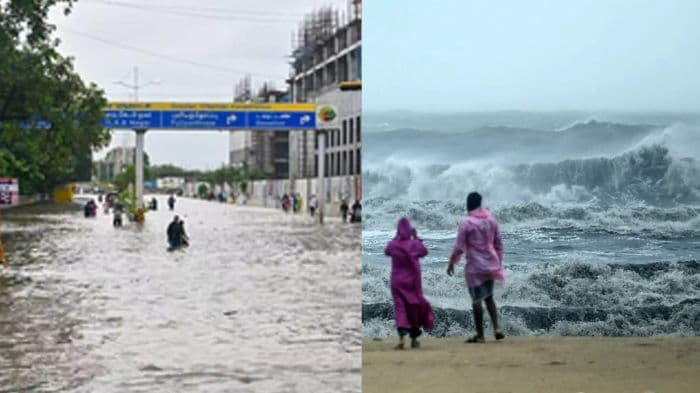
Cyclone Fengal made landfall along the Tamil Nadu-Puducherry coast on Dec 1 around 2 am triggering record-breaking rainfall and causing significant disruption in the region.
It resulted in unprecedented rainfall, with Puducherry receiving up to 490 mm and Villupuram recording 504 mm of rain, making it one of the highest in 30 years.

Chennai received between 9 cm to 13 cm of rain since Nov 30 morning
A day before, the Indian Meteorological Department had issued a red alert for Tamil Nadu, South Andhra Pradesh, Kerala, and the interior of Karnataka.
Heavy rainfall lashed Chennai accompanied by gusty winds with speeds reaching 70-80 kmph to 90 kmph in the coastal districts of north Tamil Nadu and south Andhra Pradesh.
Several parts of the city have been flooded, while three people have died so far due to electrocution in separate rain-related incidents in Chennai.
Cyclone Fengal, which was predicted to move west-southwestwards after hitting on Nov 30 near Puducherry, along the Tamil Nadu coast, remained stationary for six hours.
Chennai airport resumed around 4 am on Dec 1 after a brief suspension. However, passengers did complain of delayed and cancelled flights even after the operations were resumed.
Meanwhile, the Indian Army and Nationa Disaster Response Force (NDRF) began their rescue operation at 6:15 am, with over 100 individuals being evacuated in the first two hours.
A Humanitarian Assistance and Disaster Relief (HADR) column consisting of one officer, six Junior commissioned officers and 62 other ranks have also been deployed in Puducherry.
The cyclone is expected to weaken into a deep depression within the next few hours, the India Meteorological Department (IMD) said.
According to the IMD forecast, it is expected to move westward slowly over north coastal Tamil Nadu and Puducherry in the next six hours.
From digital pets to AI robots: How Hong Kong schools are reshaping classroom learning
Why Are Nearly 2,000 MBBS Seats Still Vacant After NEET Counselling 2026?
Ghaziabad School Introduces Global Lexile Framework to Assess Reading Skills of Students
SRMIST to Host National Conference on Regenerative Biology and Bioengineering from November 3

King's College London, Cranfield University agree to merge in August 2027
From digital pets to AI robots: How Hong Kong schools are reshaping classroom learning
Why Are Nearly 2,000 MBBS Seats Still Vacant After NEET Counselling 2026?
King's College London, Cranfield University agree to merge in August 2027

Hong Kong plans weekly AI and coding lessons for children: Is India ready for the shift?
Who handles student discipline? Singapore schools look beyond teachers, lessons India can learn

From digital pets to AI robots: How Hong Kong schools are reshaping classroom learning
Why Are Nearly 2,000 MBBS Seats Still Vacant After NEET Counselling 2026?
Ghaziabad School Introduces Global Lexile Framework to Assess Reading Skills of Students
SRMIST to Host National Conference on Regenerative Biology and Bioengineering from November 3
King's College London, Cranfield University agree to merge in August 2027
From digital pets to AI robots: How Hong Kong schools are reshaping classroom learning
Why Are Nearly 2,000 MBBS Seats Still Vacant After NEET Counselling 2026?
King's College London, Cranfield University agree to merge in August 2027
Hong Kong plans weekly AI and coding lessons for children: Is India ready for the shift?
Who handles student discipline? Singapore schools look beyond teachers, lessons India can learn
Copyright© educationpost.in 2026 All Rights Reserved.