


The Education Ministry report also highlights higher Aadhaar seeding, improved gender parity, better school infrastructure, and continued efforts to achieve universal enrollment under NEP 2020.
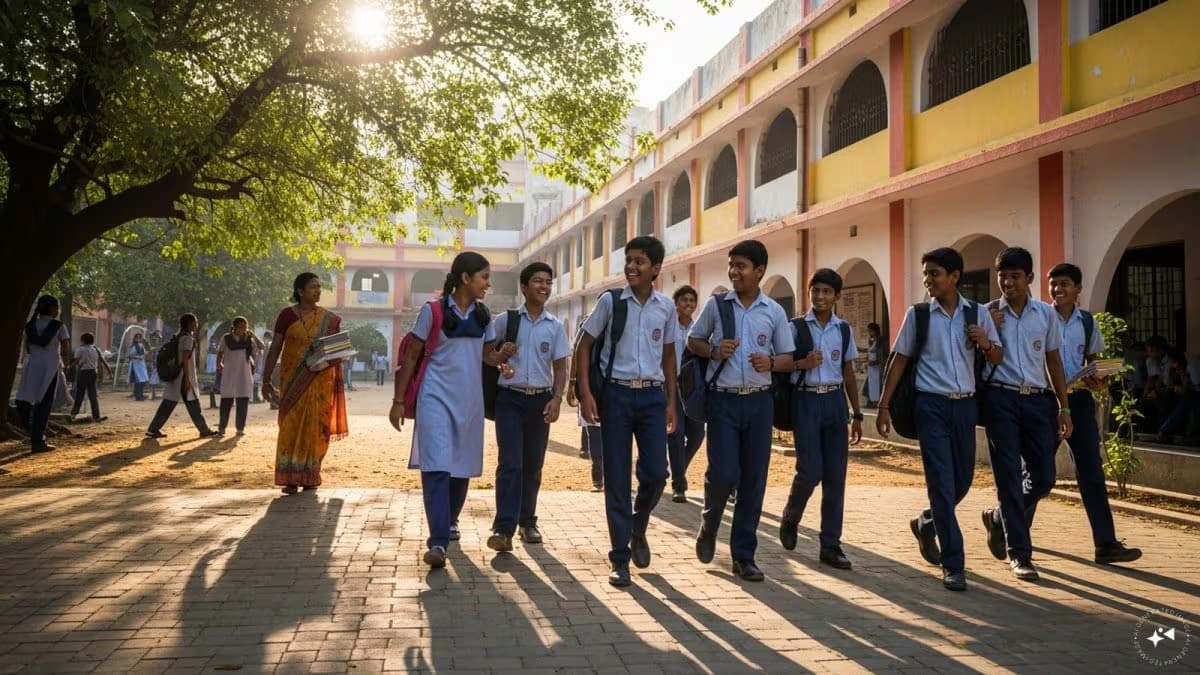
The Union Ministry of Education has released the Unified District Information System for Education Plus (UDISE+) Report 2025-26, highlighting how the country's school education system is increasingly relying on student-level digital data to improve enrollment tracking, reduce dropouts, strengthen governance, and support implementation of the National Education Policy (NEP) 2020.
The report outlines progress in creating a nationwide student-wise database, expanded Aadhaar-linked enrollment records, improvements in gender representation, teacher deployment, school infrastructure, and key education indicators such as the Gross Enrolment Ratio (GER) and Pupil-Teacher Ratio (PTR).

According to the report, NEP 2020 identifies enrollment and regular attendance of school-age children as one of the primary goals of the schooling system.
It recommends universal participation in school by tracking students and their learning levels to ensure they remain enrolled, continue attending classes, and receive opportunities to return to school if they drop out.
The ministry said building a unique student-wise database has made this possible by enabling authorities to identify children who have dropped out, detect ghost students, ensure that government benefits reach eligible students, improve expenditure management, and strengthen governance.
The report noted that individual student-wise data from all recognized schools across the country was first collected through UDISE+ during the 2022-23 academic year.
According to the latest report, a total of 24.72 crore students were enrolled during the 2025-26 academic year. The enrollment data covers students across the foundational, preparatory, middle, and secondary stages of school education.
The ministry clarified that enrollment figures for the foundational stage include only Balvatika and pre-primary classes in schools registered under UDISE+ and do not include enrollment at Anganwadi centers operated by the Ministry of Women and Child Development.
The report said maintaining unique student records helps recognize and support the individual learning needs of every child.
During 2025-26, about 22.3 crore students, representing approximately 90.2% of total enrollment, voluntarily provided their Aadhaar numbers for the database.
Among states and Union Territories, Andhra Pradesh and Lakshadweep recorded the highest Aadhaar seeding rate at 99.6%, followed by Andaman and Nicobar Islands and Chandigarh at 99.2%, Puducherry at 98.6%, Haryana at 98.5%, and Maharashtra at 98%.
The report identified Meghalaya, with 35.3%, Nagaland, with 65.1%, and Manipur, with 69.2%, as the states reporting the lowest Aadhaar seeding rates, compared with the national average of 90.2%.
The report also examined the distribution of schools and students across states.
According to the ministry, states including Uttar Pradesh, Madhya Pradesh, Rajasthan, Karnataka, Odisha, Andhra Pradesh, Chhattisgarh, Assam, Jammu and Kashmir, Uttarakhand, Himachal Pradesh, and Meghalaya have a higher proportion of schools relative to enrolled students, indicating underutilization of available school infrastructure.
In contrast, Maharashtra, Bihar, West Bengal, Tamil Nadu, Gujarat, Telangana, Punjab, Haryana, Delhi, and Kerala have comparatively fewer schools relative to student enrollment, resulting in a larger number of students per school.
The ministry said the availability of schools at different educational stages directly influences student participation.
While a large number of foundational and preparatory schools have been established following the implementation of the Right to Education Act, the report observed that the expansion of secondary schools has not kept pace.
According to the ministry, this imbalance could increase the risk of students dropping out at higher grades.
The report highlighted variations in the distribution of schools across educational stages.
West Bengal has 78.9% of its schools at the foundational and preparatory levels but only 11.7% at the secondary level. In contrast, Chandigarh has 83.7% of its schools at the secondary level and only 5.3% at the foundational and preparatory stages.
The UDISE+ report also focused on equity in school participation across gender, social groups, and minority communities.
According to the ministry, education remains one of the most effective tools for achieving social justice and equality. The report stated that ensuring inclusive and equitable education continues to be a major objective of NEP 2020 and other education sector development programs.
At the national level, girls account for 48.4% of total school enrollment.
The report said the Gender Parity Index (GPI), measured as the ratio of girls' GER to boys' GER, remained above 1 across all educational stages, indicating proportionately higher participation by girls than boys.
The ministry clarified that transgender student data has been included within the "boys" category for publication purposes.
Minority students account for more than 20% of total enrollment nationwide.
Among minority communities, Muslims represent 79.4% of enrolled minority students, followed by Christians at 10.1%, Sikhs at 7.1%, Buddhists at 2.0%, Jains at 1.3%, and Parsis at 0.1%.
The report also provided data on the social composition of enrolled students. According to the findings, 27.5% of students belong to the General category, 17.7% belong to Scheduled Castes (SC), 10% belong to Scheduled Tribes (ST), and 44.9% belong to Other Backward Classes (OBC).
Teacher deployment remains another key focus area of the report.
The ministry said teachers play a critical role in shaping students' future, making balanced deployment across different school categories essential.
The report analyzed teacher distribution across foundational, preparatory, middle, and secondary stages, as well as across different management categories and social groups.
According to the report, both the Right to Education Act and NEP 2020 emphasize maintaining an appropriate Pupil-Teacher Ratio to improve classroom interaction and learning outcomes.
NEP 2020 recommends maintaining a PTR of 30:1 across all levels of school education.
The report noted that lower PTR enables teachers to provide greater individual attention and build stronger classroom engagement with students.
It also highlighted regional differences in school utilization.
According to the findings, Chandigarh and Delhi have the highest number of students per school while maintaining PTR within the norms prescribed under the Right to Education Act, indicating efficient utilization of school infrastructure.
By comparison, Ladakh, Mizoram, Himachal Pradesh, Sikkim, and Meghalaya have relatively fewer students per school, suggesting there is scope to optimize school infrastructure in these regions.
The report also highlighted continued improvements in school infrastructure.
Referring to NEP 2020, the ministry said schools require adequate and safe infrastructure, including electricity, clean drinking water, functional toilets, boundary walls, computing devices, internet connectivity, libraries, sports facilities, and inclusive learning spaces to provide quality education.
The report noted that financial support provided to states and Union Territories through the Samagra Shiksha Scheme has contributed to strengthening school infrastructure and improving learning environments.
The report further discussed the importance of measuring the Gross Enrolment Ratio (GER), describing it as a key indicator for achieving the NEP 2020 goal of universal school education and 100% GER up to the secondary level by 2030.
According to the ministry, GER compares enrollment at a particular level of education with the population belonging to the corresponding official age group.
The report explained that the foundational GER measures enrollment from preschool to Class 2 against the population aged 3 to 7 years, while the preparatory GER measures enrollment in Classes 3 to 5 against the population aged 8 to 10 years. Similar methodology is followed for higher educational stages.
The ministry noted that year-to-year changes in GER are generally gradual, making long-term trends more meaningful for assessing progress toward universal school education.
It added that GER exceeding 100% may reflect factors such as overage or underage enrollment, interstate migration, and other demographic variations.

Jammu and Kashmir Unemployment: Economic Growth Has Yet to Resolve Job Crisis

China’s Chery unveils AI companion robot designed to ease loneliness
Varanasi Air Show 2026: Schools in Two Chandauli Blocks to Hold Online Classes on October 22, 24

India AI Fellowship 2026: UG Students to Get ₹1 Lakh, PG Students ₹2 Lakh

New Zealand teachers work nearly five hours more than OECD average
China’s Chery unveils AI companion robot designed to ease loneliness
.jpg&w=256&q=75)
New Zealand reforms could leave more students without school qualifications

Alfred Nobel’s will created one of the world’s most recognised prizes. Here’s how

Pepperdine University earns Google recognition and Digital Education Council membership for AI initiatives
Dhirubhai Ambani International School breaks into global top 10 with record IB score

Jammu and Kashmir Unemployment: Economic Growth Has Yet to Resolve Job Crisis
China’s Chery unveils AI companion robot designed to ease loneliness
Varanasi Air Show 2026: Schools in Two Chandauli Blocks to Hold Online Classes on October 22, 24
India AI Fellowship 2026: UG Students to Get ₹1 Lakh, PG Students ₹2 Lakh
New Zealand teachers work nearly five hours more than OECD average
China’s Chery unveils AI companion robot designed to ease loneliness
New Zealand reforms could leave more students without school qualifications
Alfred Nobel’s will created one of the world’s most recognised prizes. Here’s how
Pepperdine University earns Google recognition and Digital Education Council membership for AI initiatives
Dhirubhai Ambani International School breaks into global top 10 with record IB score
Copyright© educationpost.in 2026 All Rights Reserved.