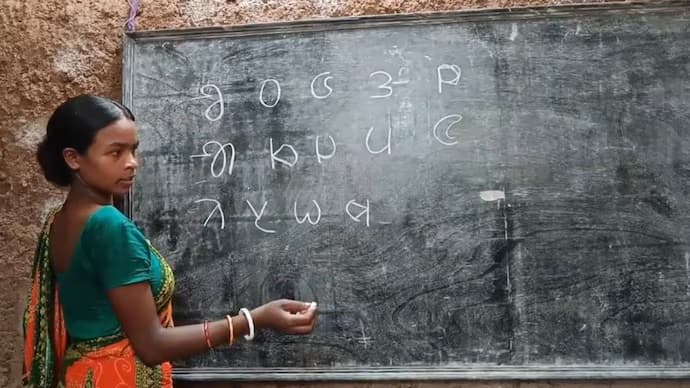
Teaching out of a tin-roofed hut, Malati Murmu offers tribal children access to education in their own language, filling a gap left by the formal schooling system.

A 30-year-old tribal woman in West Bengal’s Purulia district is running a free school in Jiling Sereng village, teaching 45 children without any government support, infrastructure, or salary.
Malati Murmu, who lives in the Ayodhya Hills region, runs the school from a tin-roofed mud hut with no blackboards, no staff, and no funding.

Yet each morning, children from nearby tribal families arrive to learn how to read and write in Santhali using the Ol Chiki script.
“When I came here after marriage, I saw no real schooling,” said Malati. “So I began with a few children at home.”
The initiative, which started informally, gained support from local villagers in 2020, who helped her build two small classrooms. She now teaches students up to Class 4.
“Now they read and write in their language. That’s new for us,” said Sunita Mandi, a local resident.
Malati’s husband, Banka Murmu, helps run the school. “There’s a government school nearby,” he said, “but we wanted something of our own.”
While the state struggles to maintain functional schools in many tribal regions, this effort in Jiling Sereng has emerged as a grassroots solution, born not from policy but from community need and individual initiative.
Malati balances teaching with caring for her two children and managing household responsibilities. “We don’t ask for anything,” she said. “Only that the children come.”
Despite belonging to a tribal community and having no access to formal resources, Malati has created a space for learning where none existed.
There are no official appointments or schemes involved, just a classroom born out of necessity and one woman’s resolve.


DPDP Act Explained: What is India’s Digital Personal Data Protection Law and Why is it in the News?

IIT Bombay puts stricter cheating rules on hold, drafts new procedure for exam misconduct

ISRO expands student outreach during World Space Week 2026

Gujarat launches PARAKH Cell to shift school assessments toward competency-based learning

IIT Hyderabad launches AI lab with S&P Global for finance research

DPDP Act Explained: What is India’s Digital Personal Data Protection Law and Why is it in the News?

IIT Bombay puts stricter cheating rules on hold, drafts new procedure for exam misconduct

Gujarat launches PARAKH Cell to shift school assessments toward competency-based learning

IIT Hyderabad launches AI lab with S&P Global for finance research

Nana Patekar’s advice to graduates takes on new meaning after his death

DPDP Act Explained: What is India’s Digital Personal Data Protection Law and Why is it in the News?

IIT Bombay puts stricter cheating rules on hold, drafts new procedure for exam misconduct

ISRO expands student outreach during World Space Week 2026

Gujarat launches PARAKH Cell to shift school assessments toward competency-based learning

IIT Hyderabad launches AI lab with S&P Global for finance research

DPDP Act Explained: What is India’s Digital Personal Data Protection Law and Why is it in the News?

IIT Bombay puts stricter cheating rules on hold, drafts new procedure for exam misconduct

Gujarat launches PARAKH Cell to shift school assessments toward competency-based learning

IIT Hyderabad launches AI lab with S&P Global for finance research

Nana Patekar’s advice to graduates takes on new meaning after his death
Copyright© educationpost.in 2024 All Rights Reserved.
Designed and Developed by @Pyndertech