From Jantar Mantar fast to Safdarjung Hospital: Sonam Wangchuk’s NEET protest raises questions over educational rights
The activist’s hospital transfer after a prolonged hunger strike intensified discussions around alleged examination irregularities, student grievances, medical intervention, and the wider demand for transparency in India’s competitive examination system.
Pragya Kumari18 July 2026 10:34
Climate activist and education reformer Sonam Wangchuk was shifted to Delhi’s VMMC & Safdarjung Hospital on July 18 after completing 20 days of an indefinite hunger strike at Jantar Mantar, with authorities citing concerns over his deteriorating health and directions from the Delhi High Court.
Wangchuk was moved from the protest site around 7:44 am after Delhi Police said the decision was taken on expert medical advice and in compliance with court directions.
“As per orders of the Hon’ble High Court and on expert medical advice, due to the deteriorating health condition of Sh. Sonam Wangchuk, he has been shifted to the hospital for essential medical care,” Delhi Police said in a post on X.
The development came after the Delhi High Court directed authorities to ensure daily monitoring of Wangchuk’s health and provide medical intervention if required based on doctors’ advice.
While officials described the move as a medical step to protect Wangchuk’s health, protest organizers and supporters alleged that he was removed from the site without consent.
Wife objects to treatment without consent
Wangchuk’s wife, Gitanjali J Angmo, objected to medical treatment being administered without approval from his family and doctors who had monitored his condition during the hunger strike.
Posting from Safdarjung Hospital, she said, “Nothing should be administered to him orally or intravenously without take consent from me, his family, and his doctors who have been monitoring his health for the past 20 days.”
She also questioned the decision to hospitalize Wangchuk, saying he was stable a day earlier.
“He is at Safdarjung Hospital. I forbid them from administering anything without my consent. No treatment should start without my consent. I hold everybody accountable if anything happens,” Angmo said.
Health concerns after prolonged fast
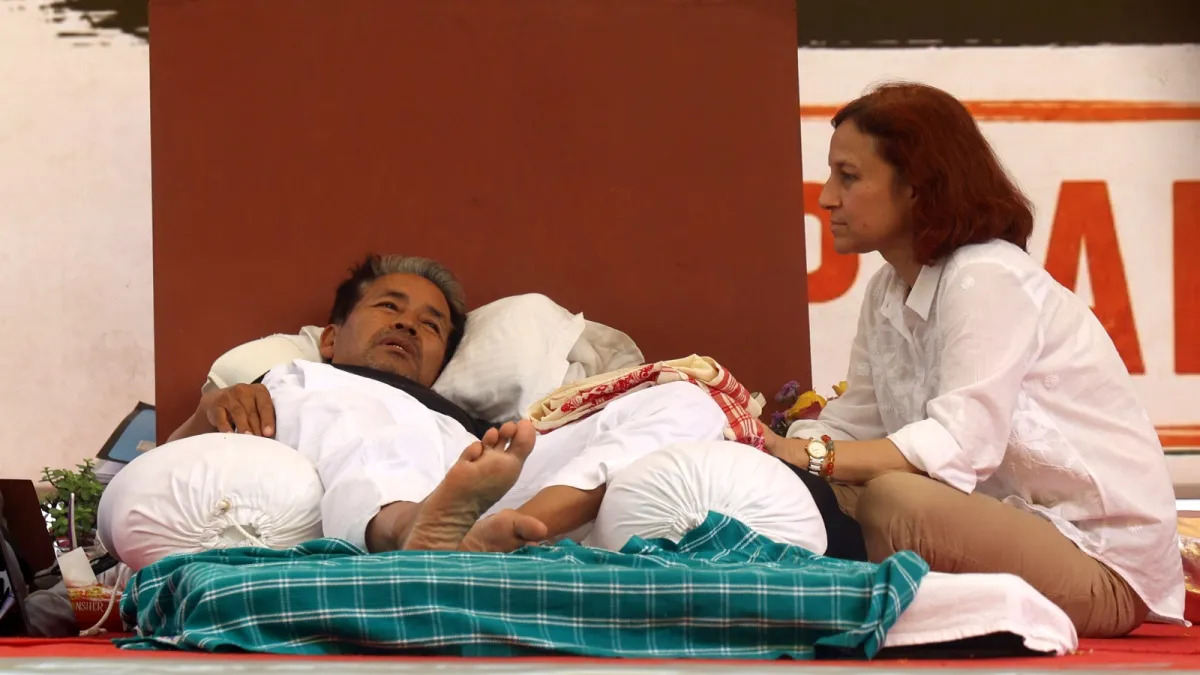
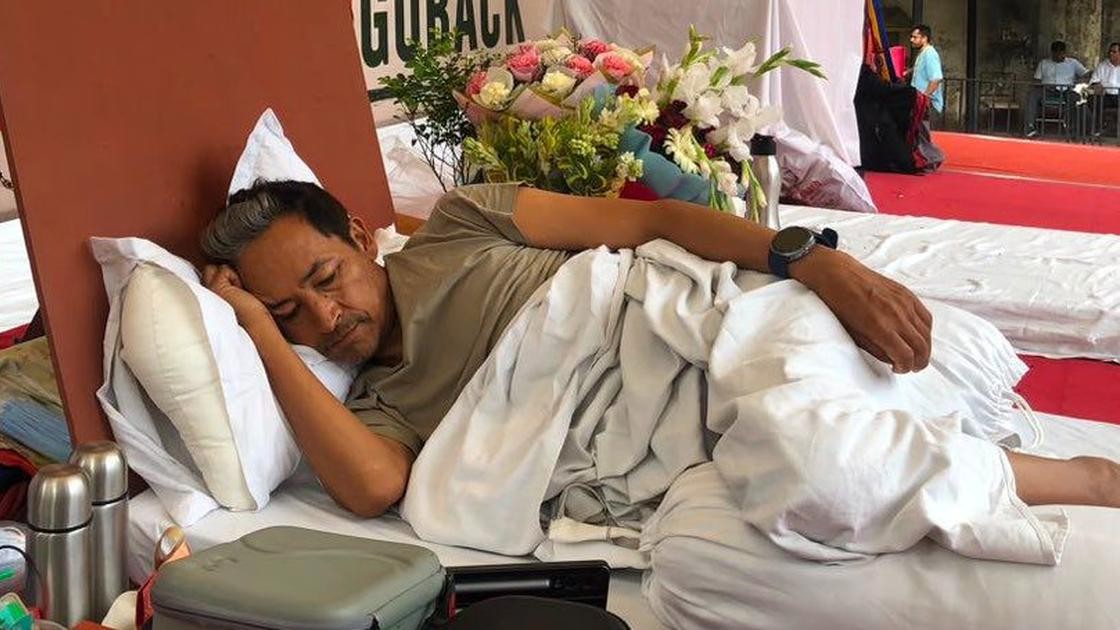
Wangchuk’s health had been under regular medical observation as he entered the later stages of his indefinite fast.
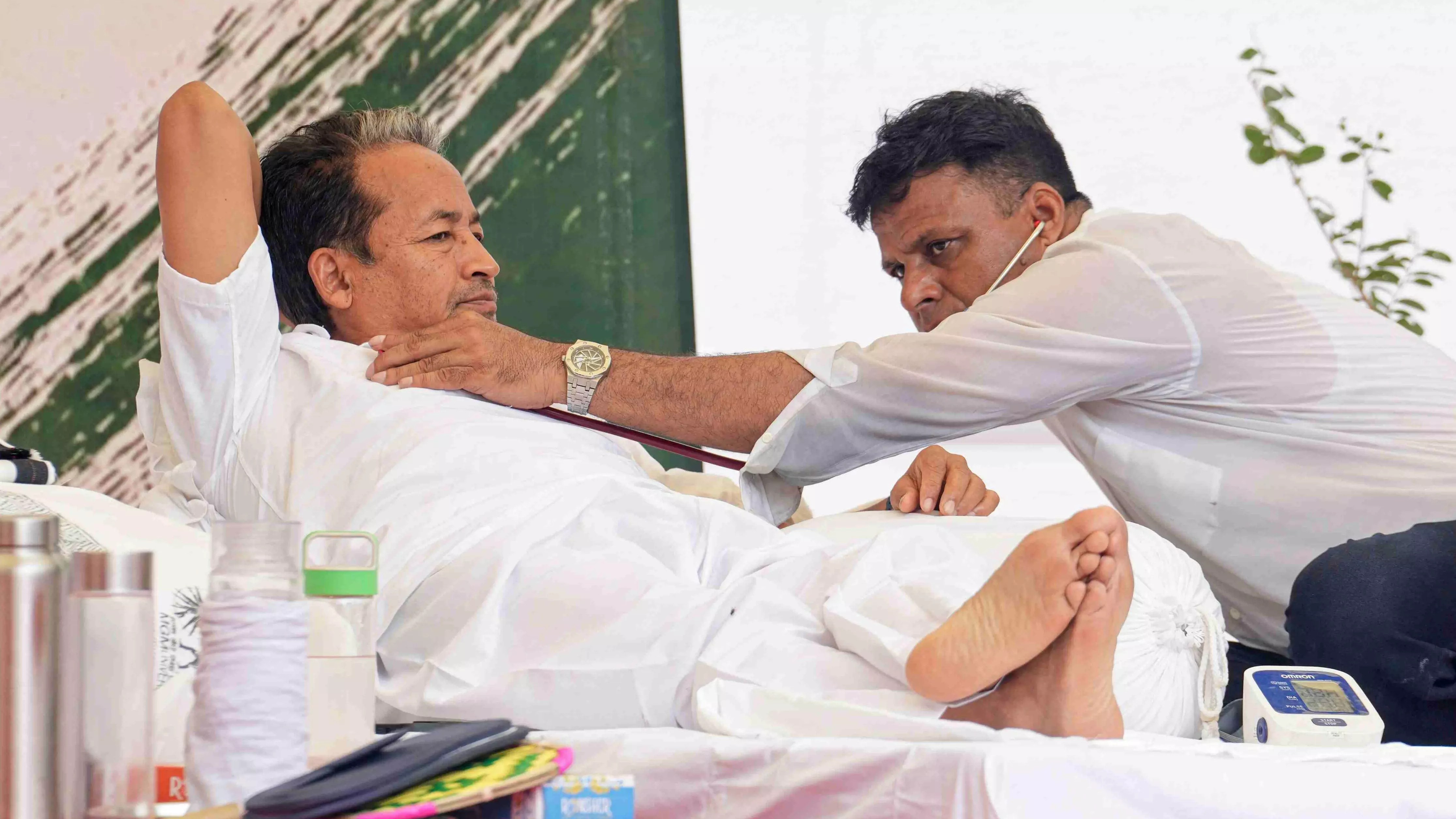
A medical team from VMMC & Safdarjung Hospital examined him and other protesters at Jantar Mantar on July 17. According to the assessment, Wangchuk showed signs of mild dehydration and weighed 56.55 kg, having lost around 350 grams in 24 hours.
His blood pressure was recorded at 108/68 mmHg, blood sugar at 70 mg/dL, and pulse rate at 72 per minute.
Doctors said Wangchuk had entered the third stage of prolonged fasting, where the risk of complications increases, including possible impact on vital organs.
An emergency registration card issued by RML Hospital on July 13 stated that Wangchuk had voluntarily undergone a medical examination but declined consent for treatment and refused hospital transfer.
The report recorded mild dizziness as the provisional diagnosis. His hydration status was described as fair, with blood pressure at 107/70 mmHg, pulse rate at 72 per minute, oxygen saturation at 98% on room air, and random blood sugar at 67 mg/dL.
The Union health ministry had earlier directed RML Hospital, VMMC & Safdarjung Hospital, and Lady Hardinge Medical College to monitor Wangchuk and other hunger strike participants twice daily.
The hospitals were asked to maintain emergency medical facilities, provide round-the-clock nursing support, and submit regular health reports.
Police defend hospital transfer, organizers allege force
Delhi Police said Wangchuk was shifted following the High Court’s directions and medical advice after his condition worsened.
The police claimed some protesters attempted to obstruct the transfer, resulting in a brief commotion, but personnel exercised restraint.
“While complying with the Hon’ble Court’s orders, the protesters at Jantar Mantar tried to obstruct the exercise, leading to a brief commotion. However, the police exercised maximum restraint and shifted Wangchuk safely,” the force said.
Deputy Commissioner of Police (New Delhi) Sachin Sharma said that Wangchuk was receiving necessary medical care after being admitted following the court’s directions.
However, protest organizers accused authorities of forcibly removing Wangchuk.
Cockroach Janta Party (CJP) founder Abhijit Dipke alleged police action against protesters and claimed he was detained. “I have been beaten up and put under detention by Delhi Police,” he said in a post on X.
The CJP shared a video showing Wangchuk being taken away from the protest site and alleged that a frail protester was removed after 20 days of fasting.
High Court orders daily health monitoring
The hospital transfer followed a Delhi High Court order passed on July 16 after a Public Interest Litigation (PIL) raised concerns about Wangchuk’s health.
The petition, filed by advocate RK Saini, sought directions for medical supervision of Wangchuk during his hunger strike.
A bench comprising Chief Justice Devendra Kumar Upadhyaya and Justice Tejas Karia observed that every citizen’s life was valuable and authorities must take necessary steps to protect it.
“While noting the assurances given by the learned Solicitor General, we only observe that the life of every citizen is precious and all medical efforts ought to be made by the Government authorities to save the same,” the court said.
Solicitor General Tushar Mehta, appearing for the Centre and Delhi government, assured the court that Wangchuk’s health would be monitored daily by government doctors.
The court directed authorities to provide any medical intervention recommended by doctors. However, it did not specifically order Wangchuk’s removal from the protest site.
Letter petition seeks protection of protest rights
Amid concerns over Wangchuk’s health, advocate Narendra Mishra submitted a letter-petition before the Chief Justice of India seeking protection of Wangchuk’s health, life, and the rights of peaceful protestors.
The petition sought protection of rights under Articles 14, 19, and 21 of the Constitution and requested that authorities allow the peaceful protest at Jantar Mantar to continue.
It also sought adequate medical facilities at the protest site, including doctors, emergency equipment, medicines, and regular health examinations.
The petition argued that authorities should avoid unnecessary interference or use of force except according to law.
NEET protest and examination reform campaign
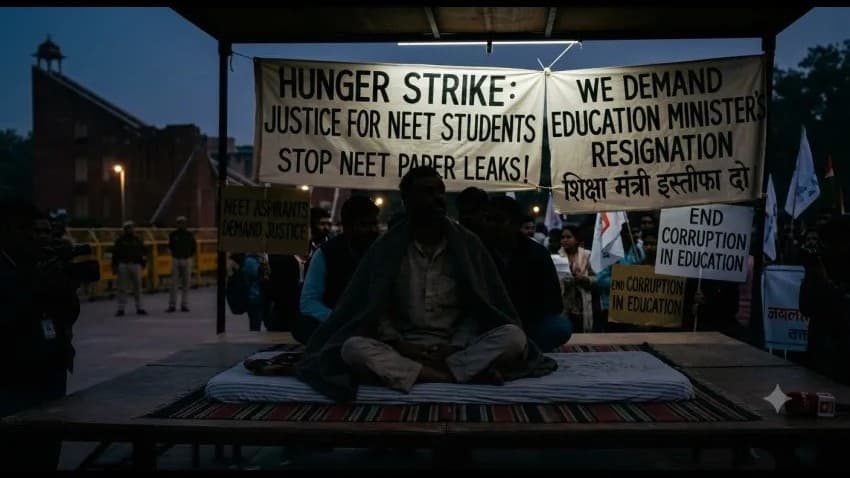
Wangchuk’s hunger strike was linked to the Cockroach Janta Party-led protest demanding accountability over alleged irregularities in India’s competitive examination system, including the NEET UG controversy.
Wangchuk and three activists from the All India Students’ Association (AISA) began the indefinite fast on June 28 at Jantar Mantar.
The protesters have demanded the resignation of Union Education Minister Dharmendra Pradhan, alleging failures in maintaining the credibility and integrity of national-level examinations.
The movement has raised concerns over alleged paper leaks, examination irregularities, and the impact of such controversies on students preparing for competitive exams.
Before being shifted to the hospital, Wangchuk urged people to participate in a march to Parliament scheduled for July 20, coinciding with the opening day of the Monsoon Session.
Opposition attacks government over police action
The hospital transfer triggered criticism from opposition parties, which accused the government of suppressing a peaceful protest.
AAP national convenor Arvind Kejriwal said the government should have engaged in dialogue instead of removing Wangchuk.
“Such arrogance is not right. Instead of forcibly lifting him, the Central government should have talked to Sonam Wangchuk,” Kejriwal wrote on X.
Former Delhi education minister Manish Sisodia said the response to paper leak concerns should not be silencing those raising questions.
AAP Rajya Sabha MP Sanjay Singh alleged that the Centre avoided dialogue with Wangchuk and accused police of using force against protesters.
Congress president Mallikarjun Kharge also criticized the action, alleging that peaceful protests were being treated as law-and-order issues.
“Be it Professor G.D. Agarwal, who sat on a fast-unto-death for 111 days to save Mother Ganga, or the Olympic wrestlers from Haryana; Be it our 750 farmers who feed the nation, Dalits and Adivasis, or the 25 youths and their families who fell victim to exam paper leaks; this authoritarian government has spared no one,” Kharge said in a post on X.
He alleged that people questioning government policies were often labeled “anti-national” or a “parasite” and described the incident at Jantar Mantar as a setback for democracy and constitutional values.
“What transpired at Jantar Mantar today is yet another blot on our democracy and Constitution,” Kharge said.
“The ‘Chhatron ki Goonj (voice of the students)’ has begun to resonate from Kota and Dehradun, and it will certainly reach the very doorstep of Delhi,” Kharge added.
NCP (SP) chief Sharad Pawar and Shiv Sena (UBT) leader Aaditya Thackeray also criticized the handling of the protest.
“The government remained a bystander as other political parties came to support him (Wangchuk). Leaders from Congress, NCP (SP), including Supriya Sule and many others, paid a visit there (Jantar Mantar) and raised a common demand,” Pawar said.
“What a shame! The world watches democracy in India being broken by force, shamelessly. Even peaceful protests for students against an incompetent minister are not tolerated anymore,” Thackeray wrote on X.
Before Wangchuk was shifted to the hospital, several opposition leaders had visited the protest site to express solidarity and urge him to prioritize his health.
Congress leader Pawan Khera, Samajwadi Party MP Dimple Yadav, and AAP chief Arvind Kejriwal were among those who met Wangchuk during the final days of his hunger strike.
The Centre and Delhi Police maintained that the action was taken solely due to medical concerns and the need to safeguard Wangchuk’s health.
From education reform to Ladakh movement
Sonam Wangchuk, a Ramon Magsaysay Award-winning engineer and education reformer, has been associated with social innovation and public campaigns for decades.
He gained national recognition through his work with the Students’ Educational and Cultural Movement of Ladakh (SECMOL), where he developed alternative education models aimed at improving learning outcomes among students.
His innovations, including the Ice Stupa project for water conservation in high-altitude regions, brought global attention to his work.
Over the years, Wangchuk expanded his activism to environmental protection and constitutional safeguards for Ladakh.
Along with regional organizations such as the Leh Apex Body and Kargil Democratic Alliance, he has demanded statehood for Ladakh, inclusion under the Sixth Schedule of the Constitution, and protection of the region’s land, culture, and environment.
Following his father’s legacy of protest
Wangchuk’s latest hunger strike has also revived memories of his father Sonam Wangyal’s activism.
In 1984, Sonam Wangyal launched a hunger strike demanding Scheduled Tribe recognition for Ladakh’s communities.
The protest drew national attention, with then Prime Minister Indira Gandhi traveling to Leh to meet him.
The movement eventually contributed to constitutional recognition of several communities from the region as Scheduled Tribes in 1989.
The father-son connection has drawn attention because both used hunger strikes to highlight public causes, though their demands emerged from different historical contexts.
Climate fasts and Ladakh campaigns
In 2024, Wangchuk undertook a 21-day climate fast in Leh to highlight concerns over Ladakh’s fragile Himalayan ecosystem.
The protest focused on demands for stronger constitutional safeguards, environmental protection, and greater control over local resources.
Later, he led the “Delhi Chalo” padyatra in September 2024, with more than 100 volunteers walking nearly 1,000 kilometers from Leh towards Delhi.
The marchers were stopped by Delhi Police near the Singhu border and later allowed to submit a memorandum at Rajghat.
In 2025, Wangchuk launched another protest in Leh over Ladakh-related demands. Following clashes in the region that resulted in four deaths, authorities detained him under the National Security Act (NSA). He remained in custody for nearly 170 days before being released in March 2026.
Public figures extend support
Wangchuk’s hunger strike received support from several public figures.
Actor Sonakshi Sinha expressed support for students raising concerns over examination issues and questioned why authorities were not engaging with protesters.
“I want to congratulate the youth of this country. They have raised their voice. They are fighting for the truth, for something good. But why isn't anyone listening? Nobody is talking. Nobody is even looking at them,” she said.
Speaking about Wangchuk’s fast, she highlighted his contribution to education and innovation. “I’ve never given a statement out like this, but today we can’t ignore him. Sonam Wangchuk. We all know him. We know what he has done for our country, what his achievements are and how many awards he has won. He is hungry. He hasn’t eaten anything...He is doing this for the future of children who lost their lives. He is fighting a system which is not working properly. I know this. You know this. We all know this,” she said.
Music composer Vishal Dadlani criticized the manner in which Wangchuk was removed from the protest site.
In a video message shared online, Dadlani expressed anger over the police action and questioned the handling of the situation. “Have you ever seen such cowardice? They have taken Sonam ji away by force. What these people are doing to this country breaks my heart; it breaks my heart. My fellow Indians, when will you wake up? If not now, then when will you wake up? I don't know what to say. I don't know what to think. I just wish I were there to help in some way. I'm absolutely furious right now,” he said.
Actors including Abhay Deol, Naseeruddin Shah, Ratna Pathak Shah, Soni Razdan, and Swara Bhasker also expressed support.
Actor Hrithik Roshan shared a video of Wangchuk discussing examination-related concerns and referred to his experience playing a teacher in the film “Super 30."
Actor Aamir Khan also addressed comparisons between Wangchuk and his “3 Idiots” character Rancho, saying the character was not based on Wangchuk.
“No, that’s not true, actually. That is a misconception. I didn’t know about Mr Sonam Wangchuk at that time when we were doing the film,” Aamir said.
He added that Wangchuk’s work deserved respect independently of any connection with the film.
Wider debate over protest and accountability
Wangchuk’s hospitalization has brought renewed attention to issues involving examination reforms, student concerns, freedom of peaceful protest, and the responsibilities of authorities during prolonged hunger strikes.
As protesters prepare for the planned march to Parliament, the debate around Wangchuk’s movement continues to involve political parties, civil society groups, students, and public figures.
His journey from education reform in Ladakh to climate activism and examination reform reflects a long-running focus on public accountability and institutional change.