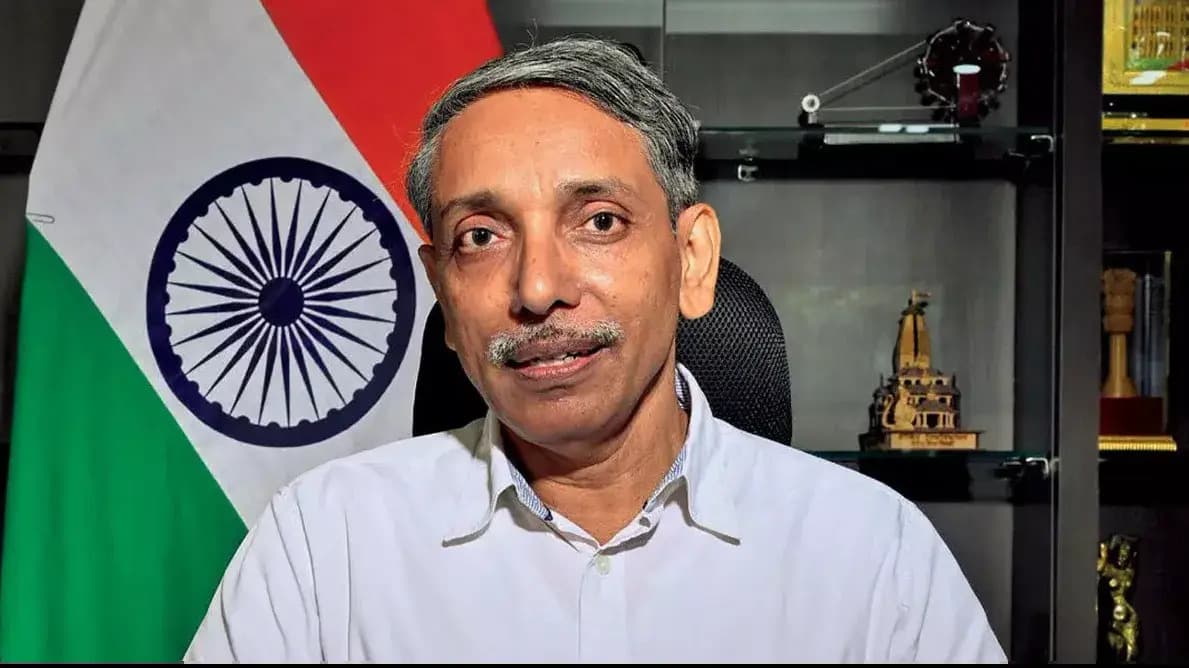
The National Testing Agency (NTA) needs a deeper institutional overhaul rather than replacement, former University Grants Commission chairman M Jagadesh Kumar has said, calling for tighter examination security, permanent professional expertise and more reliable examination infrastructure.
Kumar, who chairs the review committee for the National Education Policy, said the agency should approach examination security as an end-to-end process covering question preparation, translation, storage, printing or digital transmission, transportation, examination centers, invigilation and result processing.

“Every handover needs traceability and strict access control,” he said.
According to Kumar, immediate reforms should focus on three broad areas: securing the complete examination lifecycle, developing permanent expertise within the agency and improving the reliability of examination centers and candidate services.
He said preventing question-paper leaks alone would not address the wider vulnerabilities in the examination system. Each stage should maintain a secure record showing who accessed or modified confidential material.
Kumar also backed the four-tier question-paper scrutiny system being introduced by the NTA but said it should be supported by restricted access, encryption and independent security testing.
He said the Radhakrishnan Committee had also recommended stronger standard operating procedures, improved data security, clearly defined responsibilities and closer coordination with states.
“The long-term solution is continuous risk assessment, fewer people handling confidential material, digital traceability and independent checks at every stage,” he said.
NTA urged to build permanent professional expertise
Kumar said the NTA should develop a permanent pool of specialists in test design, cybersecurity, languages, quality analysis, logistics and vendor management instead of relying primarily on periodic expert appointments.
“The recent leadership strengthening, expert-panel refresh and specialist recruitment are useful beginnings,” Kumar said.
He said recruitment, conflict-of-interest disclosures, training and performance evaluations should become institutionalized processes. Kumar also described the reported refresh of around 600 experts and the four-tier question-paper review system as positive steps, while stressing that these measures alone would not amount to complete institutional reform.
“My assessment is that the expert-panel refresh is a strong corrective measure. Yet no single measure can complete an institution-wide reform. The wider reform programme is therefore necessary and is underway,” he said.
Examination centers also need upgrades
The former UGC chief said the NTA must simultaneously improve the quality and security of examination centers as the agency's examination requirements evolve. “Infrastructure must therefore be tested and upgraded continuously,” he said.
He recommended expanding the network of accredited centers, preferably through reliable public institutions. These centers should have CCTV surveillance, biometric verification, dependable electricity and internet connectivity, accessibility facilities and trained personnel.
"Center quality and candidate support must remain consistent across hundreds of cities,” he said.
The NTA is already expanding security measures across its operations. Its offices are being relocated on a priority basis with enhanced security arrangements, including the deployment of Central Industrial Security Force personnel.
The agency is also expected to induct additional officials and specialists as part of the ongoing restructuring. Around 20 to 25 officials are expected to join over the next two to three weeks, according to the details provided during the review of its reform measures.
Kumar opposes creating multiple testing agencies
Addressing concerns over the NTA's workload, Kumar said the agency conducts a “very large” number of examinations, but the number of tests alone should not determine whether its responsibilities need to be reduced. “The real issue is the complexity behind each examination,” he said.
He pointed to the partnership model recommended by the Radhakrishnan Committee, under which ministries, regulators and institutions requesting examinations would remain responsible for the syllabus, subject experts, question quality and academic validation.
The NTA, meanwhile, could concentrate on secure examination platforms, its center network, candidate authentication, examination delivery and result processing.
Kumar also opposed creating multiple examination agencies simply to distribute the NTA's workload.
“A single national testing body offers common security standards, technology, candidate services and result procedures. Creating many new agencies could duplicate costs and produce uneven safeguards,” he said.
Instead, he said the existing agency should be developed into a “mission-critical professional institution” by strengthening the experience, technology, records and nationwide examination-center network it has accumulated.
“NTA needs deep structural strengthening, but replacing the institution itself may not be the most useful answer,” Kumar said.
NTA expands leadership and security overhaul
The comments come as the NTA undertakes a wider restructuring of its workforce, question-paper verification system and physical security infrastructure following controversies surrounding national-level examinations.
Union Education Minister Pralhad Joshi has directed officials to ensure that required security arrangements and infrastructure are in place for the credible conduct of national examinations. The agency has also been asked to conduct a detailed audit of its examination processes and report on corrective measures.
The restructuring includes new senior positions such as Chief Technology Officer, Chief Finance Officer, Chief Information Security Officer, General Manager for Test Security and General Manager for Research and Development and Psychometrics.
The NTA is also bringing in private-sector specialists in cybersecurity, psychometrics and question-paper design.
Joshi has directed the agency to strictly follow examination protocols and undertake a comprehensive overhaul of its Confidential Operations architecture. The changes include secluded rooms, air-gapped computer systems and mandatory device-deposit protocols, with the measures directed to be implemented on a "war footing."
The reforms follow criticism of the NTA's handling of several high-stakes examinations. The agency recently ordered the re-conduct of UGC-NET papers in English, Commerce and Sociology after an internal committee identified factual, typographical and translation errors, along with repeated questions from previous examinations.
The English and Commerce papers are scheduled to be re-conducted on Sept. 9, while the Sociology paper will be held on Sept. 10. Candidates will not be required to pay an additional examination fee.
The NTA has also faced intense scrutiny following the NEET-UG 2026 controversy, which led to the cancellation of the May 3 examination after a paper leak. The developments triggered student protests and renewed demands for stronger accountability and examination safeguards.
Radhakrishnan Committee recommendations form reform roadmap
Kumar said the recommendations of the Radhakrishnan Committee provide a “sound roadmap” for rebuilding the NTA's institutional capacity.
The roadmap includes clearer allocation of responsibilities, stronger coordination with states and greater involvement of ministries and institutions conducting examinations as knowledge partners.
The government has already implemented several measures, including senior appointments, specialist leadership roles, authentication systems and state-level coordination. It reported in July that 35 of the committee's 46 major action points had been implemented.
Kumar said the long-term goal should be to establish the NTA as a professional national institution capable of conducting high-stakes examinations while continuously strengthening its technological and security systems.







_1600x900.jpg&w=256&q=75)