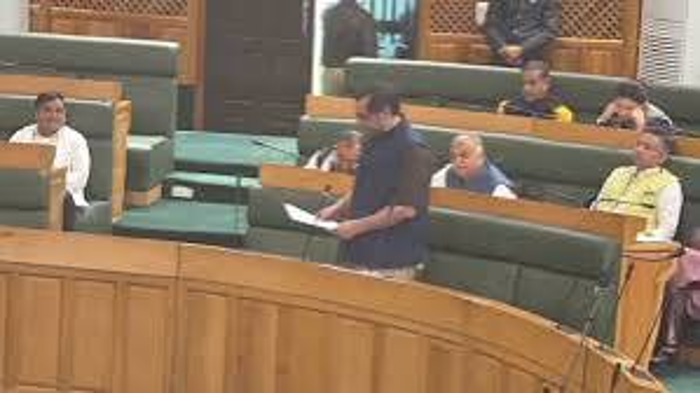
The issuance of Economically Weaker Sections (EWS) certificates in Jammu and Kashmir has become a subject of political debate following concerns over unequal distribution between the Jammu and Kashmir divisions. During the recent Jammu and Kashmir Assembly session, Peoples Conference president and Handwara MLA Sajad Gani Lone raised the issue through a Calling Attention Motion, seeking the government’s response to the alleged regional disparity.
According to the figures cited in the Assembly, Jammu and Kashmir issued 26,514 EWS certificates over the past two years. Of these, 24,058 certificates, accounting for approximately 91 per cent, were issued in the Jammu division, while the Kashmir division received only 2,486. Lone argued that the existing eligibility conditions could disadvantage residents of Kashmir and called for a review.

Speaker Abdul Rahim Rather directed the government to examine the matter and take corrective steps, if necessary, to ensure that no section of society faces injustice.
EWS Eligibility Rules and the Debate Over Regional Disparity
The Jammu and Kashmir administration introduced a 10 per cent reservation for Economically Weaker Sections on September 2, 2019, through amendments to the Jammu and Kashmir Reservation Rules, 2005.
Under the prescribed criteria, a household’s annual income from all sources must be below Rs 8 lakh, and its agricultural landholding must be less than five acres. Applicants are also excluded if their families own residential property exceeding specified limits.
These restrictions include a house or residential flat measuring 1,000 square feet or more, a residential plot of 100 square yards or more in notified municipalities, or a plot of 200 square yards or more outside notified municipalities.
Critics argue that these property-based conditions may affect regions differently because of variations in land ownership, settlement patterns and property sizes. The substantial difference in certificate issuance has consequently raised questions about whether the eligibility framework provides equitable access across both divisions.
The controversy highlights the need for the government to examine regional data, assess the practical impact of the rules and ensure that economically disadvantaged applicants receive fair opportunities to benefit from the reservation policy.








.jpg&w=256&q=75)
.jpg&w=256&q=75)
.webp&w=256&q=75)
