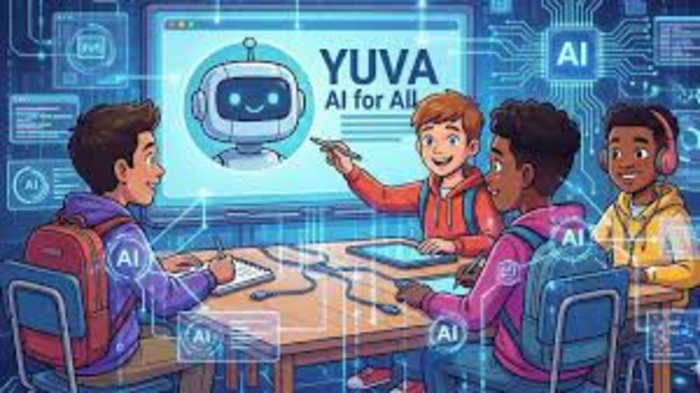
The Government of India launched the National AI Literacy Programme (YUVA AI) with the objective of introducing basic artificial intelligence concepts to school students at an early stage. The programme aims to familiarise students with emerging technologies such as AI, machine learning and data-driven decision-making, while promoting responsible and ethical use of technology. It is aligned with national initiatives such as Digital India, National Education Policy (NEP) 2020, and India’s broader vision of becoming a global technology leader.
Under the programme, age-appropriate modules will be developed for school students, focusing on foundational digital literacy, problem-solving skills, computational thinking and awareness of AI applications in daily life. The initiative emphasises inclusivity by ensuring access to students from government schools, rural areas and underrepresented communities through online platforms and partnerships with educational institutions and technology organisations.

Objectives and Scope:
The YUVA AI programme seeks to move beyond rote learning and encourage experiential and inquiry-based education, as envisaged under NEP 2020. Students will be exposed to practical examples of AI in healthcare, agriculture, education, governance and smart cities, helping them understand real-world applications rather than abstract theory. Importantly, the programme also stresses ethical AI, sensitising students to issues such as data privacy, algorithmic bias and responsible innovation.
Why it matters:
- Human capital development: Early AI exposure equips students with future-ready skills, essential for a technology-driven economy.
- Digital inclusion: Reduces the digital divide by democratising access to emerging technologies.
- Innovation ecosystem: Creates a pipeline of skilled talent to support India’s ambitions in AI, startups and advanced research.
- Ethical awareness: Encourages responsible technology use, critical for sustainable digital governance.
Challenges:
- Teacher training and curriculum integration
- Infrastructure gaps in remote regions
- Need for continuous content upgradation
Conclusion:
The National AI Literacy Programme marks a strategic investment in India’s demographic dividend. By embedding AI awareness at the school level, India is laying the foundation for an innovative, inclusive and ethically informed digital future, ensuring that technological progress translates into broad-based national development.