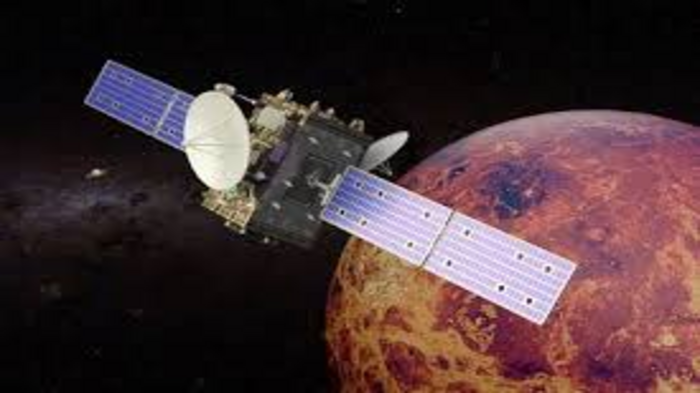
The Indian Space Research Organisation (ISRO) has announced the launch timeline for its Venus Orbiter Mission (VOM), marking a major milestone in India’s planetary exploration programme. The mission is designed to conduct comprehensive studies of Venus’s atmosphere, surface geology, and possible volcanic activity, enhancing scientific understanding of Earth’s closest planetary neighbour.
Venus presents a unique scientific interest due to its extreme climate, dense carbon dioxide atmosphere, sulphuric acid clouds, and runaway greenhouse effect. By studying Venus, scientists hope to gain insights into atmospheric evolution, climate change, and processes that may also inform understanding of Earth’s past and future. The orbiter will carry a suite of indigenous and international scientific instruments to study atmospheric composition, cloud dynamics, surface morphology, ionosphere, and interactions with solar wind.

A key focus of the mission is the investigation of active or recent volcanism on Venus. Radar and spectroscopic observations are expected to help identify surface changes and thermal anomalies, contributing to the global debate on whether Venus is geologically active. The mission will also examine atmospheric phenomena such as super-rotation and trace gases, which remain poorly understood.
The Venus Orbiter Mission builds on ISRO’s experience from successful interplanetary missions such as Chandrayaan and Mars Orbiter Mission (Mangalyaan). It reflects India’s growing capability in deep space navigation, long-duration mission operations, and cost-effective space exploration. International collaboration in payload development is also expected to enhance scientific returns and strengthen global partnerships.
Beyond pure science, the mission has technological and strategic significance. It will contribute to advancements in spacecraft autonomy, thermal control systems, and high-resolution radar imaging under extreme conditions.
Significance
The Venus Orbiter Mission expands India’s planetary science capabilities and reinforces its position as a leading space-faring nation. It enhances global scientific understanding of planetary climates and underscores India’s commitment to peaceful and collaborative space exploration.