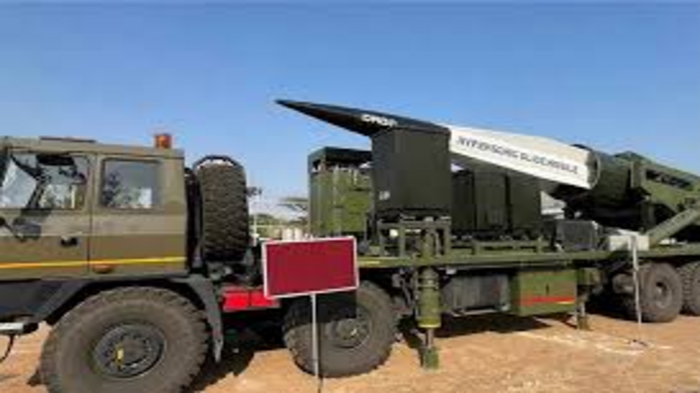
India has successfully conducted the first test of an indigenously developed Hypersonic Glide Vehicle (HGV), marking a major milestone in the country’s advanced defence and aerospace capabilities. Hypersonic systems, capable of travelling at speeds greater than Mach 5, are considered game-changers in modern warfare due to their speed, maneuverability and ability to evade conventional missile defence systems.
About Hypersonic Glide Vehicles
A hypersonic glide vehicle is launched atop a rocket booster and, after separation, glides through the upper atmosphere at extremely high speeds, executing unpredictable maneuvers. Unlike traditional ballistic missiles, HGVs follow a non-ballistic, low-altitude trajectory, making detection and interception significantly more difficult. The tested system demonstrated high-speed maneuvering and precision targeting, validating critical technologies such as thermal protection, guidance and control systems.

Strategic Significance
The successful test places India among a select group of countries with demonstrated hypersonic capabilities. It significantly strengthens India’s strategic deterrence by enhancing its ability to penetrate adversary air defence systems. Hypersonic technology also contributes to maintaining credible minimum deterrence in an evolving security environment.
Technological and Industrial Impact
The test reflects progress under the Atmanirbhar Bharat initiative, showcasing India’s growing defence self-reliance. Indigenous development of such advanced systems boosts domestic research, innovation and high-end manufacturing capabilities, reducing dependence on foreign technologies.
Way Forward
Further tests and integration with existing delivery platforms are expected to refine the system, paving the way for operational deployment and reinforcing India’s position in next-generation defence technologies.