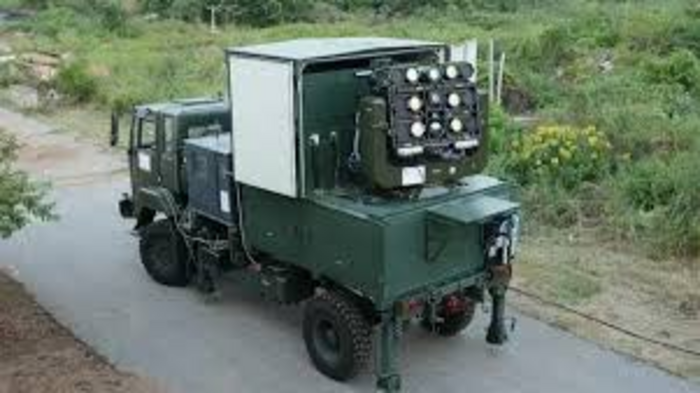
The Defence Research and Development Organisation (DRDO) has successfully tested an indigenous anti-drone system designed to detect, track, and neutralise hostile unmanned aerial vehicles (UAVs). The successful trial marks an important advancement in India’s efforts to counter emerging aerial threats and strengthen internal security.
The anti-drone system integrates multiple technologies to provide a comprehensive counter-UAV solution. It employs radars, electro-optical sensors, and radio frequency (RF) detectors to identify and track drones across varying ranges and altitudes. Once detected, the system can neutralise hostile drones through soft-kill measures such as RF jamming and Global Navigation Satellite System (GNSS) spoofing, as well as hard-kill options including laser-based or kinetic interceptors, depending on the threat profile.

The growing use of drones for surveillance, smuggling of arms and narcotics, reconnaissance, and potential terror attacks has posed new challenges for security agencies. Recent incidents near international borders and sensitive installations have highlighted the need for robust counter-drone capabilities. The indigenous system is designed to address these threats while minimising collateral damage, making it suitable for deployment in both civilian and military environments.
Developed under the Atmanirbhar Bharat initiative, the system reduces dependence on imported defence technologies and enhances domestic manufacturing capabilities. Its modular and scalable design allows deployment at critical infrastructure sites such as airports, military bases, nuclear facilities, government buildings, and border areas. The system can also be integrated with existing air defence and security networks.
Beyond internal security, the technology has potential applications in crowd management, disaster response, and protection of major public events.
Significance
The successful test enhances India’s internal security and defence preparedness against evolving drone threats. By protecting critical infrastructure and sensitive installations, the indigenous anti-drone system strengthens national security and reinforces India’s self-reliance in advanced defence technologies.