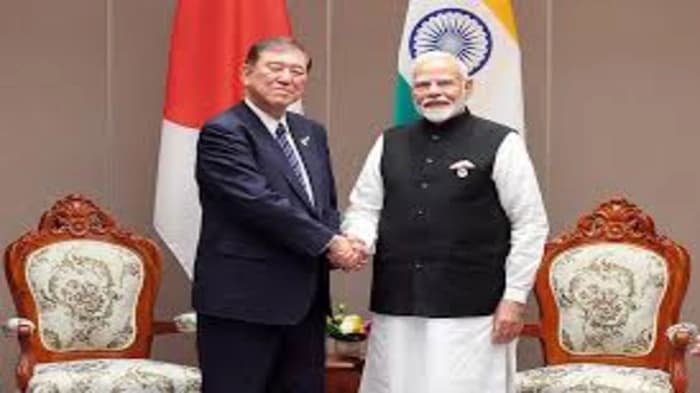
defence, advanced technology, and maritime security. The review reflects the growing convergence between the two democracies amid rising geopolitical competition in the Indo-Pacific and increasing concerns over supply-chain vulnerabilities.
Defence and security cooperation has emerged as a central pillar of the India–Japan partnership. Both countries have expanded military exercises, defence dialogues, and information-sharing mechanisms, particularly in the maritime domain. Japan’s growing security role and India’s strategic position in the Indian Ocean complement each other in ensuring a free, open, and rules-based Indo-Pacific. Cooperation on maritime domain awareness, capacity building, and humanitarian assistance and disaster relief (HADR) further strengthens regional stability.

Technology and supply-chain resilience featured prominently in the partnership review. India and Japan have identified semiconductors, critical minerals, and advanced manufacturing as priority areas for collaboration. Japan’s technological expertise and India’s manufacturing and market potential offer opportunities to diversify supply chains away from overdependence on single sources. Joint initiatives in semiconductors, digital infrastructure, and clean energy technologies align with both countries’ economic and strategic interests.
Economic cooperation underpins the strategic relationship. Japanese investments in India’s infrastructure, including high-speed rail, industrial corridors, and urban transport, contribute to long-term development while strengthening economic interdependence. These projects also support broader Indo-Pacific connectivity initiatives.
The partnership carries wider regional significance. India and Japan coordinate closely in multilateral frameworks such as the Quad, ASEAN-led mechanisms, and the G7–Outreach process. Their collaboration reinforces collective efforts to uphold international law, freedom of navigation, and regional security.
The way forward involves deepening defence industrial cooperation, accelerating technology partnerships, and enhancing people-to-people exchanges. In conclusion, the India–Japan strategic partnership represents a key pillar of India’s Indo-Pacific strategy, combining security, technology, and economic cooperation to address shared regional and global challenges.