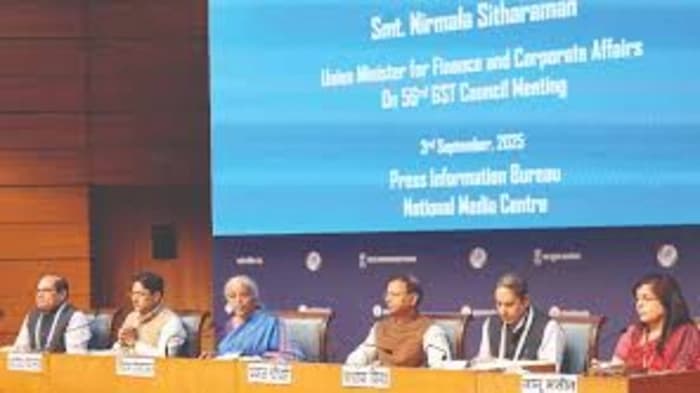
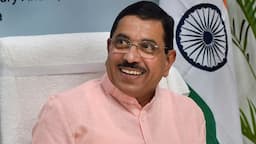
During its 56th meeting, the GST Council sanctioned a two-tier GST framework of 5% and 18%, along with a specific 40% rate for luxury and sin items

What is the GST Council?
A constitutional authority established by Article 279A of the 101st Amendment to the Constitution in 2016.

Advises on GST rates, exemptions, regulations, and levy principles.
Participants:
Finance Minister of the Union → Chairperson
Minister of State for Finance/Revenue at the Union level
Ministers of Finance/Taxation from all States/UTs
In specific situations, a representative appointed by the Governor (in the event that President’s Rule is enacted).
Quorum (Minimum Attendance):
A minimum of 50% of all members needs to be in attendance.
Voting Method:
Consensus is favored, but if it's necessary to vote:
Union Government → 33.3% weightage
Combined States/UTs → 2/3rd significance
A decision is approved if at least 75% of weighted votes support it.
Functions:
Suggest GST rates, exclusions, and threshold limits.
Tackle problems related to the reversed duty framework.
Propose GST legal frameworks and revisions.
Establish unique pricing in times of natural calamities.
Guarantee the alignment of GST between the Centre and States.
Concerning the Two-Slab GST Framework:
What is it?
Simplification of GST into two primary rates: 5% and 18%, plus a specific 40% rate for luxury/sin items.
Objective:
Streamline GST framework for better business operations and compliance.
Alleviate financial pressure on customers.
Promote fairness by imposing lower taxes on essential items and higher taxes on luxury or vice goods.
Enhance income stability and seal gaps.


NEET explained: How India’s medical entrance system evolved and why states continue to oppose it

Hema Malini Wishes PM Modi on 76th Birthday, Says Mathura People Benefited Under His Leadership

Centre to Host Two-Day State Finance Ministers’ Meet on Financing Viksit Bharat

India Seeks to Turn BRICS into Economic, Technology Powerhouse with Focus on Startups and Critical Tech

IANS Review: Kareena Kapoor, Prithviraj Shine in Meghna Gulzar’s Gripping Crime Drama ‘Daayra’

NEET explained: How India’s medical entrance system evolved and why states continue to oppose it

Assam announces ₹194.55 crore scholarships for over 1.6 lakh ST students

OpenAI to disclose AI model misalignment cases through new reporting framework

NIOS launches six-month bridge course in PTE for in-service BEd teachers

EU offers Canada associate membership as Trump threatens tariffs over move

NEET explained: How India’s medical entrance system evolved and why states continue to oppose it

Hema Malini Wishes PM Modi on 76th Birthday, Says Mathura People Benefited Under His Leadership

Centre to Host Two-Day State Finance Ministers’ Meet on Financing Viksit Bharat

India Seeks to Turn BRICS into Economic, Technology Powerhouse with Focus on Startups and Critical Tech

IANS Review: Kareena Kapoor, Prithviraj Shine in Meghna Gulzar’s Gripping Crime Drama ‘Daayra’

NEET explained: How India’s medical entrance system evolved and why states continue to oppose it

Assam announces ₹194.55 crore scholarships for over 1.6 lakh ST students

OpenAI to disclose AI model misalignment cases through new reporting framework

NIOS launches six-month bridge course in PTE for in-service BEd teachers

EU offers Canada associate membership as Trump threatens tariffs over move
Copyright© educationpost.in 2024 All Rights Reserved.
Designed and Developed by @Pyndertech