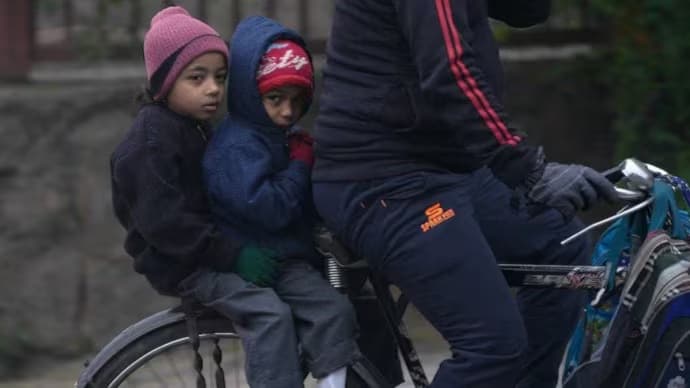
Schools across Delhi NCR have remained shut for much of December and January as a prolonged cold wave, dense fog, and high pollution levels prompted authorities to suspend in-person classes or shift intermittently to online and hybrid modes, a situation parents say is disrupting routines and affecting learning outcomes.
With frequent last-minute changes to schedules, parents say children are struggling to maintain discipline and focus, while families are finding it increasingly difficult to plan daily routines.

“Every morning feels uncertain because we don’t know whether our child will have school, online classes, or no classes at all. There is absolutely no clarity on what the schedule or timings will be tomorrow, and this constant confusion is affecting both students and parents,” said Aparjita Gautam, adding that children are losing their study rhythm and parents are struggling to adjust work and household responsibilities around sudden changes.
Gautam said repeated winter closures have become a pattern rather than an exception. “This has become a yearly ritual in January, with schools shutting down due to pollution, dense fog, or extreme cold. The government should seriously consider revising the academic calendar so that exams and teaching schedules are not disrupted every winter,” she said.
“It’s time to acknowledge that this is no longer an exception but a recurring problem. The government can revise it in a way that students get winter vacations in January, and maybe in December, they can complete the schedule,” she added.
Other parents echoed concerns over lack of clear guidelines. “There is no clarity from the government’s side. Opening for just one day doesn’t help at all. This is just troubling the parents and affecting the children’s studies. If they have to study from home, then they should just close the schools completely and let everyone study from home,” said Pankaj, adding that pollution-related measures have been inconsistent and poorly defined.
Parents also raised concerns about academic pressure, especially for senior students. “Children themselves are getting troubled. Their exams are coming up, and if the syllabus isn’t finished, how will they prepare? This is especially difficult for students in Classes 9 to 12, where the course is vast. The younger children can’t sit with masks on for long periods, even if schools are open. Older kids might manage, but it’s hard for the little ones. On the other hand, the hybrid or online mode puts a lot of strain on their eyes. We might prefer the hybrid mode so they stay safe, but both options have their own disadvantages. It’s a real dilemma,” a parent said.
Parents have also called for changes to academic planning, suggesting that winter disruptions be accounted for in advance. They said summer breaks, weekends, or other holidays could be adjusted to offset learning loss during peak winter months so that education schedules remain intact.
Concerns have also been raised about the quality of online instruction, with parents pointing out that large virtual classrooms limit meaningful interaction. Frequent closures due to pollution, cold, heat, or rain have further reduced classroom time.
One parent said the principal of their ward’s school informed them that morning timings had been pushed back from 7.55 am to 8.55 am, with the school day ending at 2.20 pm instead of 1.55 pm, resulting in a further reduction in instructional hours.
School administrators say the uncertainty has made operations increasingly difficult. Jyoti Arora, principal of Delhi World Public School, Noida Extension, said sudden closures pose serious communication and scheduling challenges.
“There is a perception that sending a single WhatsApp message is enough, but communication doesn’t end there. Information also has to be updated on e-portals and other platforms. Sudden closures disrupt the entire flow of the week. We have functions, unit tests, assessments, and practice schedules planned in advance, and everything has to be rearranged. Every class and every period is accounted for, so frequent replanning becomes extremely difficult,” she said.
Arora said schools often face resistance from parents. “At times, parents feel schools want to shut down deliberately, or they claim they didn’t see the message or check their email. Ultimately, schools end up bearing the brunt of the situation,” she added.
She also highlighted the challenges posed by prolonged online learning. “Younger students need constant supervision, while senior students often spend the entire day online with minimal monitoring. The schedule goes haywire, and when schools reopen, it becomes difficult to bring students back to a physical learning routine as they get settled into their own zones,” she said.
Arora noted that parents frequently question school closures when offices remain open, while academic and co-scholastic activities suffer. “Syllabus completion suffers, sports fields remain unused, and co-scholastic activities come to a halt, leaving schools without their usual vibrancy,” she said.
She added that pollution-related restrictions, traffic congestion, changes in bus routes, and CBSE practical examinations further disrupt schedules for senior students. Revising the academic calendar, avoiding certain holidays, and giving schools greater flexibility in managing closures could help reduce disruption, she said.