


The Unboxed School, designed by Bengaluru student Divit Garg, uses a shipping container to create a learning and play space for children of migrant construction workers. The first unit is nearing completion, with operations expected to begin by the end of 2026.
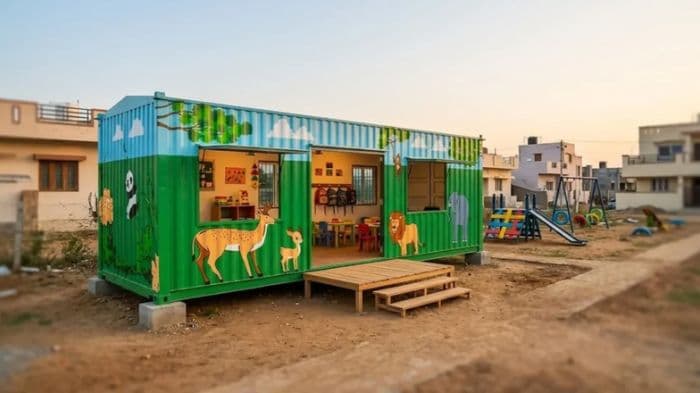
A Class 12 student in Bengaluru has designed a portable classroom for children of migrant construction workers, aiming to bring a dedicated space for learning and play closer to families who frequently move between construction sites.
The project, called The Unboxed School, is being developed by Divit Garg using a shipping container that can accommodate around 20 to 25 children. The first unit is located at a residential development on Sarjapur–Attibele Road in Bengaluru and has an estimated cost of ₹5 lakh. The structure is nearing completion, but interior work and the installation of solar panels remain unfinished. The school is expected to begin operating by the end of 2026.

The initiative responds to the difficulties migrant families can face in securing continuous education for their children when employment requires them to relocate. Changes in residence can complicate school admissions, particularly when families arrive during the academic year or encounter language barriers.
Why migrant workers’ children can struggle to access education
Children living in construction workers’ settlements may have limited access to safe spaces for learning and recreation while their parents are at work. Some spend time near construction materials and machinery, while others are cared for by older siblings.
Garg began considering the problem after teaching Economics in government schools and observing the condition of some classrooms. He later visited construction sites and labour colonies, where he saw how difficult it could be for children to access suitable learning environments.
Garg described the settlements as dusty, noisy and cramped. He also pointed to the difficulties families face when construction projects end and workers move to new locations.
A 2019 UNESCO Global Education Monitoring Report cited a survey across seven Indian cities in which eight in 10 migrant children living at worksites had no access to education. Separately, a 2020 report by UNICEF and Young Lives India, drawing on Census 2011 data, estimated that India had 92.95 million internal child migrants. The latter figure includes child migrants across the country and should not be interpreted as the number of children who are out of school.
The portable classroom is intended to address part of this challenge by providing a nearby place where children can learn and play. It is not, by itself, a replacement for formal schooling or a guarantee of uninterrupted education when families relocate.
From a school design project to a portable classroom
Garg’s interest in designing spaces for children began in Class 9, when he entered a design competition organised by the University of Illinois Urbana-Champaign. He developed a playscape design for a government school in India and received an Honourable Mention.
He subsequently delivered a TEDx talk on sustainable public spaces for young people. His interest in turning designs into practical projects led him to intern with Anthill Creations, an organisation that develops low-cost playgrounds using recycled materials.
Through that experience, he gained exposure to the fabrication of physical play spaces and projects involving shipping containers. He began exploring whether a container could serve as the basis for a low-cost classroom, avoiding the need to construct an entire building from scratch.
The resulting initiative, The Unboxed School, combines a classroom with a playscape. Its design is intended to be adaptable to different locations where children have limited access to dedicated learning and recreation facilities.
How the container classroom is designed
The proposed classroom uses a standard shipping container measuring approximately 40 feet by 8 feet. Its interior is planned to accommodate 20 to 25 children, with a small washroom at one end and a storage area at the other. The storage space could also be used as a smaller classroom for children requiring additional learning support.
Heat management presented a particular design challenge. Steel containers can become very hot during the day, while conventional insulation could increase the project’s cost.
Garg’s design therefore incorporates heat-reflective paint and passive turbine vents intended to help manage indoor temperatures without relying on electricity for ventilation. Solar panels are planned as part of the final fit-out.
The container is to be placed on a concrete platform measuring about 420 square feet. Transport by truck is estimated at around ₹30,000, although the cost could vary according to distance. The ₹5 lakh figure is the project’s stated target cost, rather than a confirmed universal price for reproducing the model elsewhere.
A real estate developer is funding the first project through its corporate social responsibility commitments. The classroom and playscape are being developed within one of the company’s residential developments.
Teaching arrangements and expansion plans
Garg hopes the first unit will demonstrate whether the model can be replicated at other construction sites and residential developments.
He wants real estate companies, non-governmental organisations and public agencies to consider providing similar spaces for children in migrant workers’ communities.
Possible teaching arrangements include support from government-school teachers outside regular school hours or assistance from local volunteer groups. These are proposed options; the project’s final teaching arrangements and operating schedule will need to be established before the school opens.
The model’s longer-term viability will depend on more than the cost of constructing a container classroom. It will require regular maintenance, suitable teaching support and a plan for children whose families move to another site. The initiative will also need to establish how children’s learning will be tracked and how they can transition into formal schools where necessary.
As the first unit has not yet begun operating, its effects on attendance, learning outcomes and continuity of education remain unknown.

Gulf countries gain ground in global higher education as student mobility patterns shift
Bengaluru Class 12 student designs ₹5 lakh portable classroom for migrant workers’ children

AI boom puts forward deployed engineers on track for ₹1 crore annual packages

70% of study-abroad aspirants target budgets below ₹30 lakh

NTA opens JEE Main 2027 registration, applications close on Nov 22
AI boom puts forward deployed engineers on track for ₹1 crore annual packages

Reed College’s concrete owl stolen, frozen and set on fire

Canada announces $813 million research boost to back 450-plus researchers

Abu Dhabi aims to bring 2,000 Emirati teachers into private schools within five years
Australian schools record thousands of student sexual misconduct reports as child safety concerns grow

Gulf countries gain ground in global higher education as student mobility patterns shift
Bengaluru Class 12 student designs ₹5 lakh portable classroom for migrant workers’ children
AI boom puts forward deployed engineers on track for ₹1 crore annual packages
70% of study-abroad aspirants target budgets below ₹30 lakh
NTA opens JEE Main 2027 registration, applications close on Nov 22
AI boom puts forward deployed engineers on track for ₹1 crore annual packages
Reed College’s concrete owl stolen, frozen and set on fire
Canada announces $813 million research boost to back 450-plus researchers
Abu Dhabi aims to bring 2,000 Emirati teachers into private schools within five years
Australian schools record thousands of student sexual misconduct reports as child safety concerns grow
Copyright© educationpost.in 2026 All Rights Reserved.