


UNESCO reports that internationally mobile students from Arab countries are increasingly choosing destinations within the Gulf and Jordan, while the UAE expands its international university network. Dubai recorded a 29% rise in international student enrolment in 2024–25, as Saudi Arabia opens its higher education sector to foreign institutions.
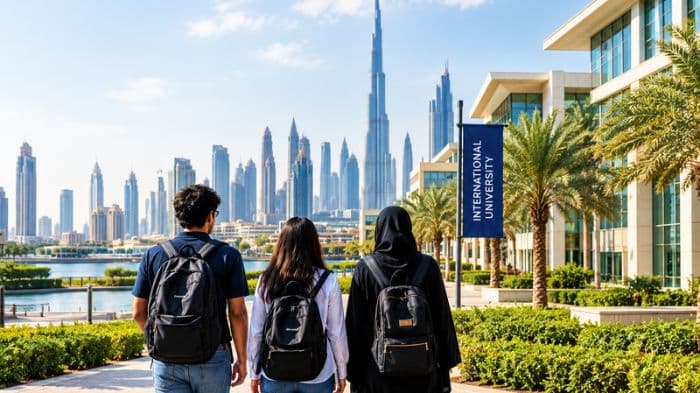
The Gulf is strengthening its position in international higher education as student mobility patterns evolve and governments invest in universities, research and workforce development.
The United Nations Educational, Scientific and Cultural Organization (UNESCO) has identified a growing concentration of internationally mobile students from Arab countries in the Gulf and Jordan, marking a change from the stronger dominance of Western Europe and North America a decade earlier.

UNESCO’s first Higher Education Global Trends Report, published in May 2026, found that nearly 7.3 million students studied outside their home countries in 2023, more than three times the 2.1 million recorded in 2000. Despite this growth, international mobility still reaches fewer than 3% of the global student cohort.
The report also identifies Türkiye and the United Arab Emirates as increasingly popular destinations, with international student mobility to both countries rising at least fivefold over the preceding decade. It describes the growing concentration of Arab students in the Gulf and Jordan as part of a wider trend towards regional study destinations.
Dubai records 29% increase in international enrolment
Dubai’s private higher education sector recorded a 29% increase in international student enrolment in the 2024–25 academic year, according to the emirate’s Knowledge and Human Development Authority (KHDA).
The authority reported a total of 42,026 students across 41 private higher education institutions, representing 20% growth in overall enrolment compared with the previous academic year. International students accounted for 35% of the total student population.
Of the 41 institutions, 37 were international campuses. Four new international universities opened in Dubai during the 2024–25 academic year, representing institutions from China, India, Russia and Italy.
The institutions offered 706 academic programmes, with business, information technology, engineering, media and design, and humanities among the popular fields of study. Information technology, engineering, and health and medicine recorded the largest increases in enrolment compared with the previous academic year.
Dubai’s Education 33 strategy aims to increase the proportion of international students to 50% of the total student population in higher education institutions by 2033. The emirate also aims for the sector to contribute AED 5.6 billion to its gross domestic product and for Dubai to become one of the world’s top 10 cities for university study. These are policy targets, not achieved outcomes.
Saudi Arabia expands opportunities for foreign universities
Saudi Arabia is also developing its international higher education presence by allowing foreign universities to establish local campuses. The initiative forms part of the country’s Vision 2030 agenda, which seeks to diversify the economy and develop skills aligned with labour-market needs.
The Saudi Ministry of Education says the country has introduced a framework permitting distinguished foreign universities to open branches. The framework is intended to encourage competition, transfer expertise and expand programmes aligned with economic priorities.
Among the institutions that have received foreign-investment licences are Arizona State University, the University of Wollongong, the University of Strathclyde, the Royal College of Surgeons in Ireland and IE University, according to a legal analysis by Pinsent Masons.
The University of Wollongong is progressing plans for a Riyadh campus. Its current institutional information says English-language and foundation programmes are planned for 2026, followed by undergraduate degrees in 2027, subject to the required approvals.
The expansion could allow students to access programmes from international institutions without travelling to their home countries. However, the costs, course availability and qualifications offered will vary by institution, and the presence of a foreign university does not automatically mean its programmes will be cheaper than studying abroad.
International campuses reshape the region’s education offer
International branch campuses are an established feature of higher education in the UAE and Qatar, where overseas institutions operate alongside national universities.
Dubai has developed a network of foreign institutions through its private higher education sector and dedicated academic zones. Qatar’s Education City, meanwhile, hosts campuses of several international universities, including Georgetown University, Northwestern University and Carnegie Mellon University.
These models allow students to pursue degrees from overseas institutions while remaining in the region. They also create opportunities for collaboration between universities, although the nature of partnerships, research activity and qualification arrangements differs across institutions.
Saudi Arabia’s newer campus initiatives add another dimension to this regional expansion. Their longer-term development will depend on student demand, regulatory approvals, investment and the ability of institutions to establish sustainable academic operations.
Why governments are investing in higher education
The expansion of higher education is linked to broader economic and workforce priorities across the Gulf. Governments are seeking to develop domestic talent, strengthen research capacity and support sectors beyond oil and gas, including technology, healthcare, finance, logistics and advanced manufacturing.
In the UAE, Dubai’s Education 33 strategy explicitly links higher education with research, international collaboration and the development of skills for emerging industries. Saudi Arabia’s foreign-university framework similarly identifies labour-market needs and the transfer of expertise as objectives.
For international students, these investments can increase the range of programmes available closer to home. Studying in the Gulf may also provide access to regional employers and professional networks, particularly for students interested in sectors expanding across the region.
However, the practical benefits depend on individual circumstances. Students need to compare tuition fees, living costs, scholarships, course recognition, visa conditions and post-study employment rules rather than assume that a regional campus will necessarily be less expensive or provide better career prospects than a university in Europe or North America.
Global student mobility continues to face inequalities
The Gulf’s growing role forms part of a wider expansion in higher education, but UNESCO’s report also highlights persistent inequalities in access and completion.
Global higher education enrolment reached approximately 269 million students in 2024, compared with around 100 million in 2000. Yet participation differs sharply by region, and the number of students enrolled has grown faster than the global graduation ratio. UNESCO also notes that international mobility remains limited to a small proportion of students worldwide.
The changing distribution of international students does not establish that Western destinations are losing their overall dominance. UNESCO reports that the United States, United Kingdom, Australia, Germany, Canada, Russia and France together continued to host half of all international students.
The growing appeal of the Gulf and Türkiye therefore represents an expansion and diversification of the destination landscape rather than evidence that traditional study destinations have been displaced.
For universities in the Gulf, the next challenge will be to convert investment and enrolment growth into sustainable academic provision, research capacity and recognised qualifications. For students, the region’s expanding offer adds more options to an international education market in which cost, quality, access and employment prospects remain central considerations.
Gulf countries gain ground in global higher education as student mobility patterns shift

Bengaluru Class 12 student designs ₹5 lakh portable classroom for migrant workers’ children

AI boom puts forward deployed engineers on track for ₹1 crore annual packages

70% of study-abroad aspirants target budgets below ₹30 lakh

NTA opens JEE Main 2027 registration, applications close on Nov 22
AI boom puts forward deployed engineers on track for ₹1 crore annual packages

Reed College’s concrete owl stolen, frozen and set on fire

Canada announces $813 million research boost to back 450-plus researchers

Abu Dhabi aims to bring 2,000 Emirati teachers into private schools within five years

Australian schools record thousands of student sexual misconduct reports as child safety concerns grow

Gulf countries gain ground in global higher education as student mobility patterns shift
Bengaluru Class 12 student designs ₹5 lakh portable classroom for migrant workers’ children
AI boom puts forward deployed engineers on track for ₹1 crore annual packages
70% of study-abroad aspirants target budgets below ₹30 lakh
NTA opens JEE Main 2027 registration, applications close on Nov 22
AI boom puts forward deployed engineers on track for ₹1 crore annual packages
Reed College’s concrete owl stolen, frozen and set on fire
Canada announces $813 million research boost to back 450-plus researchers
Abu Dhabi aims to bring 2,000 Emirati teachers into private schools within five years
Australian schools record thousands of student sexual misconduct reports as child safety concerns grow
Copyright© educationpost.in 2026 All Rights Reserved.