The war between the United States, Israel and Iran has entered its most volatile phase in decades, with Washington and Tel Aviv confirming a sweeping military operation that Tehran says killed its Supreme Leader and dozens of top officials.
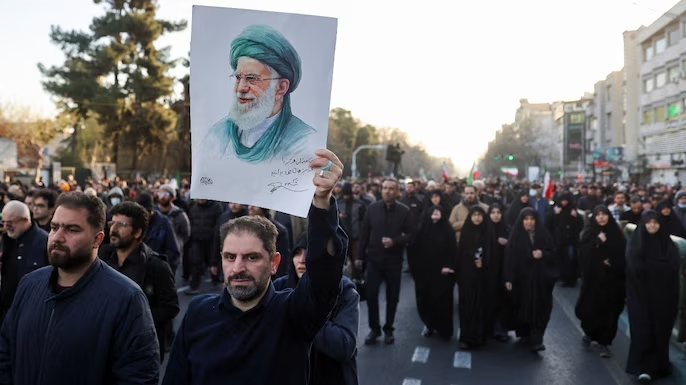
Iranian state media announced that Ayatollah Ali Khamenei, 86, was killed in joint US-Israeli strikes. The announcement followed US President Donald Trump’s claim that Khamenei had been eliminated in the operation. Tehran has declared 40 days of national mourning and seven days of public holidays.

Intelligence and military sources cited by CBS News reported that nearly 40 senior Iranian officials were killed in the strikes, including Defense Minister Amir Nasirzadeh and Revolutionary Guards commander Mohammed Pakpour.
The escalation marks the second time in eight months that the Trump administration has used direct force against the Islamic Republic, dramatically widening the conflict footprint across West Asia.
Civilian toll mounts as strikes widen
Iran told the United Nations Security Council that hundreds of civilians have been killed and wounded in the US-Israel bombardment.
According to the Iranian Red Crescent, at least 201 people have been killed and more than 700 injured nationwide. Among the most devastating incidents was a reported strike on a girls’ school in southern Iran, where at least 85 people are feared dead.
Explosions were also reported near the offices of Khamenei in Tehran, alongside confirmed strikes on Islamic Revolutionary Guard Corps command centres, missile launch sites and air defense systems.
Leadership vacuum and national mourning
Tehran confirmed that Khamenei’s daughter, son-in-law and grandson were also killed in the attack. The declaration of 40 days of mourning signals both political shock and an attempt to consolidate internal control amid fears of instability.
The killing of Iran’s Supreme Leader — the country’s most powerful authority — represents an extraordinary rupture in the Islamic Republic’s command structure.
Iran retaliates across the region
In response, Iran has launched hundreds of drones and ballistic missiles targeting US and Israeli interests across the region.
While Washington reports minimal damage to its bases, Israeli authorities confirmed injuries from shrapnel caused by intercepted projectiles. In Dubai, one fatality has been confirmed following debris from aerial interceptions.
Iranian strikes have spread across at least six neighboring countries. Attacks were reported near Dubai International Airport, prompting major disruptions across Gulf aviation corridors. Airports in Kuwait and Abu Dhabi also faced operational interruptions, while Bahrain, Jordan and Saudi Arabia reported intercepting incoming drones and missiles.
The Airports Company South Africa said the closure of UAE airspace was affecting Emirates and Qatar Airways flights.
IRGC claims attacks on US assets
Iran’s Islamic Revolutionary Guard Corps announced it had struck a US-bound ammunition ship at Jebel Ali anchorage with four drones and targeted an American naval base in Kuwait’s Abdullah Mubarak area with ballistic missiles and drones, claiming “significant damage and casualties.”
It also said an MST-class combat support ship carrying fuel for US vessels in the Indian Ocean was hit by Iranian Qadr-380 missiles. Independent verification of these claims is pending.
Trump’s warning: “Force never seen before”
Trump issued a fresh warning on his Truth Social platform after Iran signalled further retaliation.
“Iran just stated that they are going to hit very hard today, harder than they have ever been hit before,” he wrote. “They better not do that… because if they do, we will hit them with a force that has never been seen before.”
The rhetoric underscores the risk of rapid military escalation between Washington and Tehran.
Political fallout in Washington and at the UN
White House spokesperson Karoline Leavitt said congressional leaders were briefed, though senior Democrats, including House Minority Leader Hakeem Jeffries, criticized the lack of formal congressional authorisation, calling the strikes “an act of war.”
The United Nations Security Council convened an emergency session, where US and Iranian representatives exchanged stark warnings.
The International Atomic Energy Agency said it is closely monitoring Iranian nuclear facilities and currently reports “no evidence of radiological impact.”
India issues advisory amid widening crisis
India has advised foreign nationals affected by the West Asia crisis to approach their nearest Foreigners Regional Registration Office (FRRO) to extend or regularize their stay.
In a government advisory issued Sunday, authorities said those forced to alter travel plans due to developments in the region would be assisted with necessary formalities.
What next
With “Operation Epic Fury” entering its next phase, military exchanges continue across multiple theatres. Diplomatic channels remain strained, and fears of a broader regional war are mounting as both sides escalate rhetoric and force posture.
Our Global Desk is verifying developments and will continue to bring real-time updates as the conflict unfolds.