


Students and opposition parties demand Shah's resignation after his remarks on the India-Nepal border dispute trigger protests and political turmoil.
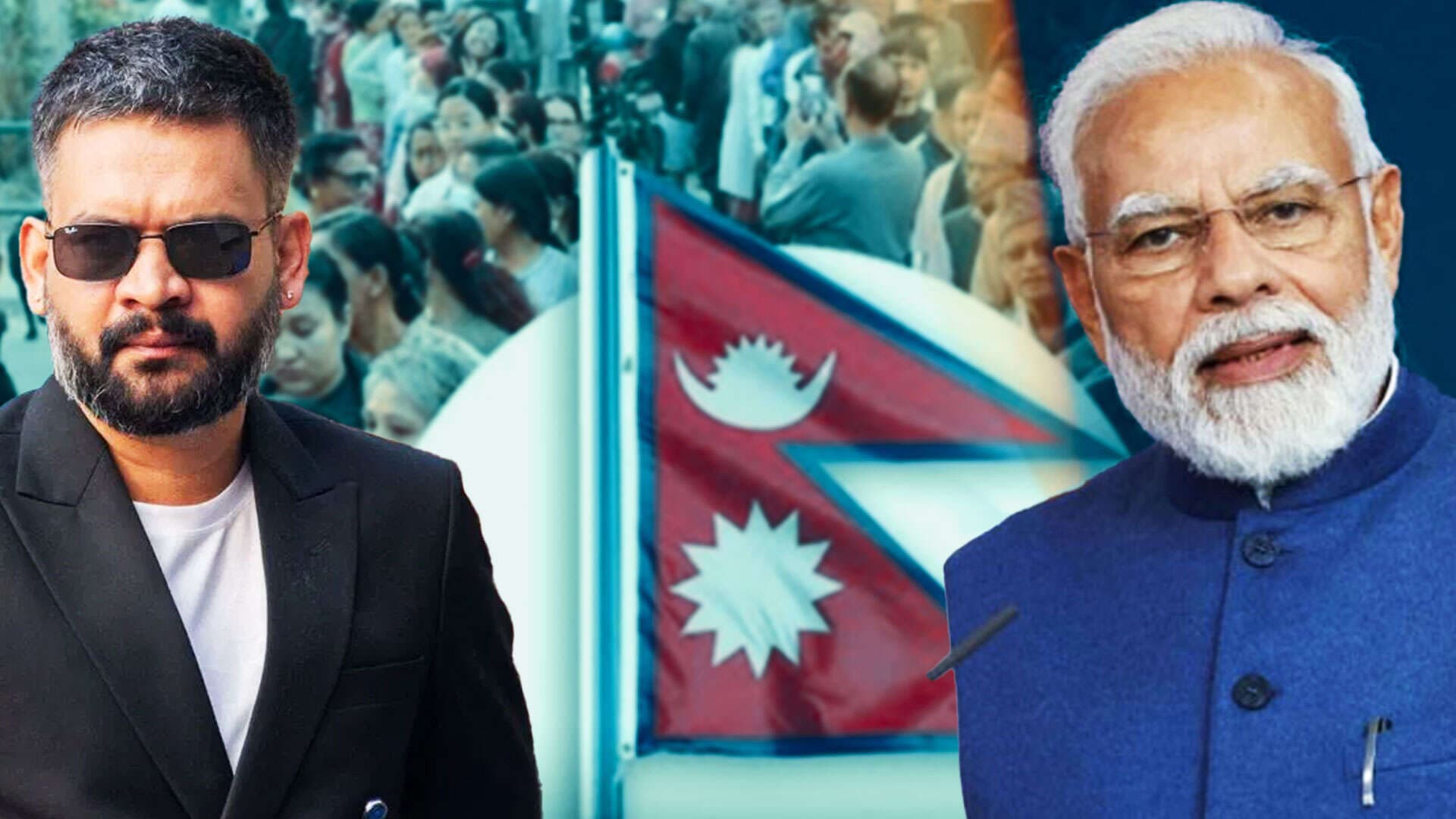
Prime Minister Balendra "Balen" Shah triggered a political storm in Nepal after suggesting that border disputes with India were not entirely one-sided, sparking protests, disrupting Parliament and prompting opposition parties to demand his resignation.
The controversy erupted after Shah, speaking in Parliament recently said Nepal had crossed into Indian territory at several points along the border. His remarks immediately sparked outrage among opposition parties, student groups and sections of the public, who accused him of weakening Nepal's longstanding position on sensitive territorial disputes with India.

The backlash has united an otherwise fragmented opposition against the prime minister. Shah, who rose to power as an anti-establishment outsider and rode a wave of public discontent to Nepal's highest office, now finds himself facing protests just months into his tenure.
During the parliamentary debate, Shah reportedly argued that the border issue required an objective assessment by historians, surveyors and technical experts. He also referred to diplomatic exchanges with India and suggested that historical records, including colonial-era maps, should be examined to better understand the dispute. His remarks framed the issue as one requiring mutual understanding rather than unilateral accusations.
Responding swiftly, the Indian Ministry of External Affairs on Jun 3, reiterated that all India-Nepal boundary issues are strictly bilateral and leave no room for third-party involvement. MEA spokesperson Randhir Jaiswal said both countries were already addressing boundary-related matters through established mechanisms.
The controversy has once again brought the spotlight on the long-running dispute over Kalapani, Lipulekh and Limpiyadhura. India maintains that all three areas are integral parts of its territory and has consistently described its position as clear, consistent and non-negotiable.
Shah's comments also revived memories of Nepal's assertive stance under former prime minister KP Sharma Oli, whose government approved a revised national map incorporating the disputed territories.
A former rapper, Bengaluru-trained engineer and ex-mayor of Kathmandu, Shah has often positioned himself as a political outsider willing to challenge established narratives. As mayor, he stirred controversy by displaying a "Greater Nepal" map in his office, a move widely seen as a response to the "Akhand Bharat" map displayed in the Indian Parliament.
Public anger over his latest remarks surfaced almost immediately. Student organizations gathered at Kathmandu's Maitighar Mandala on June 2 under the slogan "Let's Protect Sovereignty", accusing the prime minister of making anti-national statements. The Nepali Congress-affiliated Tarun Dal also organized a protest march, condemning what it called irresponsible remarks that undermined Nepal's position on border issues.
The protests quickly spilled into Parliament. Proceedings in both the House of Representatives and the National Assembly were disrupted as opposition lawmakers demanded an apology, the removal of Shah's remarks from official records and, ultimately, his resignation.
Opposition parties, led by the Nepali Congress and CPN-UML, intensified pressure on the government, arguing that Shah's comments diluted Nepal's diplomatic position regarding disputed territories.
As criticism mounted, Nepal's Foreign Ministry stepped in to contain the fallout. The ministry clarified that the prime minister's remarks referred to practical border management issues, including encroachments in no-man's-land areas and boundary shifts caused by rivers, rather than any concession on Nepal's territorial claims.
"The issue mentioned by the prime minister in Parliament is essentially related to encroachment in the Dasgaja area and cross-border occupation," the ministry said.
The clarification, however, did little to calm the political storm.
At the heart of the controversy lies a dispute dating back more than two centuries. The disagreement centres on the interpretation of the 1816 Treaty of Sugauli, signed after the Anglo-Nepalese War. While the treaty identified the Kali River as Nepal's western boundary, India and Nepal differ over the river's precise origin, resulting in competing territorial claims over Kalapani, Lipulekh and Limpiyadhura.
Nepal argues that the Kali River originates at Limpiyadhura, placing all three areas within its territory. India maintains that historical records, surveys and administrative control support its claim that the boundary begins near Kalapani.
India administers the region as part of Uttarakhand's Pithoragarh district and considers the area strategically important because of its proximity to China. Nepal, meanwhile, has continued pressing its claims through diplomatic channels and updated national maps.
The dispute gained renewed attention in 2020 after India inaugurated a road to the strategically significant Lipulekh Pass, a key route for trade and for Indian pilgrims travelling to Mount Kailash in Tibet. Nepal objected to the project, further straining bilateral relations.
The latest controversy highlights the political sensitivity of border issues in Nepal and the delicate balance Kathmandu must maintain in its relationship with India. Despite periodic disagreements, the two countries share deep cultural, economic and people-to-people ties, supported by an open border that facilitates trade and movement.
For Shah, the immediate challenge is political damage control. The irony is hard to miss: a leader propelled to power by public protests is now confronting a growing protest movement of his own.
Madurai Kamaraj University seeks grants for college struggling to pay salaries amid ₹2 crore annual deficit
IISc Study Challenges Chandrasekhar Limit, Finds White Dwarfs Could Grow Far Beyond Expected Mass

Surat medical college ragging case: Two senior doctors arrested after PG student’s death

IIIT Ranchi student death: NHRC to examine allegations of administrative negligence and delayed medical aid
.jpg&w=256&q=75)
Karnataka introduces 7.5% sub-quota for rural government school students in professional course admissions
Madurai Kamaraj University seeks grants for college struggling to pay salaries amid ₹2 crore annual deficit
IISc Study Challenges Chandrasekhar Limit, Finds White Dwarfs Could Grow Far Beyond Expected Mass
Surat medical college ragging case: Two senior doctors arrested after PG student’s death
IIIT Ranchi student death: NHRC to examine allegations of administrative negligence and delayed medical aid
Karnataka introduces 7.5% sub-quota for rural government school students in professional course admissions

Madurai Kamaraj University seeks grants for college struggling to pay salaries amid ₹2 crore annual deficit
IISc Study Challenges Chandrasekhar Limit, Finds White Dwarfs Could Grow Far Beyond Expected Mass
Surat medical college ragging case: Two senior doctors arrested after PG student’s death
IIIT Ranchi student death: NHRC to examine allegations of administrative negligence and delayed medical aid
Karnataka introduces 7.5% sub-quota for rural government school students in professional course admissions
Madurai Kamaraj University seeks grants for college struggling to pay salaries amid ₹2 crore annual deficit
IISc Study Challenges Chandrasekhar Limit, Finds White Dwarfs Could Grow Far Beyond Expected Mass
Surat medical college ragging case: Two senior doctors arrested after PG student’s death
IIIT Ranchi student death: NHRC to examine allegations of administrative negligence and delayed medical aid
Karnataka introduces 7.5% sub-quota for rural government school students in professional course admissions
Copyright© educationpost.in 2026 All Rights Reserved.