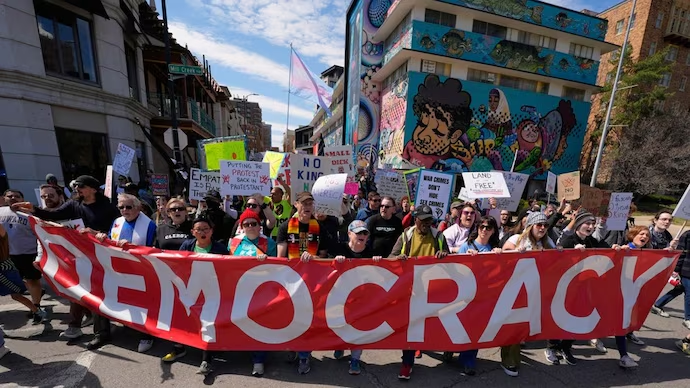
Millions of people poured onto the streets across the United States and parts of Europe on March 28 in sweeping “No Kings” protests targeting President Donald Trump, in one of the largest coordinated waves of dissent in recent years.
The protests — spanning more than 3,100 events across all 50 US states — reflected a broad coalition of grievances, from aggressive immigration enforcement and the war in Iran to concerns over transgender rights and the growing influence of billionaires in public life.

Minnesota emerges as epicenter
The political flashpoint of the day was Minnesota, where thousands gathered at the Capitol in St. Paul for the flagship rally. The event featured a high-profile appearance by Bruce Springsteen, who headlined the programme and delivered a pointed critique of federal immigration actions.
Springsteen performed Streets of Minneapolis, a song written in response to the fatal shootings of two civilians by federal agents, and praised local resistance to immigration crackdowns led by US Immigration and Customs Enforcement (ICE).
“Your strength and your commitment told us that this was still America,” he told the crowd, warning against what he described as a “reactionary nightmare” unfolding in US cities.
Nationwide mobilization, from cities to small towns
Protests stretched from major urban centres like New York City to small towns such as Driggs, Idaho — underscoring the movement’s reach beyond traditional liberal strongholds. Organizers said nearly two-thirds of participants came from outside major cities, including conservative-leaning states.
Attendance estimates suggested a growing movement: earlier rounds of protests drew over 5 million in June and 7 million in October. Organizers projected Saturday’s turnout could touch 9 million, though final figures were yet to be confirmed.
In Washington, D.C., hundreds marched past the Lincoln Memorial to the National Mall, chanting “No kings” and carrying placards reading “Regime change begins at home.” Demonstrations also drew around 40,000 participants in San Diego, according to police.
Mockery, symbolism and dissent
Protests blended political messaging with satire and symbolism. In Topeka, Kansas, demonstrators staged theatrical performances, including impersonations of a “frog king” and caricatures of Trump. Others used humor to critique authority, with activists donning costumes to mock immigration enforcement agencies.
Participants described the protests as both an act of resistance and a show of solidarity. “It’s about taking authoritarianism and making fun of it,” said one protester, highlighting the role of satire in challenging power.
White House, Republicans dismiss protests
The White House brushed aside the demonstrations, with spokesperson Abigail Jackson calling them the work of “leftist funding networks” lacking broad public support. The National Republican Congressional Committee also condemned the rallies, labeling them as platforms for “far-left” rhetoric.
Broad coalition of causes
While immigration enforcement — particularly in Minnesota — remained a central issue, protesters voiced a wide array of concerns. Speakers criticized economic inequality, US foreign policy, and what they described as the erosion of civil liberties.
In New York, civil rights advocates warned against attempts to intimidate dissent. “They want us to be afraid… but they are wrong,” said a speaker from the New York Civil Liberties Union.
Global echoes of protest
The movement extended beyond US borders, with demonstrations held in over a dozen countries. In London, protesters rallied against the war and far-right politics, while in Paris, hundreds — many of them American expatriates — gathered at Bastille Square.
In Rome, thousands marched amid domestic political tensions, directing criticism at Prime Minister Giorgia Meloni and broader global conflicts.
Organizers said the international demonstrations were adapted to local contexts, with some countries branding them as “No Tyrants” protests.
A movement testing its scale
With millions mobilized across continents, organizers framed the protests as a defining moment of public resistance. Whether March 28 turnout meets projections or not, the scale and spread of the demonstrations signal a widening and increasingly organized opposition movement.
“Donald Trump may pretend that he’s not listening,” one labour leader told the Minnesota crowd, “but he cannot ignore the millions in the streets.”




.jpg&w=256&q=75)





.jpg&w=256&q=75)
