


Tehran’s reported willingness to surrender near-weapons-grade uranium could unlock a wider agreement with Washington on ending hostilities, curbing enrichment and releasing frozen assets.
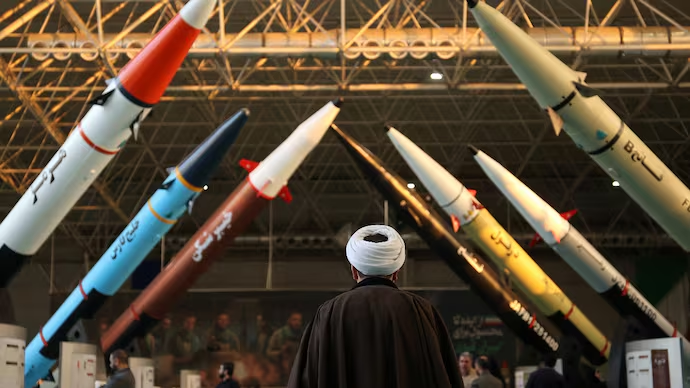
Iran has agreed in principle to give up its stockpile of highly enriched uranium as part of a broader peace deal being negotiated with the United States, marking a potentially major breakthrough in efforts to end the ongoing West Asia conflict.
According to a report by The New York Times, citing two US officials, Tehran has signalled its willingness to relinquish its near-weapons-grade uranium reserves as part of a larger agreement aimed at ending hostilities and reviving stalled nuclear diplomacy.

The development comes after US President Donald Trump said Washington and Tehran were close to finalising a deal that could help de-escalate tensions and reopen the Strait of Hormuz, a critical global oil shipping route. While Trump did not reveal details of the proposed pact, US officials told the newspaper that Iran had broadly agreed to surrender its uranium stockpile.
Officials cautioned, however, that the understanding remains preliminary, with the exact method for disposing of the uranium still unresolved. Future rounds of nuclear talks are expected to determine whether the material will be transferred abroad, diluted, or neutralised through other means.
The reported concession represents a significant shift in negotiations, particularly after Iranian sources recently claimed that Supreme Leader Mojtaba Khamenei had directed that the country’s uranium reserves should not leave Iran.
According to the International Atomic Energy Agency, Iran currently holds nearly 400 kilograms of uranium enriched to 60% purity, a level considered close to weapons-grade. Israeli officials have long argued that the stockpile could be further refined to produce material for multiple nuclear weapons.
The uranium issue had emerged as one of the biggest stumbling blocks in the talks. Iranian negotiators were reportedly seeking to delay any formal commitment on the stockpile until later stages of the negotiations. But US officials said Washington insisted on an upfront commitment, warning that failure to secure one could collapse the talks and trigger renewed military action.
The NYT report also said US military planners recently prepared contingency plans to target Iran’s uranium reserves, much of which is believed to be stored underground at the Isfahan nuclear facility. The site was previously hit by US Tomahawk missile strikes in 2025. Among the options reportedly discussed was the use of bunker-busting bombs to destroy the buried stockpile.
At one point, Trump also reportedly considered authorising a joint US-Israeli commando mission to seize the uranium after Iran regained access to it following earlier strikes. The plan was ultimately shelved because of the operational risks involved.
One proposal being discussed reportedly mirrors the framework of the 2015 nuclear deal negotiated under former US President Barack Obama, under which Iran transferred large portions of its enriched uranium to Russia. Another option would involve reducing the enrichment level to render the material unusable for weapons.
The next phase of negotiations is expected to focus on the future of Iran’s uranium enrichment programme. While the United States is reportedly pushing for a long-term halt to enrichment activities, Iran is said to be seeking a significantly shorter timeline.
The proposed agreement is also expected to include the release of billions of dollars in frozen Iranian assets held overseas. According to the report, much of the money linked to reconstruction aid would only be unlocked after a final nuclear agreement is signed, giving Tehran a strong incentive to stay at the negotiating table.
The wider regional fallout remains significant. Twelve weeks after the US and Israel launched coordinated strikes on Iran on February 28, the consequences continue to reverberate across West Asia. The attacks reportedly killed several senior Iranian figures, including the country’s supreme leader, and derailed US-Iran nuclear negotiations for the second time in less than a year.
Iran responded by targeting Israel and neighbouring countries hosting American military bases, unsettling Gulf states that had long viewed themselves as insulated from the region’s escalating conflicts.

IIIT Ranchi student death: NHRC to examine allegations of administrative negligence and delayed medical aid
.jpg&w=256&q=75)
Karnataka introduces 7.5% sub-quota for rural government school students in professional course admissions

Dubai forum to examine AI agents’ role in journalism and digital publishing

NEET PG Counselling 2026 Round 1 registration begins Oct 12, check schedule and key dates
Groundwater and urban resilience in focus at UAEU’s international conference
IIIT Ranchi student death: NHRC to examine allegations of administrative negligence and delayed medical aid
Karnataka introduces 7.5% sub-quota for rural government school students in professional course admissions
Dubai forum to examine AI agents’ role in journalism and digital publishing
NEET PG Counselling 2026 Round 1 registration begins Oct 12, check schedule and key dates
PM Modi praises NEP impact, Tamil Nadu CM Vijay seeks ₹5,110 crore in dues

IIIT Ranchi student death: NHRC to examine allegations of administrative negligence and delayed medical aid
Karnataka introduces 7.5% sub-quota for rural government school students in professional course admissions
Dubai forum to examine AI agents’ role in journalism and digital publishing
NEET PG Counselling 2026 Round 1 registration begins Oct 12, check schedule and key dates
Groundwater and urban resilience in focus at UAEU’s international conference
IIIT Ranchi student death: NHRC to examine allegations of administrative negligence and delayed medical aid
Karnataka introduces 7.5% sub-quota for rural government school students in professional course admissions
Dubai forum to examine AI agents’ role in journalism and digital publishing
NEET PG Counselling 2026 Round 1 registration begins Oct 12, check schedule and key dates
PM Modi praises NEP impact, Tamil Nadu CM Vijay seeks ₹5,110 crore in dues
Copyright© educationpost.in 2026 All Rights Reserved.