With uncertainty persisting over a trade agreement with the United States, clouding investment sentiment and export prospects, India has sharply accelerated negotiations on a free trade agreement with the European Union, moving close to what could become one of its biggest trade pacts to date.
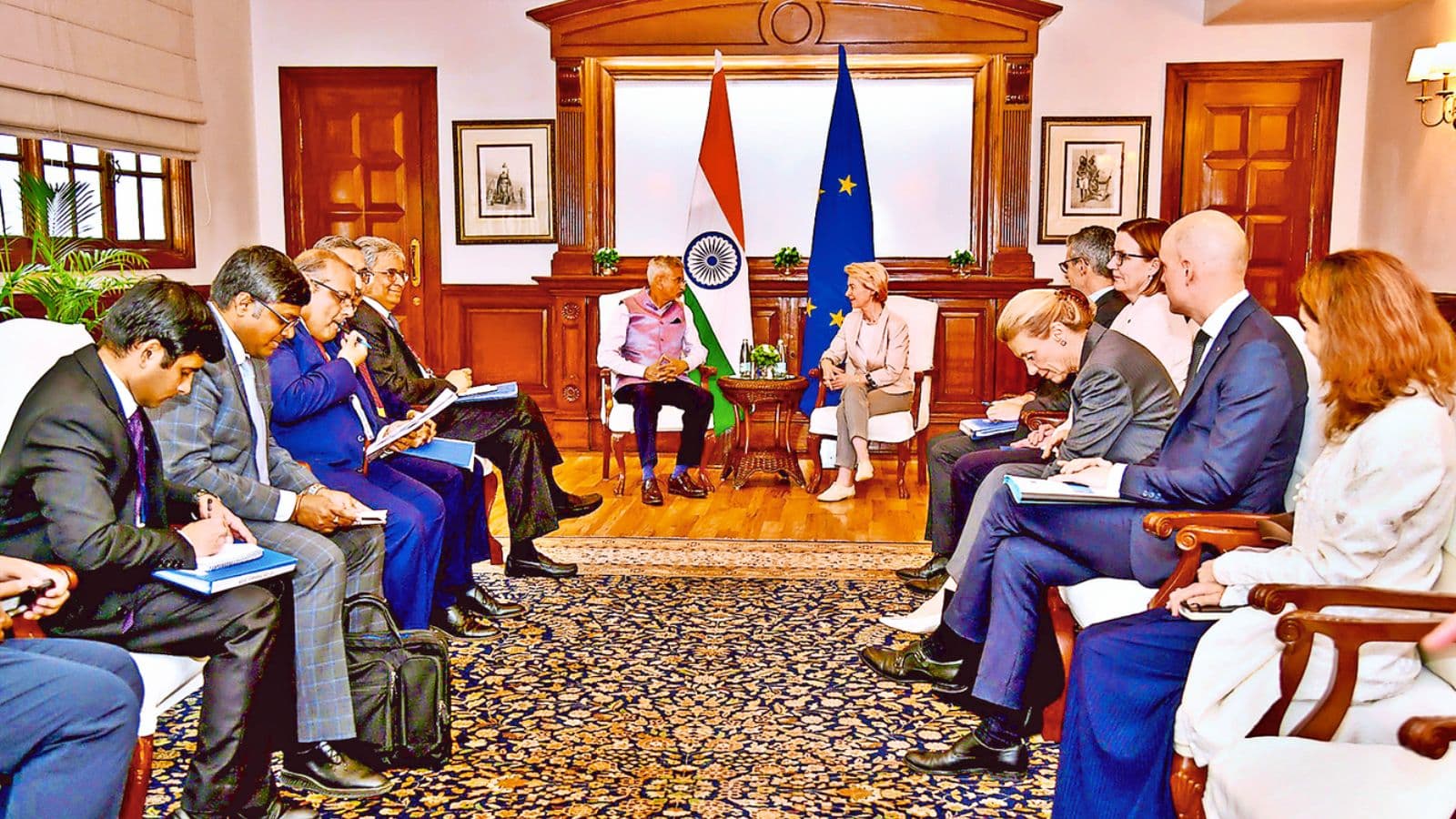
Commerce Secretary Rajesh Agarwal said on January 15 that India and the EU have already concluded talks on 20 of the 24 chapters of the agreement and are pushing to finalize the remaining issues before senior EU leaders visit India later this month.

The President of the European Council, António Luís Santos da Costa, and European Commission President Ursula von der Leyen will be the chief guests at India’s Republic Day celebrations and will also co-chair the 16th India–EU Summit on January 27, the Ministry of External Affairs confirmed.
“We are in the last and most arduous leg of the negotiations,” Agarwal told reporters. “We have closed 20 out of 24 chapters and are engaged almost on a day-to-day basis. We are trying to see if we can meet the timeline before our leaders meet.”
A deal with global impact
The push for speed reflects a shared sense of urgency on both sides. With global trade increasingly shaped by protectionist measures and volatile tariff regimes—particularly in the US—India has stepped up efforts to diversify markets. In 2025 alone, New Delhi has concluded three trade agreements, while the EU recently sealed a long-pending deal with the Mercosur bloc in South America.
Once signed and implemented, the India–EU pact would rank among the largest trade agreements India has ever entered into, potentially offsetting the impact of steep US tariffs and opening fresh avenues for labour-intensive Indian exports into the European market.
Government officials said that sensitive agricultural issues—often the most contentious part of trade talks—are not part of the current negotiations. This aligns with reports from Euractiv, which quoted von der Leyen as telling European parliamentarians in a closed-door meeting that the agreement with India would exclude agriculture.
Agriculture off the table, but hurdles remain
Agriculture has long been a red line for India, especially in talks with Washington, where the US has pushed for access for genetically modified crops such as corn and soya. It is also politically sensitive within the EU, as illustrated by recent protests by French farmers against the EU–Mercosur deal, which they argue threatens domestic agriculture through cheaper imports.
Despite progress, India–EU negotiations have faced friction over issues such as carbon taxation, automobiles and whisky. Germany, the EU’s largest automobile exporter, has sought greater access to India’s market, even as New Delhi seeks to protect its rapidly expanding domestic auto sector—one of the country’s largest employment generators.
The most significant challenge for India remains the EU’s carbon border tax. The bloc began implementing the world’s first such levy on January 1 under the Carbon Border Adjustment Mechanism (CBAM), which imposes carbon-related charges on imports from energy-intensive sectors including steel, aluminium, cement, fertilizers and chemicals.
India’s exports of aluminium, iron and steel to the EU are expected to be particularly affected, and there are concerns that an expanded CBAM could erode gains anticipated from the trade agreement.
Strategic shift amid US uncertainty
The urgency around the EU deal has been sharpened by stalled talks with the US and mounting pressure on Indian exporters. The Commerce and Industry Ministry, industry sources say, has asked trade lawyers working on negotiations to avoid taking leave as deadlines approach.
Commerce and Industry Minister Piyush Goyal has held multiple high-level meetings with EU Trade Commissioner Maroš Šefčovič in recent months, underlining the strategic priority New Delhi is placing on the agreement.
Indian exporters, especially in labour-intensive sectors such as apparel, are already feeling the pinch. Negotiations for summer orders worth an estimated $2 billion have reportedly stalled due to high US tariffs, with buyers increasingly shifting orders to competitors such as Bangladesh, Vietnam and China, which face lower duties.
Industry executives warn that missing the summer buying cycle could have lasting consequences, as once supply chains move, they are difficult to pull back. For India, a timely and comprehensive trade deal with the EU could prove crucial in cushioning exporters against global uncertainty—and in reshaping its trade strategy for the years ahead.