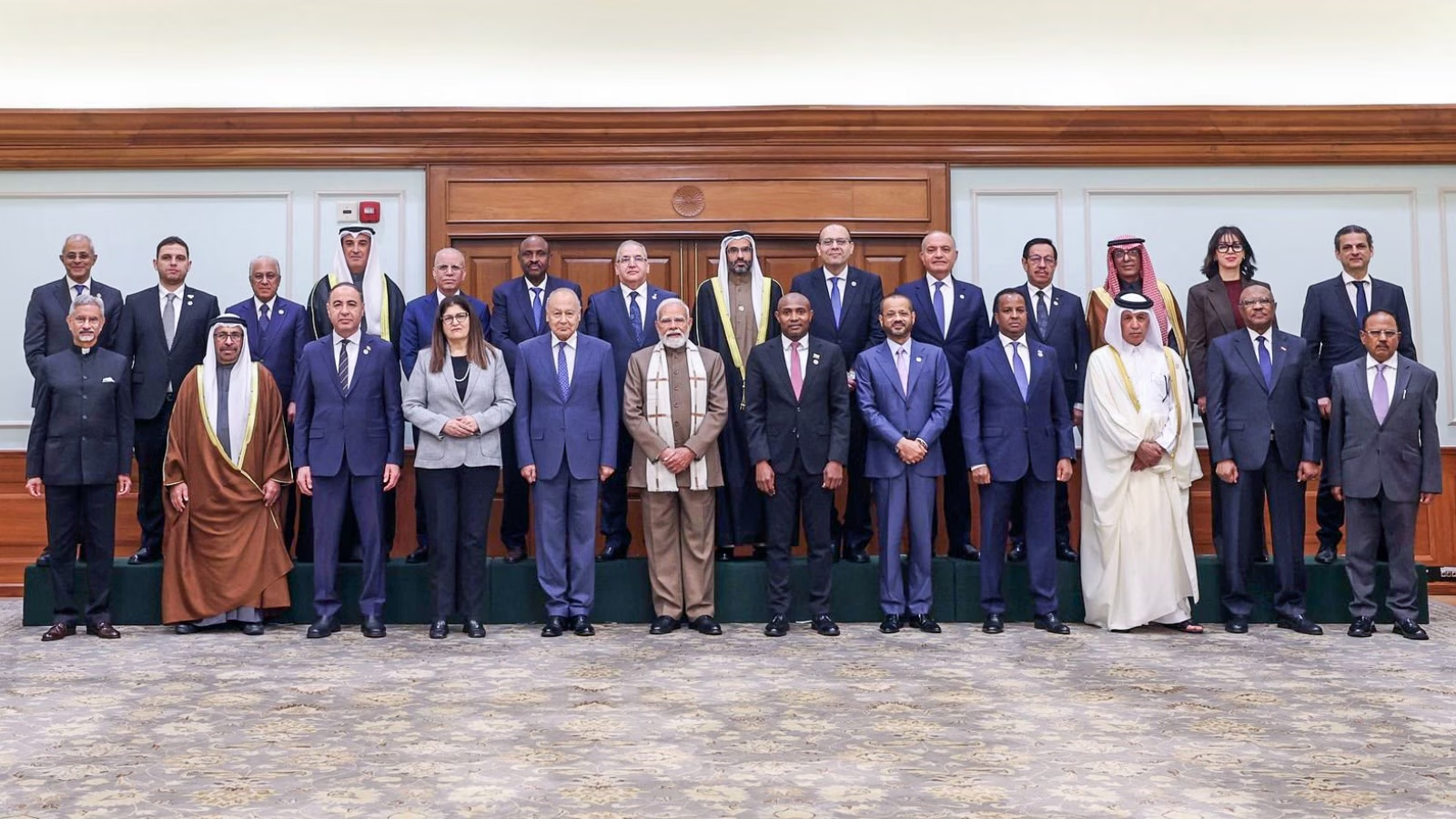
India on January 31 reaffirmed its long-standing support for the people of Palestine and welcomed ongoing efforts to end the war in Gaza, as Prime Minister Narendra Modi met a high-level delegation of Arab leaders in New Delhi amid shifting geopolitical currents in West Asia.
The delegation, in India for the second India–Arab Foreign Ministers’ Meeting (FMM), included foreign ministers, heads of Arab delegations and the Secretary General of the League of Arab States. During the interaction, Modi underlined India’s commitment to peace and stability in the region, while positioning the Arab world as a key pillar of New Delhi’s extended neighbourhood.

“The Arab world is a part of India’s extended neighbourhood, linked by deep civilisational bonds, vibrant people-to-people connections and enduring brotherly ties,” Prime Minister Modi said in a post on X after the meeting, adding that both sides shared a commitment to peace, progress and stability.
He expressed confidence that deeper cooperation in technology, energy, trade and innovation would unlock new opportunities and elevate India–Arab ties to “new heights”.
In a statement, the Prime Minister’s Office said Modi also conveyed his appreciation for the role played by the Arab League in supporting regional peace and stability, a reference seen as particularly significant against the backdrop of ongoing efforts to craft a roadmap for Gaza.
Modi’s remarks assume added importance as India weighs its response to an invitation from US President Donald Trump to join the proposed Gaza Peace Board. While New Delhi has yet to signal its next move, recent engagement underscored India’s calibrated diplomacy in a region marked by conflict and flux.
The Arab leaders are in India for the India–Arab FMM, the highest institutional mechanism guiding the partnership between the two sides. The meeting is being co-chaired by India and the United Arab Emirates.
Addressing the ministerial session, External Affairs Minister S Jaishankar said advancing a comprehensive peace plan to end the Gaza conflict — based on United Nations Security Council Resolution 2803 — was a widely shared priority.
“Various countries have made policy declarations on the peace plan, individually or collectively. This is the larger context in which we deliberate on the region’s challenges and prospects,” Jaishankar said.
Pointing to the rapid churn in West Asia over recent years, Jaishankar said multiple developments of far-reaching consequence had not only reshaped the region but also reverberated globally. In that context, he stressed the need to strengthen forces of stability, peace and prosperity based on shared interests.
Jaishankar also struck a hard note on terrorism, calling for concerted global action and reiterating India’s zero-tolerance stance. “A common threat in both our regions to these objectives is that of terrorism in all its forms and manifestations,” he said.
“Cross-border terrorism is particularly unacceptable because it violates the basic principles of international relations and diplomacy,” Jaishankar added, in remarks widely seen as directed at Pakistan.
He asserted that societies targeted by terrorism had the right to defend themselves. “Zero-tolerance for terrorism must be an uncompromising universal norm,” he said.
Highlighting the depth of India’s engagement with the Arab world, Jaishankar noted that India enjoys strong partnerships with all members of the Arab League. The region hosts some of India’s largest expatriate communities, supplies critical energy resources, and is a major trading partner with growing collaboration in technology and connectivity.
“We are crucial to each other when it comes to food security and health security,” he said, adding that the collective deliberations at the FMM would also give a boost to several bilateral relationships.
Jaishankar said India’s expanding technological capacities — developed with a people-centric focus — could offer valuable lessons and best practices for Arab partners, creating mutual gains.
Situating the dialogue within a broader global shift, Jaishankar said the meeting was taking place at a time when the international order was undergoing a profound transformation. “Politics, economics, technology and demography are all fully into play,” he said, noting that the changes were most visible in West Asia, where the strategic landscape had altered dramatically over the past year.
“These developments impact all of us, and India as a proximate region,” he said, adding that they would inevitably shape India’s future engagement with Arab nations.
According to the Ministry of External Affairs, the India–Arab FMM was formalized in March 2002, with India holding Observer status in the League of Arab States, a pan-Arab body comprising 22 member countries.
The first such meeting hosted by India saw participation from all 22 Arab nations. Foreign ministers from Oman, Palestine, Sudan, Comoros, Somalia and Libya attended, while Egypt, Yemen, Saudi Arabia and Qatar were represented by deputy ministers. Other members, including Algeria, Jordan, Kuwait, Bahrain, Lebanon, Syria, Mauritania and Iraq, sent senior diplomats and officials.