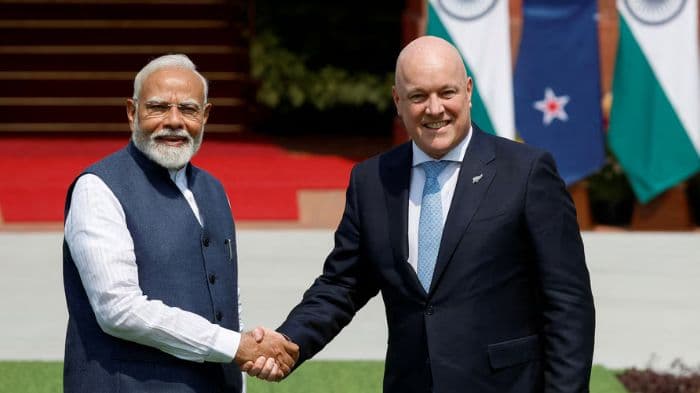
A question posed by a New Zealand journalist during Prime Minister Narendra Modi's visit to the country has once again brought attention to a recurring issue that has followed him on recent overseas tours — his decision not to hold open press conferences.
The latest exchange took place in Auckland on July 10, where a local journalist asked India's Secretary (East) in the Ministry of External Affairs (MEA), Rudrendra Tandon, why the Prime Minister does not hold press conferences.

Responding to the question, Tandon said it would not be appropriate for him, as a civil servant, to comment on the Prime Minister's communication style. He added, however, that Modi believes in maintaining direct contact with people rather than communicating through intermediaries.
The question marked the third such instance in less than two months where journalists in host countries publicly raised the issue during Modi's foreign visits.
The first came during the Prime Minister's visit to Norway in May. After Modi and Norwegian Prime Minister Jonas Gahr Støre delivered their joint statements without taking questions, a Norwegian journalist called out as the leaders were leaving, asking why the Indian Prime Minister would not "take some questions from the freest press in the world".
The moment drew international attention and sparked debate over media access during official visits.
The issue resurfaced during Modi's Australia visit earlier this month. At a media interaction in Melbourne, an Australian journalist remarked that the Prime Minister "famously avoids news conferences" while seeking an opportunity to ask a question, once again drawing attention to the absence of an open media interaction.
Days later, the same subject came up in New Zealand, where Tandon was asked to explain the Prime Minister's approach. While declining to offer a personal opinion, the senior diplomat said Modi's preference has been to communicate directly with citizens.
Prime Minister Modi has rarely addressed unscripted questions in an open press conference since assuming office in 2014. During bilateral visits, official engagements generally include joint statements, ceremonial events and meetings with business leaders and the Indian diaspora, while media interactions are usually handled by government officials or conducted through written statements.
The recent questions from journalists did not overshadow the substantive outcomes of the Prime Minister's three-nation tour. During visits to Indonesia, Australia and New Zealand, India signed agreements across sectors including defence, critical technologies, energy security, education, supply chains and digital cooperation, while also reviewing regional and global strategic issues with partner countries.
However, the repeated questions in Norway, Australia and New Zealand indicate that the Prime Minister's media engagement practices have increasingly become a subject of interest during his overseas visits, alongside discussions on diplomacy and bilateral cooperation.