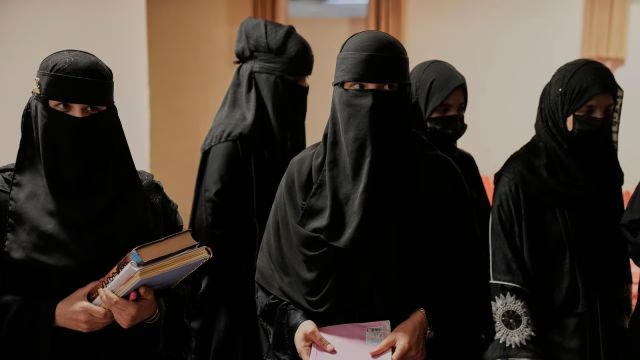
When the Taliban banned education for women beyond primary school, Sodaba’s world collapsed. A pharmacology student with big dreams and nowhere to go, she watched as parks, restaurants, workplaces — and finally classrooms — were stripped from Afghan women’s lives.
But amid the silence of closed schools and shuttered campuses, a new kind of classroom emerged—one without walls, borders, or the Taliban’s reach.

Desperate to keep learning, Sodaba went online. There, she discovered a lifeline: a free computer programming course taught in Dari, her native language, by a fellow Afghan who had once been a refugee himself.
“I believe a person should not bow to circumstance,” the 24-year-old said, asking to be identified only by her first name for safety. “These new skills gave me back my confidence—and my direction.”
Her virtual teacher, Murtaza Jafari, now 25, fled Afghanistan as a teenager, arriving alone in Greece after a perilous sea journey from Turkiye. He barely spoke English or Greek, had never touched a computer, and didn’t know what coding was. But inside a shelter in Athens, with help from a local teacher, he began to learn.
“I had no idea — zero zero,” Jafari recalls. But within months, he earned a programming certificate. Years later, he launched Afghan Geeks, a company that now teaches Afghan women coding, website development, and chatbot design—skills that could one day help them work from home in a country where nearly all professions are now closed to them.
A new digital frontier for women
Since December, Afghan Geeks has enrolled 28 female students in beginner to advanced coding courses. Jafari mentors many of them personally, helping them secure online internships and freelance gigs, and even hiring top performers to join his team.
“I’ve never seen their faces,” he says. “I never ask for cameras. I respect their safety and their culture. What matters is that they learn, and grow.”
For clients in the US, U.K., Europe, and Afghanistan, hiring Afghan Geeks is more than business—it’s solidarity. “They keep coming back,” Jafari said, “because they believe in our mission: to empower women.”
From five volunteers to 4,000 students
The digital defiance doesn’t stop there. In another corner of Afghanistan’s virtual underground, Zuhal, a 20-year-old student who goes by a pseudonym for security reasons, co-founded Vision Online University—a grassroots digital academy offering free courses to women across the country.
What began with five volunteers has exploded into a movement: more than 150 educators and administrators now teach over 4,000 women, despite having no salaries and no external funding.
“We have no support,” Zuhal said. “But we have a mission: free education for girls, and a future for Afghanistan.”
Vision Online University runs classes in psychology, Quranic studies, foreign languages, nursing, public speaking and more. Zuhal herself, still reeling from the pain of being barred from formal education, is now pursuing a computer science degree through an American online university — while keeping the academy alive with donated time and shaky internet.
“When the ban came, I was depressed,” she said. “But I knew I couldn’t give up. If I stop now, thousands of girls will lose hope again.”
Hope, coded into every line
With the Taliban’s grip tightening—banning women not just from schools but even from public speech and visibility — Afghan women are building an alternate future online. From secret coding bootcamps to underground digital universities, they are writing new scripts of resistance, one class, one student, one keystroke at a time.
It’s not just about education anymore. It’s about survival, dignity, and reclaiming a voice in a world that tried to erase them.
“Sharing knowledge,” Jafari says, “is how we make a real difference. That’s what keeps us going.”