


As BJP expands eastward and returns in Assam, Kerala swings back to the UDF while Tamil Nadu throws up a disruption, marking a decisive shift in political power across key states.
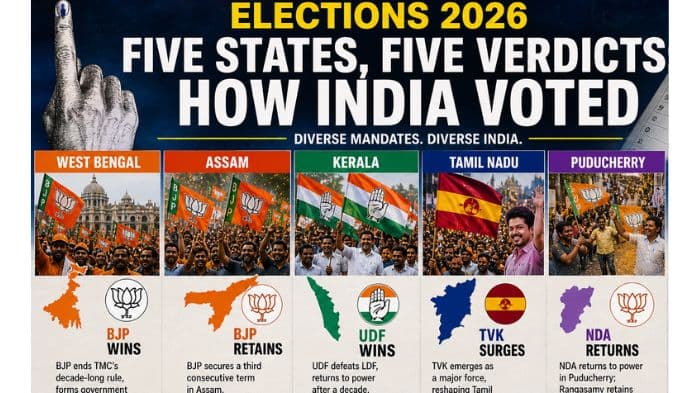
The results of the 2026 Assembly elections across five states and one Union Territory have delivered a varied political outcome, underscoring how electoral preferences continue to differ widely across India.
Counting of votes, conducted under the supervision of the Election Commission of India, concluded on May 4, with clear victories emerging in each state, though not along a single national pattern.

BJP expands in the East, retains Assam
The Bharatiya Janata Party (BJP) has registered a significant breakthrough in eastern India, securing a decisive victory in West Bengal and forming the government in the state for the first time. The result marks the end of over a decade of rule by the Trinamool Congress and represents a major expansion of the BJP’s footprint in the region.
In Assam, the BJP has retained power, securing another term and reinforcing its position in the Northeast. The outcome highlights the party’s continued strength in the state, where it has maintained organisational depth and voter support over successive elections.
Together, these results indicate consolidation for the BJP in eastern and northeastern India.
Kerala returns to UDF
In Kerala, the Congress-led United Democratic Front (UDF) has secured a clear victory, defeating the incumbent Left Democratic Front (LDF). The result reflects the state’s long-standing pattern of alternating governments between the two alliances.
The scale of the UDF’s win suggests a decisive mandate, with voters opting for a change after a decade of Left rule. The outcome also carries wider significance, as it marks a shift in one of the key states where the Left had maintained political relevance.
.png)
Tamil Nadu sees disruption in established order
Tamil Nadu has delivered one of the most closely watched outcomes of this election cycle. The entry and performance of newer political forces have altered the traditional contest between established Dravidian parties.
Early trends and results indicate that the state’s political landscape is undergoing change, with established voting patterns facing disruption. The outcome suggests a shift in voter behaviour, though the long-term implications will become clearer over time.
Continuity in Puducherry
In the Union Territory of Puducherry, the National Democratic Alliance (NDA) has returned to power, indicating continuity in governance. The result contrasts with the more dramatic shifts seen in larger states, reflecting a more stable political preference among voters in the region.

Why Were the Meeting Records Made Public?
Significance of the Fifth Plenum

Major Security Breaches and the Role of Artificial Intelligence

Legal Provisions and Guardian Liability

The Role of Satellite Networks in Ukraine’s War

Will AI Become Compulsory in Indian Schools? What NCERT’s New Curriculum Means

McMaster University researcher wins $250,000 fellowship to advance bone implant research

Vande Bharat Sleeper Train: Varanasi–New Delhi Route Approved, Check Route, Timings and Stops

DA Hike 2026: Centre Approves 3% Increase, Allowance Rises to 63%

Haryana Listed 500 CHEERAG Seats at School After Recognition Withdrawal, Records Show

Why Were the Meeting Records Made Public?
Significance of the Fifth Plenum
Major Security Breaches and the Role of Artificial Intelligence
Legal Provisions and Guardian Liability
The Role of Satellite Networks in Ukraine’s War
Will AI Become Compulsory in Indian Schools? What NCERT’s New Curriculum Means
McMaster University researcher wins $250,000 fellowship to advance bone implant research
Vande Bharat Sleeper Train: Varanasi–New Delhi Route Approved, Check Route, Timings and Stops
DA Hike 2026: Centre Approves 3% Increase, Allowance Rises to 63%
Haryana Listed 500 CHEERAG Seats at School After Recognition Withdrawal, Records Show
Copyright© educationpost.in 2026 All Rights Reserved.