


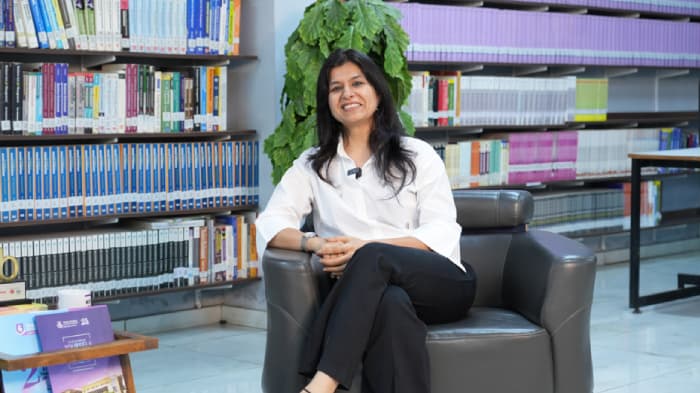
As India pushes towards becoming a Viksit Bharat powered by startups, innovation, and demographic advantage, perhaps one entrepreneurial skill deserves far greater attention than it currently receives, which is observation, writes Bindiya Dua.
A few evenings ago, after a long workday and nearly an hour in traffic, I took my children to a book fair. Like most children, they were excitedly discussing books in the car, calculating how many they could buy within a budget, and imagining what they would read first. The excitement was not merely about purchasing books, but about exploring something new.
Later that night, exhausted and too tired to cook, we stopped at a crowded fast-food outlet for dinner. Families occupied almost every table. Children scanned menus, parents waited for orders, and conversations blended into the familiar noise of urban life.

And then one small moment stayed with me.
At a nearby table sat a child, probably six or seven years old, completely immersed in a cartoon playing on a mobile phone. What struck me was not the screen itself, but the child’s visible disconnect from the environment despite being physically present within it.
Almost instinctively, while passing by, I softly remarked, “You could have watched this at home too. Since you are here, observe what is around you.”
That moment brought me back to one powerful word: observation.
Today, entrepreneurship is often associated with funding, coding, incubation centres, business models, and startup ecosystems. But long before any of these come into the picture, entrepreneurship begins with the ability to notice what others ignore.
The founder of Naukri.com once shared how the idea for the platform emerged from a simple observation. During the magazine era, many readers would flip magazines from the back because job advertisements were printed there. That behaviour revealed something deeper: people were not searching for entertainment first; what mattered most to them at that stage of life was employment opportunity. Recognizing that human priority made a dedicated job portal logical.
The same behavioural pattern later evolved into platforms like Shaadi.com, which digitized another section people repeatedly searched for in newspapers — matrimonial listings.
Such businesses did not emerge merely from technology. They emerged from carefully observing human behaviour.
This is perhaps where an important societal shift deserves reflection. Children today are growing up in environments where every silent moment is instantly filled by screens, notifications, reels, or structured entertainment. While technology itself is not the problem, constant stimulation often leaves little room for quiet observation.
Yet observation is how individuals gradually develop curiosity, empathy, social understanding, and the ability to identify meaningful problems. Ironically, these are the very qualities we later expect from entrepreneurs and innovators.
Many startup failures occur because problems are identified inside comfortable rooms instead of through lived human experiences. Real-world problems are discovered in queues, during travel, inside markets, through conversations, and while observing how people behave, struggle, decide, and adapt. One cannot build meaningful solutions for society without first understanding society itself.
And this is where the discussion becomes larger than entrepreneurship alone.
India today proudly speaks about startup culture, innovation, demographic dividend, and becoming a global innovation-driven economy. But demographic advantage is not built merely by having a younger population. It is built by nurturing young minds capable of understanding people, noticing patterns, and identifying problems worth solving.
Perhaps this process begins much earlier than business schools and startup incubators — at home, during childhood itself.
Maybe quality exposure for children is not always about expensive experiences or constant digital engagement. Sometimes, it is much simpler: conversations, meeting relatives, observing public spaces, listening to people, travelling without distraction, asking questions, and remaining mentally present in real environments.
Because before an individual becomes an entrepreneur, the person must first become an observer.
And perhaps, in the race to build the next startup ecosystem, observation is one foundational skill we should not allow to disappear.
(This article is written by Bindiya Dua, Asst. Prof. At Narayana Business School, Ahmedabad. This is an opinionated article; EPN has nothing to do with this editorial.)

Housing costs, education and austerity fuel protests across Europe

Hundreds of websites go offline as critical PHP flaws trigger global cyber alert

Anti-Putin cyberattack disrupts nationwide school assessments in Russia

SRH University begins 2026–27 winter semester with Indian students across German campuses

Ghana and Germany discuss closer cooperation in technical education

Delhi Police may seek further custody of CJP leaders Saurav Das, Ashutosh Ranka

SBI probes data leak after personal details in 3,897 customer records surface on dark web
Sharjah schools set boundaries for AI use in homework and exams

Former MIT scientist wins $6 million defamation verdict in misconduct dispute

McMahon highlights Trump’s push to return education powers to states

Housing costs, education and austerity fuel protests across Europe
Hundreds of websites go offline as critical PHP flaws trigger global cyber alert
Anti-Putin cyberattack disrupts nationwide school assessments in Russia
SRH University begins 2026–27 winter semester with Indian students across German campuses
Ghana and Germany discuss closer cooperation in technical education
Delhi Police may seek further custody of CJP leaders Saurav Das, Ashutosh Ranka
SBI probes data leak after personal details in 3,897 customer records surface on dark web
Sharjah schools set boundaries for AI use in homework and exams
Former MIT scientist wins $6 million defamation verdict in misconduct dispute
McMahon highlights Trump’s push to return education powers to states
Copyright© educationpost.in 2026 All Rights Reserved.