


A policy monograph on preventing cadre capture, political extortion, and the repetition of bengal’s failed transition cycles, writes Ryan Baidya
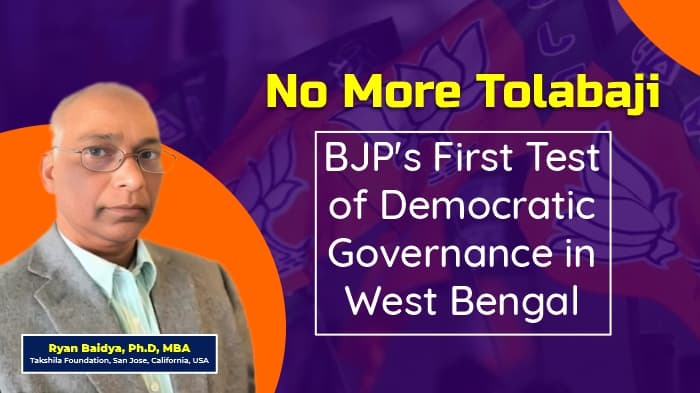
West Bengal’s transition from TMC to BJP administration, if it is to become a true democratic renewal, must go beyond electoral victory. A change of party does not automatically mean a change of political culture. The deeper test is whether the new administration can prevent the old habits of tolabaji, dadabaji, protection money, syndicate pressure, cadre interference, and political intimidation from reappearing under a new political color.
Bengal has seen this pattern before. Many citizens voted against the CPM/Left Front expecting relief, only to later experience a new cadre-centered political culture under TMC. The danger now is that some local power-brokers, contractors, political handlers, and opportunistic cadres may change their party identity before or after the election while continuing the same conduct.
There are already allegations of extortion and tolabaji by BJP-associated cadres in industrial areas of West Bengal, and possibly elsewhere. Whether such reports are isolated, exaggerated, politically motivated, or widespread, BJP cannot afford to ignore them. In a state with Bengal’s recent political memory, even a few incidents can revive public fear and damage trust.
This monograph argues that BJP must immediately create a citizen-centered, legally accountable, multi-layered anti-extortion framework. This must include internal vigilance, anonymous citizen reporting, protection for complainants, verification mechanisms, industrial-area monitoring, police accountability, and strict party discipline. The purpose is not revenge. The purpose is to prevent the new administration from becoming a new version of the system citizens rejected.
A fair and clean election can remove a party from office, but it cannot automatically remove the habits, networks, and incentives that grew under that party. Political culture survives elections unless it is deliberately dismantled.
The central question in West Bengal is therefore not merely whether citizens voted for BJP or against TMC. Many may have voted against the excesses of TMC rather than for a fully formed BJP governance model. The real question is whether BJP understands the responsibility that comes with such a conditional mandate.
If citizens voted to escape corruption, intimidation, local extortion, cut-money, syndicate pressure, and party-worker arrogance, then BJP must not interpret the result as a license for its own cadres. It must treat the mandate as a warning: Bengal wants relief from political domination, not a new owner of the same machinery.
Tolabaji is not merely petty corruption. It is a system of political extraction. It can include forced payments, protection money, illegal commissions, cut-money, forced subcontracting, intimidation of business owners, political gatekeeping, interference in contracts, and pressure on citizens through local party networks.
Its companion culture, dadabaji, converts local political identity into social domination. A party worker becomes a broker, enforcer, collector, negotiator, and unofficial authority. The citizen learns that legal rights are not enough; one must also manage the local political handler.
This damages democracy in several ways:
In industrial regions, the damage is even greater. Factories, transporters, traders, contractors, and small manufacturers become vulnerable to unofficial collections. This raises business costs, discourages expansion, and signals to investors that West Bengal remains politically unsafe for enterprise.
West Bengal has already experienced one major transition in which public anger against a cadre-driven political order helped bring another party to power. Many citizens hoped that the end of the CPM/Left era would bring political freedom, administrative fairness, and dignity. Yet over time, many people came to believe that the earlier structure had been replaced by another network of local political control.
This is the central lesson for BJP: citizens can remove a party, but unless the system is corrected, the habits of coercion may survive.
Many local operatives are not ideological workers. They are power-seekers. Before an election, after an election, or during a transition, they may change political color. But changing political color does not change political appetite. A person who practiced tolabaji under one flag may continue under another if the new party gives shelter.
Therefore, BJP must be alert not only to defeated opponents, but also to opportunists who join the winning side. These color-changing cadres are especially dangerous because they bring old methods into the new administration.
BJP should not assume that electoral victory means democratic understanding. Winning an election gives a party the authority to administer, but it does not automatically make its cadres democratic in conduct, temperament, or ethics.
Democracy is not merely the counting of votes. It is a system of citizen sovereignty, limited power, lawful administration, public accountability, and respect for dissent. A party may win a fair election and still behave undemocratically if its workers treat citizens as subjects, public offices as party assets, and police stations as instruments of political control.
A democratic administration must understand the following principles:
This is especially important in West Bengal because decades of cadre politics have weakened the civic meaning of democracy. Many party workers, across parties, have learned politics as access, pressure, collection, recommendation, intimidation, and control. They may understand electoral mobilization, but not democratic governance.
Therefore, BJP must train, discipline, and monitor its own cadres from the beginning. Without such internal correction, the party may win the state but fail democracy.
The return of tolabaji under a new political banner would create several immediate risks.
Citizens may quickly conclude that nothing has changed. If they see the same local intimidation, the same demand for payments, the same interference in police complaints, and the same arrogance by party workers, the moral legitimacy of the new administration will decline.
Industrial units and small businesses are highly sensitive to local coercion. If entrepreneurs must pay unofficial money to transport goods, secure permissions, avoid harassment, or continue operations, West Bengal’s industrial revival will be weakened before it begins.
If local party workers influence police stations, citizens will lose faith in law. Police must serve the law, not party instruction. A politicized police station becomes the first point of democratic failure.
Officials may be pressured by local cadres, MLAs, contractors, or party-linked middlemen. Bureaucrats must be protected from political extortion so they can administer lawfully.
The coming Lok Sabha election will be influenced not only by speeches but by early public experience. If citizens begin hearing that BJP cadres are behaving like TMC cadres, disappointment will spread quickly. Opposition parties will not need to create the narrative; BJP’s own undisciplined cadres will create it.
BJP must stop this culture at its germination stage. The response must be institutional, not merely rhetorical.
The Chief Minister, state BJP president, and district leadership should jointly declare that no party worker, newly joined cadre, contractor, union handler, or local strongman is authorized to collect money, interfere in administration, pressure businesses, influence police complaints, or act as an unofficial gatekeeper.
The government should create a state-level anti-extortion portal and helpline. Citizens, businesses, transporters, contractors, and industrial units should be able to report:
Every complaint should receive a tracking number. Anonymous complaints may be accepted, but administrative or legal action should require verification.
The portal must also contain a transparent public dashboard. Citizens should be able to see redacted complaint data, including anonymous complaints, without exposing the identity of complainants or prejudging the accused. The dashboard should show the nature of the allegation, broad location, date of complaint, department assigned, current status, steps taken, and final outcome.
Such transparency will allow citizens to follow the administration’s response in near real time. It will also act as a strong deterrent against mushrooming corruption, because local extortion networks will know that complaints cannot be easily buried, hidden, or politically suppressed. At the same time, safeguards must be built in to prevent false complaints, personal vendetta, or political misuse.
BJP must also create internal vigilance. This is necessary because misconduct by party-associated workers can destroy both governance and political trust.
The party should maintain confidential local-level observers who report misuse of the BJP name. However, this must not become a reckless spy network. It must be disciplined, documented, and reviewed.
Any informer system can be misused. Therefore, there must be a second layer of verification. Reports from local informers should be cross-checked by independent observers, administrative sources, business feedback, and district-level review.
This “informer of informer” principle is important because false allegations can be used for factional politics, revenge, business rivalry, or personal vendetta.
Industrial belts need special monitoring. Each major industrial region should have a direct anti-extortion cell connected to the district administration and a state-level industrial protection authority.
Business associations should be encouraged to submit monthly confidential reports on local political pressure, illegal collections, transport obstruction, labor intimidation, and contractor coercion.
Police stations must be monitored for political capture. If citizens repeatedly report that a police station refuses complaints against party-linked persons, the officers concerned should be reviewed, rotated, or investigated.
A POP-like Police-of-Police mechanism should be considered for politically sensitive complaints, where police misconduct or political misuse is investigated outside the local chain of pressure.
BJP must act against its own people first if credible allegations arise. Internal suspension should be swift where misuse of party identity is credible. Legal action should follow where evidence supports criminal wrongdoing.
The public message must be clear: joining BJP is not protection from law.
A strong anti-extortion system must also protect against misuse. Otherwise, it can become another weapon of political control.
The following safeguards are necessary:
The purpose is lawful accountability, not political revenge.
BJP should treat cadre training as a governance priority. Workers must be taught that political victory does not make them local authorities. They are not collectors, brokers, enforcers, or unofficial officers.
Training should include:
A party that does not train its workers after victory risks being captured by its worst elements.
West Bengal does not need another party-centered society. It needs citizen-centered democratic administration.
BJP’s victory, if it is to become historically meaningful, must not simply replace TMC’s political machinery with BJP’s political machinery. It must dismantle the culture of local extraction. The test is not how strongly BJP speaks against TMC corruption. The test is how firmly it acts against corruption by its own people.
The message must be direct:
If BJP fails at this early stage, Bengal may repeat the tragic cycle from CPM to TMC: citizens vote for relief, but receive a new structure of coercion. If BJP succeeds, West Bengal can begin a new chapter in which government administers, police protect, industry grows, and citizens finally feel that democracy belongs to them.
(This article is written by Ryan Baidya, Ph.D., MBA, Takshila Foundation, San Jose, California, USA. This is an opinionated article; EPN has nothing to do with this editorial.)

Housing costs, education and austerity fuel protests across Europe

Hundreds of websites go offline as critical PHP flaws trigger global cyber alert

Anti-Putin cyberattack disrupts nationwide school assessments in Russia

SRH University begins 2026–27 winter semester with Indian students across German campuses

Ghana and Germany discuss closer cooperation in technical education

Delhi Police may seek further custody of CJP leaders Saurav Das, Ashutosh Ranka

SBI probes data leak after personal details in 3,897 customer records surface on dark web

Sharjah schools set boundaries for AI use in homework and exams

Former MIT scientist wins $6 million defamation verdict in misconduct dispute

McMahon highlights Trump’s push to return education powers to states

Housing costs, education and austerity fuel protests across Europe
Hundreds of websites go offline as critical PHP flaws trigger global cyber alert
Anti-Putin cyberattack disrupts nationwide school assessments in Russia
SRH University begins 2026–27 winter semester with Indian students across German campuses
Ghana and Germany discuss closer cooperation in technical education
Delhi Police may seek further custody of CJP leaders Saurav Das, Ashutosh Ranka
SBI probes data leak after personal details in 3,897 customer records surface on dark web
Sharjah schools set boundaries for AI use in homework and exams
Former MIT scientist wins $6 million defamation verdict in misconduct dispute
McMahon highlights Trump’s push to return education powers to states
Copyright© educationpost.in 2026 All Rights Reserved.
