


Business schools must rethink their purpose by prioritizing depth, independent thinking, and real value creation over imitation, noise, and box-ticking to remain relevant in a rapidly changing world.
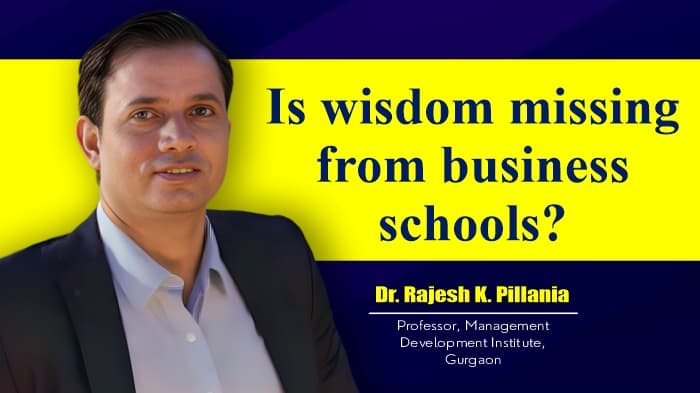
For some time now, business schools and business education have been subject to difficult questions by various stakeholders around the world on the real value that these schools are adding to the students, industry, and other stakeholders. It is high time that business schools ask themselves some tough questions and make sure that they are creating value as well as being perceived as value creators.
For the creation of value for students, industry, and various other stakeholders, it is important that business schools and business education apply a lot of wisdom. Are business schools making some not-so-good decisions and actions which might not help them in the long run ? Is wisdom missing from business schools?

Here are five questions which every Business School should introspect :
First, is the focus of the business school on copying from other business schools, in the name of benchmarking ? Are the programmes different across different business schools ? Our Business School, following the practice of differentiation, has been teaching at business schools.
Second, is there a lack of depth in general, and in teaching in particular, in the business schools? Are the pass-out students able to go into deep, different concepts and apply them, and able to create value?
Third, is there an application of free mind and practice of independent thinking and the rule of logic in business schools?
Fourth, is there a focus on what really matters, or has noise overtaken business schools?
Fifth, is there a focus on creating some real value or just taking the right boxes for the sake of it in Business Schools?
These are some basic, fundamental, and hard-hitting questions which business schools need to take seriously for serious introspection for the business of business schools. There are many more such questions arising from the increasing scrutiny of business schools and the value addition by them. To the above questions, if the answers are negative, then there is a need for doing a course correction.
The fundamental purpose of raising these questions is to promote a serious discussion among various members of business schools. The business-as-usual at business school is not going to work for long. Business schools need to get their act together to make sure they are adding real value and are also perceived the same by various stakeholders. The concept of business school, when it was started, was great both in letter and spirit, but it requires serious rethinking to stay relevant in the changing and demanding times.
This needs to be a regular annual exercise to make sure the business schools stay on the right course to stay relevant to various stakeholders and create real value and impact.
(This article is written by Dr. Rajesh K. Pillania, Professor, Management Development Institute, Gurgaon. This is an opinionated article; EPN has nothing to do with this editorial.)

Rekha Sharma’s 40% Disability Certificate Disputed After Medical Board Reassessed It at 30%

Arctic Seals Face Rising Extinction Risk as Climate Change Accelerates Sea Ice Loss

India's Multi-Alignment Policy Faces Fresh Diplomatic Challenges

AI Model Can Identify Zero-Day Vulnerabilities in Critical Software

Patent Rejection Opens Possibilities for Generic Competition

Canada shifts focus to research talent as New Zealand targets growth in international education

Delhi to Attempt Artificial Rain Again as Pollution Chokes Capital; New Aircraft to Be Deployed

Want to speak Japanese with anime characters? Japan is developing an AI-powered language education app

Why are 3 in 4 Singapore parents turning to private tuition despite trust in schools?

Delhi-NCR schools go hybrid: Which classes are affected and what parents should know?

Rekha Sharma’s 40% Disability Certificate Disputed After Medical Board Reassessed It at 30%
Arctic Seals Face Rising Extinction Risk as Climate Change Accelerates Sea Ice Loss
India's Multi-Alignment Policy Faces Fresh Diplomatic Challenges
AI Model Can Identify Zero-Day Vulnerabilities in Critical Software
Patent Rejection Opens Possibilities for Generic Competition
Canada shifts focus to research talent as New Zealand targets growth in international education
Delhi to Attempt Artificial Rain Again as Pollution Chokes Capital; New Aircraft to Be Deployed
Want to speak Japanese with anime characters? Japan is developing an AI-powered language education app
Why are 3 in 4 Singapore parents turning to private tuition despite trust in schools?
Delhi-NCR schools go hybrid: Which classes are affected and what parents should know?
Copyright© educationpost.in 2026 All Rights Reserved.