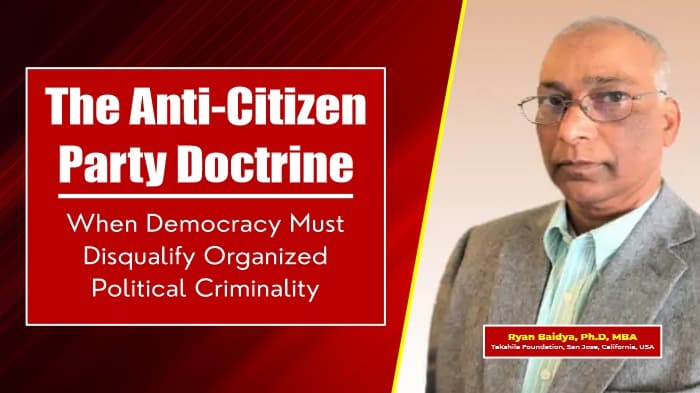
This article advocates for the Anti-Citizen Party Doctrine, a legal framework designed to disqualify political parties that systematically betray the public trust. The author argues that electoral participation is a privilege that should be revoked if an organization utilizes its power to facilitate corruption, violence, or institutional criminality. Using the Trinamool Congress (TMC) in West Bengal as a primary case study, the article details numerous allegations of extortion, physical abuse, and misuse of state resources by party-linked figures. The article suggests that when misconduct becomes structural rather than incidental, individual prosecution is insufficient to protect the democratic process. To preserve the integrity of the state, the author proposes a graduated system of penalties overseen by an independent judiciary to ensure parties remain accountable to the citizens they serve. Under this doctrine, any party proven to be structurally anti-citizen would face suspension or a complete ban from future elections.
The Case for an Anti-Citizen Party Doctrine
A democracy exists for citizens, not for political parties. Political parties are only vehicles through which citizens temporarily delegate public power. They are not owners of the state. They are not masters of the people. They are not entitled to administer forever. They are not above law, morality, or constitutional order.

Therefore, when a political party receives power from citizens but then uses that power to loot public resources, intimidate voters, protect criminals, suppress justice, permit rape and killing, and convert state machinery into a party-controlled network, that party should lose the privilege of participating in the electoral process.
This view is not anti-democratic. It is democracy defending itself.
The principle is simple:
A political party that becomes structurally anti-citizen should not be allowed to ask citizens for another mandate.
In Democracy, Parties Do Not Rule; They Administer
In a monarchy, rulers rule. In a dictatorship, rulers command. In a democracy, elected officials administer. They are not rulers; they are temporary public managers, trustees, and servants of the citizens. The treasury, police, courts, welfare systems, schools, hospitals, and administrative offices do not belong to the party in government. They belong to the citizens.
Therefore, when a political party receives the people’s mandate, it receives not the right to rule, but the duty to administer honestly, protect citizens, preserve justice, and return power peacefully when the mandate ends.
Electoral Participation Is a Privilege, Not a License
In ordinary democratic debate, parties should be free to criticize, oppose, mobilize, campaign, and present alternative visions. No party should be banned merely because it is unpopular, ideological, regional, religious, nationalist, socialist, conservative, or sharply critical of the government.
But electoral participation cannot be treated as an unconditional right when a party itself becomes a machinery of citizen exploitation.
A party that contests elections promises public service. If it wins, it receives access to the treasury, police, administration, contracts, welfare systems, education, health institutions, and law-enforcement machinery. These are sacred public instruments. They belong to the people.
When a party uses those instruments for private enrichment, extortion, political revenge, and intimidation, it betrays the democratic contract.
One corrupt leader may be an individual criminal. A few corrupt members may suggest weak internal discipline. But when criminality appears across multiple levels—municipal officials, councillors, panchayat leaders, student-union spaces, local party figures, contractors, and protected cadres—then the question becomes larger. The question is no longer only whether individuals committed crimes. The question becomes whether the party organization itself became a shelter, beneficiary, and enabler of crime.
This was the concern expressed in my earlier note: when a large number of party members are caught in corruption or abuse, it is no longer enough to dismiss them as “bad apples”; the organization’s principles and operating culture must be examined.
The TMC Example: Why This Question Has Become Urgent
The recent developments in West Bengal make this question unavoidable. Reports describe a series of arrests and seizures involving Trinamool Congress-linked figures after the change in political control. These include allegations of extortion, intimidation, corruption, relief material diversion, illegal cash storage, arms recovery, and sexual offences. Each case must be proven in court. But collectively, they raise a grave constitutional question. (See Appendix A)
Recent reports say police arrested several TMC-linked persons, including panchayat and municipal figures, amid allegations of post-poll violence, extortion, intimidation, corruption, firearm recovery, illegal storage of government relief material, welfare fraud, financial misconduct, and serious sexual offense allegations in one case. The report also mentioned cash recovery of about ₹3.4 crore connected to an arrested Baduria municipal figure and recovery of firearms and ammunition near his farmhouse.
In another report, police said about ₹2.24 crore in cash was dug up near the farmhouse of arrested TMC leader and Baduria Municipality chairman Dipankar Bhattacharya; this reportedly followed an earlier recovery of ₹80 lakh in cash and nearly 4,000 tarpaulin sheets allegedly meant for government relief distribution.
Kolkata also saw arrests of TMC councillors on extortion-related allegations. NDTV reported that Arijit Das Thakur and Sachin Singh, two Trinamool councillors from the Kolkata Municipal Corporation, were arrested on charges of extortion. Another recent report said TMC councillor Mahesh Sharma was arrested on extortion and intimidation allegations.
Reports also described the arrest of a TMC-affiliated man in connection with the discovery of cash and arms at Surendranath College. Another TMC councillor, Biswajit Mondal, was reportedly arrested in Kolkata amid assault and molestation allegations.
These are not final convictions. But they are not trivial allegations either. A democratic society must ask: if repeated reports involve cash, public relief materials, arms, extortion, intimidation, sexual misconduct, and party-linked figures, should the party be treated merely as a normal electoral competitor? Or should there be a constitutional inquiry into whether the party’s ecosystem became anti-citizen?
Corruption Is Only One Part of the Problem
The issue is not only money. Corruption loots the public treasury, but rape, killing, torture, and intimidation attack the citizen’s body, dignity, family, and right to live without fear.
West Bengal’s record during the TMC administration has included serious allegations of political violence, post-poll retaliation, rape, murder, and institutional failure. In 2021, the Calcutta High Court ordered a CBI investigation into serious post-poll violence cases, including murder and rape allegations. CBI materials later reported post-poll violence investigations and, in 2025, the first conviction in a CBI-investigated West Bengal post-poll violence case involving the rape of a minor girl.
The RG Kar Medical College rape and murder case became another national symbol of citizen-safety failure. A woman trainee doctor was raped and murdered inside a Kolkata government medical institution on August 9, 2024; the Supreme Court Observer notes that the Supreme Court later took suo motu cognizance and that the Calcutta High Court had ordered a CBI probe. Reuters reported that the former RG Kar principal was charged with alleged evidence tampering, while a local police officer was arrested for alleged failure to protect the crime scene.
A political party should not automatically be banned because a crime occurred during its administration. Crimes happen under every government. But when repeated violence, rape allegations, intimidation, police failure, evidence tampering, and protection of accused persons appear under a party’s political ecosystem, then the matter becomes larger than law and order. It becomes a question of democratic legitimacy.
When Does a Party Become Anti-Citizen?
A party becomes anti-citizen when it no longer treats citizens as sovereign people, but as prey, vote banks, subjects, or obstacles.
A party should be investigated as an anti-citizen organization when there is evidence that it has engaged in, tolerated, protected, or benefited from:
- systematic corruption;
- public-resource looting;
- extortion and “cut-money” networks;
- illegal occupation of property;
- diversion of welfare or relief materials;
- political violence;
- rape, molestation, killing, or torture;
- intimidation of voters and opposition workers;
- suppression of police complaints;
- protection of criminal leaders and cadres;
- misuse of police and administration;
- attacks on whistleblowers, journalists, victims, and witnesses;
- refusal to respect the peaceful transfer of power.
This does not mean every allegation is true. It means that when such allegations become widespread, repeated, and connected to party-linked actors, democracy must have a mechanism to investigate the party organization itself.
The Bad Apple Argument Is No Longer Enough
The “bad apple” argument has limits.
If one councillor is arrested, the party may say: individual misconduct.
If one local leader is caught with cash, the party may say: isolated corruption.
If one cadre commits violence, the party may say: personal crime.
But what if arrests occur across municipalities, panchayats, colleges, relief-distribution networks, property disputes, extortion cases, arms recoveries, and sexual-offence allegations?
Then the “bad apple” argument collapses.
At that stage, the proper question is:
Did the party merely contain some criminals, or did the party become a structure through which criminality gained political protection?
If a party’s local leaders use fear to control citizens, if illegal money supports political operations, if police fail to act against party-linked criminals, if victims fear reporting crimes, and if leadership protects or rewards such persons, then democracy must look beyond individual prosecution.
It must examine the party.
Proposed Doctrine: The Anti-Citizen Party Doctrine
India needs a constitutional doctrine under which a political party can be suspended or banned from elections if it becomes structurally anti-citizen.
The doctrine may be stated as follows:
A political party shall be considered an anti-citizen political organization when, through its leadership, elected representatives, candidates, office-bearers, affiliated bodies, or organized cadres, it engages in, protects, tolerates, or benefits from systematic corruption, violence, rape, killing, extortion, intimidation, public-resource looting, obstruction of justice, or misuse of state machinery, and where such conduct is widespread, repeated, leadership-protected, and injurious to the life, dignity, property, liberty, voting freedom, or lawful rights of citizens.
Under this doctrine, a party like TMC—or any similar party, regardless of ideology—should not be allowed to participate in the electoral process if an independent constitutional inquiry proves that it functioned as an anti-citizen political organization.
The doctrine must apply equally to all parties. It must not be designed against one party alone. It must apply to TMC, BJP, Congress, CPI(M), regional parties, caste parties, religious parties, or any future party that behaves in the same manner.
The name of the party is secondary. The conduct is primary.
Why Individual Prosecution Is Not Enough
Some may argue that existing criminal law is sufficient. If a leader commits a crime, arrest him. If a councillor extorts money, prosecute him. If a cadre commits violence, punish him.
Yes, individual prosecution is necessary. But it is not enough when the party organization benefits from the wrongdoing.
A company may face corporate liability when its officers commit crimes for corporate benefit. A terrorist organization may be banned when its members act as part of a violent network. A nation may face sanctions when state policy violates human rights. Similarly, a political party must face organizational consequences when it becomes a political-criminal enterprise.
Otherwise, a party can enjoy the fruits of crime while sacrificing only a few expendable individuals.
That cannot be democracy.
The Penalty Should Be Graduated
A full ban should be the final step. But a serious democracy must have a penalty ladder.
First, there should be an independent inquiry.
Second, guilty individuals should be disqualified from contesting elections.
Third, illegal assets should be seized.
Fourth, party-linked financial networks should be audited.
Fifth, the party may lose public funding, tax benefits, and election-symbol privileges.
Sixth, if the party is structurally corrupted, it may be suspended for one or more election cycles.
Seventh, in the gravest case, the party should be banned from elections.
This is not revenge. It is constitutional hygiene.
A party that has used public power against citizens should not be allowed to return to the same citizens and ask for another mandate without first facing institutional accountability.
Safeguards Against Misuse
This doctrine must not be controlled by the ruling party. Otherwise, every ruling party will accuse its opponents of being anti-national or anti-citizen.
Therefore, any ban must require:
- independent investigation;
- public evidence;
- party’s right to respond;
- protection for witnesses and victims;
- judicial hearing;
- written findings;
- right to appeal;
- periodic review;
- high standard of proof.
The decision should be made by a constitutional tribunal or the Supreme Court, not by political executive order.
This is important. Without safeguards, the doctrine becomes authoritarian. With safeguards, it becomes democratic self-defense.
A Draft Legal Standard
A possible constitutional or statutory provision may read:
Where a political party is found, after independent investigation and judicial determination, to have systematically engaged in, enabled, protected, or benefited from corruption, violence, extortion, rape, killing, intimidation, public-resource looting, obstruction of justice, or misuse of state machinery, and where such conduct is widespread, repeated, and linked to the party’s leadership, elected representatives, office-bearers, candidates, affiliated bodies, or organized cadres, such party may be declared an Anti-Citizen Political Organization.
A second clause may provide:
Upon such declaration, the party may be subjected to graded penalties, including audit, seizure of illegal assets, disqualification of responsible leaders, withdrawal of recognition, freezing of election symbol, suspension from contesting elections, and, in the gravest cases, a complete ban from participating in the electoral process.
TMC and Similar Parties Should Face This Standard
Citizens’ view is clear: TMC or any similar party should not be permitted to participate in the electoral process if it is proven that the party became a systematic anti-citizen organization.
This conclusion does not depend on political hatred. It depends on a democratic principle: the citizen is higher than the party.
A party that misuses the people’s mandate to harm the people cannot claim a permanent right to return to the ballot.
Electoral democracy cannot mean that citizens are forced to choose again and again among organizations that have already shown contempt for citizen safety, public money, women’s dignity, justice, and free political participation.
Conclusion: The Citizen Comes Before the Party
Democracy must protect political competition. But first, democracy must protect citizens.
The right of citizens to live without fear is greater than the right of a party to contest elections. The dignity of women is greater than a party symbol. The safety of voters is greater than the ambition of leaders. Public money belongs to the people, not to party networks. Police must protect citizens, not political criminals.
Therefore, a party that becomes anti-citizen forfeits its democratic legitimacy.
The final principle should be stated without hesitation:
A political party that uses democracy to capture power, and then uses power to loot, intimidate, rape, kill, suppress, and exploit citizens, should not be allowed to participate in democracy again unless it is investigated, cleansed, restructured, and proven fit to serve the people.
This doctrine is not anti-democratic.
It is the minimum self-defense of a democracy that still believes the citizen is sovereign.
Appendix A
Some High profile Corruption Examples
The major, systemic corruption operations that resulted in formal First Information Reports (FIRs), chargesheets, or high-profile arrests of Trinamool Congress (TMC) party members and their close affiliates between 2011 and 2026 are:
1. The Large-Scale Ponzi Schemes (2 Scams)
- The Saradha Group Financial Scandal (2013): A multi-state Ponzi scheme totaling an estimated ₹2,500 crore to ₹25,000 crore. It targeted millions of low-income investors and led to the direct arrests of TMC MPs Kunal Ghosh and Srinjoy Bose, alongside state minister Madan Mitra.
- The Rose Valley Scam (2014): An even larger consortium fraud, estimated by the ED to have siphoned off over ₹15,000 crore. High-profile TMC lawmakers, including Sudip Bandyopadhyay and Tapas Paul, faced formal arrest and detention by central agencies.
2. Bribery and Illegal Trade Rackets (3 Scams)
- The Narada Sting Operation (2016): A direct institutional bribery scandal where a journalist filmed multiple high-ranking TMC cabinet ministers, MPs, and MLAs accepting cash on camera in exchange for corporate favors.
- The Cross-Border Cattle Smuggling Scam: A massive, federally investigated parallel economy operating along the India-Bangladesh border. It resulted in the arrest of influential TMC district president Anubrata Mondal.
- The Illegal Coal Mining Scam: An illicit operation involving the extraction and black-market sale of coal from Eastern Coalfields reserves, which directly entangled several top-tier party coordinators and family affiliates.
3. The Institutional Recruitment Scams (2 Scams)
- The School Service Commission (SSC) & TET Scam (2022): A sprawling "cash-for-jobs" scheme where thousands of qualified candidates were bypassed for teaching positions in exchange for bribes. It led to the recovery of over ₹50 crore in cash from properties linked to Education Minister Partha Chatterjee, leading to his arrest.
- The Municipalities Recruitment Scam (2023–2026): A mirror operation of the school scam, expanding across municipal civic bodies. Investigations into this structural bribery racket have been highly active, recently leading to the ED arrest of former minister Sujit Bose.
4. Welfare, Distribution, and Civic Scams (3 Scams)
- The Public Distribution System (PDS) Ration Scam: An investigation into the systemic diversion and black-marketing of subsidized food grains meant for poor welfare beneficiaries, resulting in the arrest of former Food Supplies Minister Jyotipriya Mallick.
- The Welfare Schemes Leakages (Housing & MGNREGA): Widespread federal probes into the diversion of central funds meant for the Pradhan Mantri Awas Yojana (housing) and fake job cards under the 100-day rural employment guarantee scheme.
- The Civic Infrastructure and Development Scams: Smaller, localized institutional financial misappropriations formally documented by investigative bodies, such as the Siliguri-Jalpaiguri Development Authority (SJDA) fund diversion and the Kolkata Municipal Corporation (KMC) street-lighting procurement inflation.
Regarding diverted funds, central investigative agencies allege that hundreds of crores of diverted public money were laundered through a web of shell companies, real estate investments, and rural industries. In the teacher recruitment scam alone, the ED attached over Rs. 636 crores of laundered funds.
The TMC has consistently denied these allegations, characterizing the investigations as political vendettas orchestrated by the central government using federal agencies
(This article is written by Ryan Baidya, Ph.D., MBA, Takshila Foundation, San Jose, California, USA. This is an opinionated article; EPN has nothing to do with this editorial.)