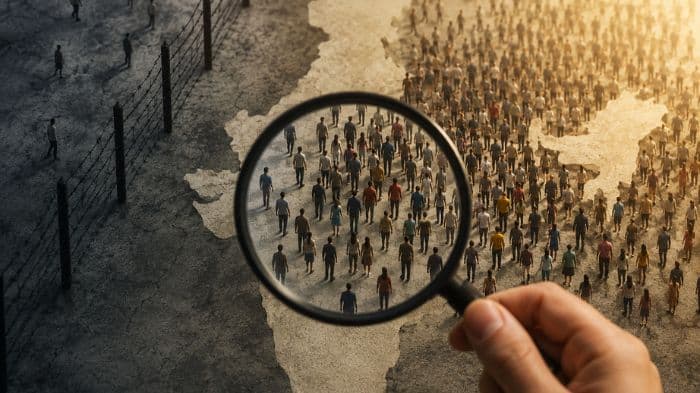
The Centre has constituted a high-level committee to examine what it describes as “unnatural demographic change” in India, linking the issue to illegal immigration, infiltration and abnormal population shifts across religious and social communities.
Announced by Union Home Minister Amit Shah, the panel will be chaired by retired Supreme Court judge Justice Prakash Prabhakar Naolekar and includes former bureaucrats, security officials, economists and the Census Commissioner.

The government says the committee will scientifically assess demographic changes occurring due to illegal immigration and other “unnatural causes” and recommend policy, administrative and legal measures within a fixed timeframe.
But the announcement has also opened up a larger political and social debate: What exactly does “unnatural demographic change” mean? Which regions are likely to come under focus? And how could the findings influence future citizenship, migration and electoral policies in India?
What the government has officially said
According to statements made by Amit Shah, the committee has been tasked with conducting a “comprehensive assessment” of demographic changes occurring across India due to “illegal immigration and other unnatural causes”.
The panel will study patterns of population shifts among religious and social communities and examine their impact on:
-national security
-sovereignty
-law and order
-social structure
-preservation of tribal societies
The committee has reportedly been given one year to submit its report, with a possible six-month extension if required.
The move follows Prime Minister Narendra Modi’s Independence Day 2025 speech, where he announced plans for a “high-level committee on demographic change”.
What does “unnatural demographic change” mean?
The phrase itself does not currently have a formal legal definition in Indian law.
However, official statements suggest the government is primarily referring to population shifts allegedly caused by:
-Illegal immigration
-Cross-border infiltration
-Undocumented settlement patterns
-Abnormal regional population growth
In political discourse, the issue has frequently been linked to migration from neighbouring countries such as Bangladesh and Myanmar, particularly in border states including Assam and West Bengal.
The government has repeatedly argued that unchecked illegal immigration can alter local demographics, strain resources and affect internal security.
Critics, however, argue that demographic anxieties in India have often become politically sensitive because they intersect with religion, citizenship and electoral mobilisation.
Why the issue is politically sensitive
Demography has long been one of the most politically charged subjects in Indian politics.
Questions around migration, religious population growth and citizenship have repeatedly surfaced during debates around:
-The National Register of Citizens (NRC)
-The Citizenship Amendment Act (CAA)
-Border security
-Assam’s migration politics
-Tribal land protection
-Voter identity verification
States such as Assam have historically witnessed major political movements centred around illegal immigration concerns. The Assam Accord of 1985 itself emerged from years of protests over migration and electoral rolls.
More recently, demographic concerns have also become central to political narratives in parts of West Bengal and the Northeast.
Government supporters argue that demographic shifts caused by illegal immigration can have genuine implications for security, welfare distribution and local identity preservation.
Opposition parties and civil society groups, meanwhile, have frequently accused the ruling BJP of using demographic fears to politically polarise voters, particularly along religious lines.
Which regions may come under focus?
While the government has not officially identified target regions, earlier official and media discussions around demographic change have frequently referenced:
-Assam
-West Bengal
-Border districts in the Northeast
-Parts of Jammu and Kashmir
-Tribal belts experiencing migration pressures
Border states are expected to receive particular attention because the committee’s mandate explicitly refers to illegal immigration and infiltration.
The panel is also expected to rely heavily on census trends, migration data, electoral rolls and local population studies.
Could this affect future policy?
The committee has been tasked not just with studying demographic change but also with recommending policy and legal responses.
That means its findings could eventually influence future decisions related to:
-Border enforcement
-Detention and deportation mechanisms
-Voter verification systems
-Citizenship documentation
-Migration monitoring
-Welfare eligibility frameworks
-Internal security planning
Some reports have suggested the panel may explore systems for identification, detention and deportation linked to illegal immigration concerns.
However, the government has not yet released detailed terms of reference publicly.
Why demography has become a global political issue
India is not the only country where demographic change has become politically contentious.
Across the world, governments are increasingly debating issues linked to migration, ageing populations, fertility decline, border movement and ethnic identity.
In Europe and the United States, migration-driven demographic shifts have become central political themes over the past decade. In South Asia too, migration and citizenship remain deeply tied to questions of identity and electoral politics.
At the same time, demographers often caution against oversimplified narratives around population change, noting that migration, fertility and urbanisation are shaped by multiple economic and social factors.
That is partly why the language used around “demographic change” tends to become politically and emotionally charged.
What's Next
The newly formed committee is expected to begin consultations with government departments, security agencies, census authorities and state administrations in the coming months.
Its report could become significant not only for immigration and security policy, but also for the broader political discourse around identity, citizenship and social balance in India.
For now, however, the government’s announcement has already ensured that demographic politics — a subject that has remained central to several major national debates in recent years — is once again back at the centre of public discussion.