


India’s foreign minister calls terrorism a shared global threat, urges deeper cooperation as he underscores New Delhi’s resolve after Pahalgam attack.
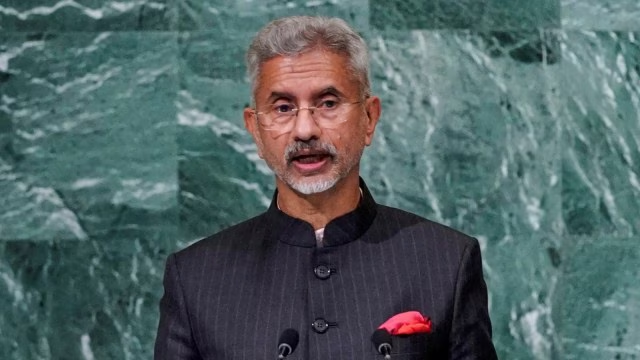
At the United Nations General Assembly on September 27, External Affairs Minister S Jaishankar launched a scathing attack on Pakistan—without naming it—accusing India’s neighbour of being the “epicentre of global terrorism for decades” and the source of many of the world’s deadliest attacks.
In a 16-minute address that drew applause from the hall, Jaishankar said: “For decades now, major international terrorist attacks are traced back to that one country. The UN’s designated lists of terrorists are replete with its nationals.” Referring to the killing of tourists in Jammu and Kashmir’s Pahalgam earlier this year, he stressed that India had “exercised its right to defend its people and brought perpetrators to justice.”

Calling terrorism a “shared threat” that must be confronted collectively, the minister urged much deeper international cooperation: “When terror hubs operate on an industrial scale and terrorists are publicly glorified, such actions must be unequivocally condemned. Those who condone nations that sponsor terror will find it comes back to bite them.”
Beyond terrorism, Jaishankar also pressed for reforms in global trade rules, voiced India’s stance on conflicts in Ukraine and Gaza, and questioned whether the UN was living up to its founding principles. He invoked India’s guiding pillars — Atmanirbharta (self-reliance), Atmaraksha (self-protection) and Atmavishwas (self-confidence) — to argue for fairness in commerce and peacebuilding.
“These are challenging times,” Jaishankar said, calling on the UN to rediscover its relevance and for member nations to shoulder leadership responsibilities: “Every member who can make this world a better place must have the opportunity to do their utmost.”
Last year too, the minister had accused Pakistan of exporting “terrorism” while measuring its GDP in terms of “radicalisation.” His latest UNGA remarks carried forward that pointed message — this time against the backdrop of a global plea to choke terror financing and dismantle what he called the “terrorism ecosystem.”
Bangladesh minister backs religious education to build moral generation
Bangladesh HSC results postponed to October 31 after venue change
_1705x959.jpg&w=256&q=75)
Ghana University launches Japanese language course to deepen cultural ties
.avif&w=256&q=75)
South Africa study finds university mentors boost school pupils’ confidence
NISM Partners with TrackWizz to Boost RegTech Education, AML Compliance and Market Surveillance
South Africa study finds university mentors boost school pupils’ confidence
.webp&w=256&q=75)
The Most Persistent Weakness in India’s Engineering Education System Is the Gap Between Knowing and Doing

Study in Singapore 2027: Top Universities, Fees, Scholarships, Student Visa and Jobs for Indian Students

Study in Taiwan 2027: Top Universities, Fees, Scholarships, Student Visa and Jobs for Indian Students

Study in Hong Kong 2027: Top Universities, Fees, Scholarships, Visa and Career Opportunities for Indian Students

Bangladesh minister backs religious education to build moral generation
Bangladesh HSC results postponed to October 31 after venue change
Ghana University launches Japanese language course to deepen cultural ties
South Africa study finds university mentors boost school pupils’ confidence
NISM Partners with TrackWizz to Boost RegTech Education, AML Compliance and Market Surveillance
South Africa study finds university mentors boost school pupils’ confidence
The Most Persistent Weakness in India’s Engineering Education System Is the Gap Between Knowing and Doing
Study in Singapore 2027: Top Universities, Fees, Scholarships, Student Visa and Jobs for Indian Students
Study in Taiwan 2027: Top Universities, Fees, Scholarships, Student Visa and Jobs for Indian Students
Study in Hong Kong 2027: Top Universities, Fees, Scholarships, Visa and Career Opportunities for Indian Students
Copyright© educationpost.in 2026 All Rights Reserved.