The Supreme Court recently upheld the Lok Sabha Speaker’s decision to constitute an inquiry committee against Allahabad High Court judge Justice Yashwant Varma, rejecting his challenge to the panel’s legality under the Judges (Inquiry) Act, 1968.
Dismissing Justice Varma’s plea, a bench of Justices Dipankar Datta and S C Sharma ruled that the Speaker committed “no illegality” in setting up the committee and that the judge was “not entitled to any relief”. The court observed that “constitutional safeguards for judges cannot come at the cost of paralysing the removal process itself”.

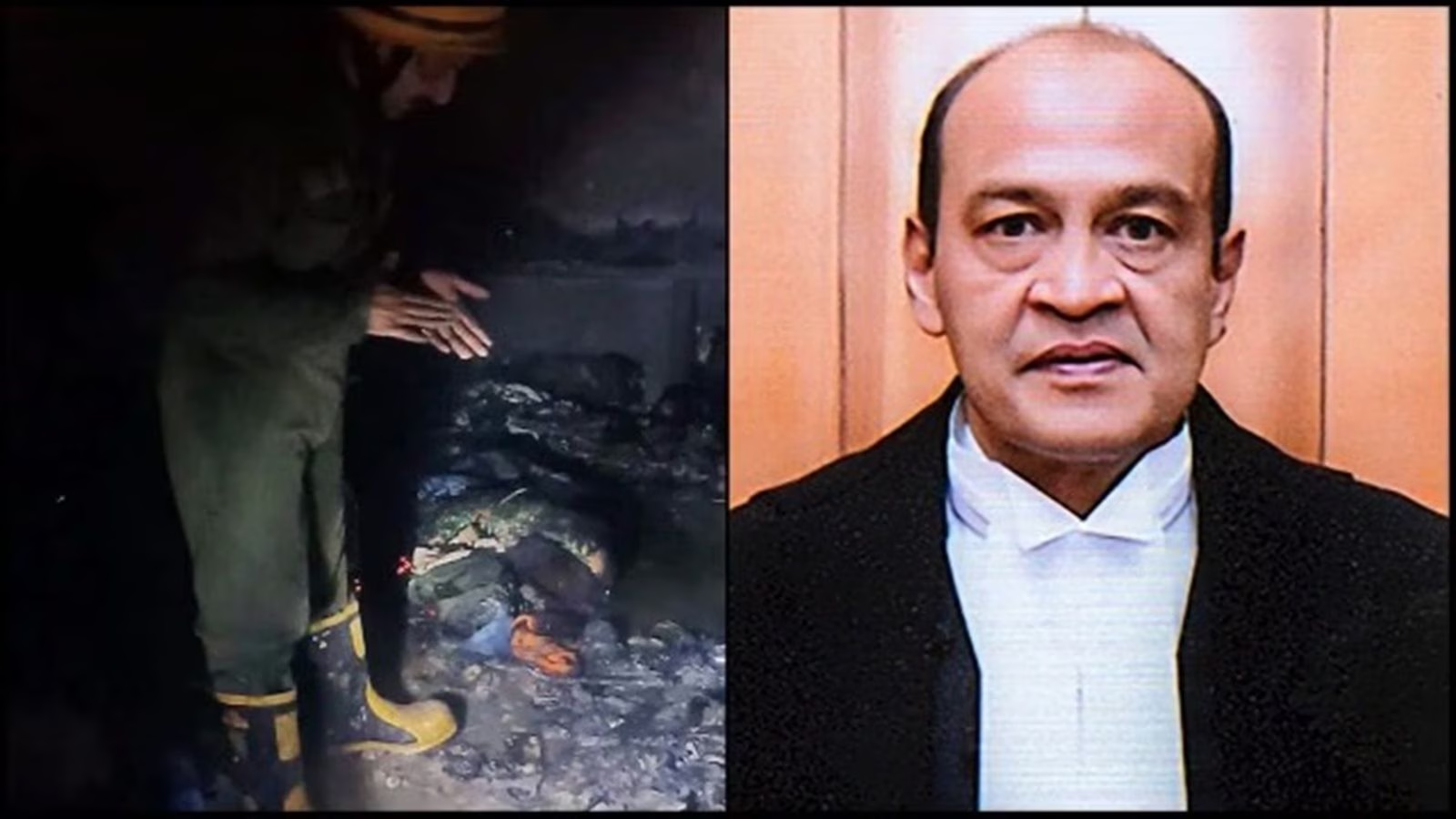
The inquiry relates to allegations surrounding the discovery of burnt cash at Justice Varma’s Delhi residence in March 2025. The committee comprises Supreme Court judge Justice Aravind Kumar, Madras High Court Chief Justice Manindra Mohan Shrivastava, and senior advocate B V Acharya.
Justice Varma had argued that the committee could not have been formed unilaterally by the Lok Sabha Speaker because notices for his removal were introduced in both the Lok Sabha and the Rajya Sabha on the same day. Citing the first proviso to Section 3(2) of the Judges (Inquiry) Act, he contended that in such a situation, a joint committee could be constituted only after the motion was admitted in both Houses of Parliament. He further claimed that if the motion failed in one House, the notice in the other must also fail.
The court rejected this interpretation, holding that the proviso does not envisage a scenario where acceptance of a motion in one House and rejection in the other automatically nullifies the process. Writing for the bench, Justice Datta said reading such a consequence into the law would amount to “judicial legislation”.
“It is a settled principle of statutory interpretation that a proviso cannot be read in a way which nullifies the provision to which it is a proviso, unless such an intention is manifest,” the bench said. The main provision of Section 3(2), it noted, empowers the Speaker or the Chairman, as the case may be, to constitute a committee once a notice of motion is admitted. That power, the court clarified, remains intact except in the limited circumstance where motions are admitted in both Houses, triggering the requirement of a joint committee.
The bench also underlined that there is nothing in the law to suggest that rejection of a motion in one House renders the other House incompetent to proceed independently in accordance with the Act.
Justice Varma had additionally questioned the rejection of the motion in the Rajya Sabha by the Deputy Chairman, following the resignation of then Chairman Jagdeep Dhankhar. The court dismissed this contention as well, relying on Article 91 of the Constitution, which authorises the Deputy Chairman to perform the Chairman’s duties when the office is vacant.
“The duties that the Chairman and the Deputy Chairman perform under the Inquiry Act cannot be separated from the office they hold as the presiding officer of the House,” the bench said.
Earlier, on January 8, the Supreme Court had declined to grant Justice Varma additional time to respond to the committee’s notice. He subsequently informed the panel that he was not in Delhi on the day the incident occurred and argued that he could not be held responsible if the premises had not been secured.
With recent ruling, the court has cleared the way for the inquiry committee to proceed, reinforcing Parliament’s authority to pursue judicial accountability within the constitutional framework.






.jpg&w=256&q=75)
.jpg&w=256&q=75)