


In a first for any Indian state, Punjab clears ₹51.4 crore to deploy advanced anti-drone systems along its volatile border with Pakistan, following an unprecedented aerial threat.
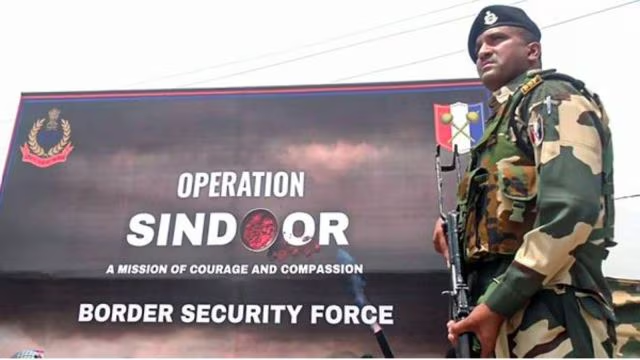
In a decisive counter to the escalating aerial threat from across the border, Punjab is set to become the first Indian state to deploy advanced anti-drone systems (ADS) along its more than 500-kilometre frontier with Pakistan.
The move follows a wave of Pakistani drone activity during Operation Sindoor, India’s cross-border military response to terror infrastructure earlier this month.

Government sources confirmed that the state Cabinet, led by Chief Minister Bhagwant Mann, sanctioned ₹51.4 crore in an emergency meeting amid the peak of hostilities. The funds will be used to procure ADS units capable of detecting and disabling both unmanned aerial vehicles (UAVs) and unmanned combat aerial vehicles (UCAVs) within an 8–10 km radius.
“The tendering process is complete. Deployment of the first tranche is expected within three months,” said a senior government official.
These systems are expected to bolster Punjab's capacity to intercept swarms of drones, a tactic recently employed by Pakistan to overwhelm defenses and gather intelligence. According to military sources, many of these drones were rudimentary, designed to camouflage the presence of more sophisticated surveillance and strike UAVs.
The anti-drone systems, once operational, will neutralize hostile drones by disrupting their radio link with ground controllers, essentially rendering them inoperable mid-air.
National coordination, tactical edge
Director General of Police Gaurav Yadav confirmed the state police’s close coordination with central agencies. “Together, we will leave no stone unturned to safeguard India against drone threats,” Yadav said.
Officials revealed that Punjab’s ADS deployment will function as a dynamic, second layer of defense — strategically reinforcing locations already under surveillance by the Border Security Force (BSF). These areas were identified through joint threat assessments based on past drone sightings.
“These systems will not just defend against aerial incursions but also strengthen our efforts to intercept cross-border smuggling of weapons and narcotics,” said another senior official.
With the BSF already reporting increased success in intercepting drone-delivered contraband—some payloads as heavy as 10–12 kg — the addition of mobile ADS units operated by Punjab Police is expected to add agility and coverage to the defense grid. Their mobility will allow rapid redeployment based on evolving operational needs, including into urban areas if required.
Tech now cleared for use
Until recently, states like Punjab lacked access to these systems due to regulatory bottlenecks. Most anti-drone technologies were under evaluation by the Ministry of Home Affairs' Anti-Rogue Drone Technology Committee (ARDTC). That has now changed.
“MHA has given clearance for certain systems after rigorous testing. States can now procure them with appropriate permissions,” an official confirmed.
These next-gen ADS platforms will also receive continual software and hardware upgrades to keep pace with evolving threats. Punjab Police will coordinate with other security agencies to ensure adaptability as drone warfare tactics evolve.
As India braces for a future where rogue drones may become a norm rather than an anomaly, Punjab’s move signals a new era in regional security preparedness — one where technology, intelligence, and coordination converge on the frontlines.

Hunter of Underwater Threats: Why INS Mangrol Is Important for the Indian Navy

Delhi Protests Renew Debate Over Constitutional Right to Peaceful Assembly

Household Inflation Rises to 5.54% in September as Price Pressures Spread
Delhi High Court Allows Urgent Hearing on Protest Site Guidelines

India Rejects China’s Objection to Standardised Names of Places in Ladakh

Karnataka student elections return after 37 years: Why political restrictions and university polls remain contentious

Global education is shifting from simply going abroad to creating more flexible routes to opportunity

Delhi Police files FIR against Congress MP Bimol Akoijam over JNU sexual harassment allegations
Utkal University tightens security after late-night explosions ahead of student polls

IET India Scholarship Award 2026: DTU’s Kush Garg wins top honor for AI device for neurodivergent children

Hunter of Underwater Threats: Why INS Mangrol Is Important for the Indian Navy
Delhi Protests Renew Debate Over Constitutional Right to Peaceful Assembly
Household Inflation Rises to 5.54% in September as Price Pressures Spread
Delhi High Court Allows Urgent Hearing on Protest Site Guidelines
India Rejects China’s Objection to Standardised Names of Places in Ladakh
Karnataka student elections return after 37 years: Why political restrictions and university polls remain contentious
Global education is shifting from simply going abroad to creating more flexible routes to opportunity
Delhi Police files FIR against Congress MP Bimol Akoijam over JNU sexual harassment allegations
Utkal University tightens security after late-night explosions ahead of student polls
IET India Scholarship Award 2026: DTU’s Kush Garg wins top honor for AI device for neurodivergent children
Copyright© educationpost.in 2026 All Rights Reserved.