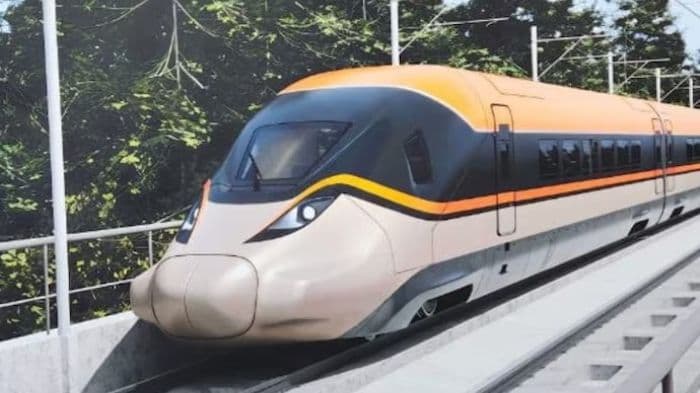
India’s ambitious bullet train project has received its first official visual identity, with Railway Minister Ashwini Vaishnaw unveiling an image of the country’s upcoming high-speed train set that will run on the Mumbai-Ahmedabad corridor.
But while the sleek design has generated excitement online, the larger project itself remains under phased construction with full operations still years away.

The newly displayed image at the Ministry of Railways headquarters in New Delhi shows a modern aerodynamic train featuring a grey body with orange-gold accents, visually inspired by Japan’s Shinkansen system. The unveiling is being seen as a symbolic milestone for India’s first bullet train network.
The train will operate on the 508-km Mumbai-Ahmedabad High Speed Rail (MAHSR) corridor, India’s first dedicated bullet train route being developed with Japanese technical and financial assistance through the Japan International Cooperation Agency (JICA).
Where the project currently stands
Despite the visual reveal, the project itself remains under active construction. According to Railway Ministry updates and parliamentary reports, operations are expected to begin in phases rather than through a full corridor launch.
The first operational section is expected to run between Surat and Bilimora or Surat and Vapi in Gujarat by August 2027, depending on construction progress. This initial stretch is expected to cover roughly 100 km.
The complete Mumbai-Ahmedabad corridor is projected to become operational closer to 2029. Several sections in Gujarat have advanced rapidly, while land acquisition and tunnelling work in Maharashtra delayed earlier timelines.
The project includes 12 stations across Maharashtra, Gujarat and the Union Territory of Dadra and Nagar Haveli. Most of the route will run on elevated viaducts, while a major undersea tunnel section is being developed near Mumbai.
India’s own bullet train set under development
One of the major shifts in the project is India’s move toward indigenous train manufacturing. Instead of relying entirely on imported Japanese train sets, the upcoming high-speed rolling stock is being developed domestically by BEML under the “B28” project.
According to project details, the train sets are designed for speeds up to 280 kmph, with initial operational speeds likely to remain around 250 kmph. Future upgrades may allow speeds between 320 and 350 kmph.
The first prototype train is expected to roll out in 2027 after undergoing structural validation, oscillation trials and high-speed testing.
Railway officials have described the project as a major step toward building domestic high-speed rail capability and reducing long-term dependence on imported systems.
Why the project was delayed
The bullet train corridor was originally targeted for partial completion much earlier, but the project encountered major delays after land acquisition disputes, environmental clearances and political opposition in Maharashtra slowed progress.
The COVID-19 pandemic also affected construction schedules and supply chains during crucial phases of execution.
While Gujarat saw faster progress due to quicker land acquisition, tunnelling and station work near Mumbai moved at a slower pace for several years. The mountain tunnel breakthrough achieved earlier this year was considered one of the project’s key engineering milestones.
Bigger bullet train ambitions
Even as the Mumbai-Ahmedabad corridor remains under construction, the government has already announced plans for additional high-speed rail corridors across India.
These proposed routes include Delhi-Varanasi, Mumbai-Pune, Delhi-Ahmedabad, Hyderabad-Bengaluru and other economically dense corridors where railways believe high-speed trains could significantly reduce travel time.
Ashwini Vaishnaw has repeatedly argued that high-speed rail networks could transform regional economies and eventually compete with short-haul air travel in India.
Cost and criticism
The Mumbai-Ahmedabad bullet train project remains one of India’s most expensive infrastructure ventures, with costs having risen significantly from original estimates over the years. Critics have questioned the financial viability of the project and argued that investment should instead prioritise conventional rail upgrades.
Supporters, however, say the project is intended as a long-term technological leap that could modernise India’s railway ecosystem, create manufacturing capability and reduce future travel time between major economic centres.
For now, the newly unveiled image may have offered Indians their clearest look yet at the country’s first bullet train, but the actual high-speed journey is still some distance away.






.png&w=256&q=75)