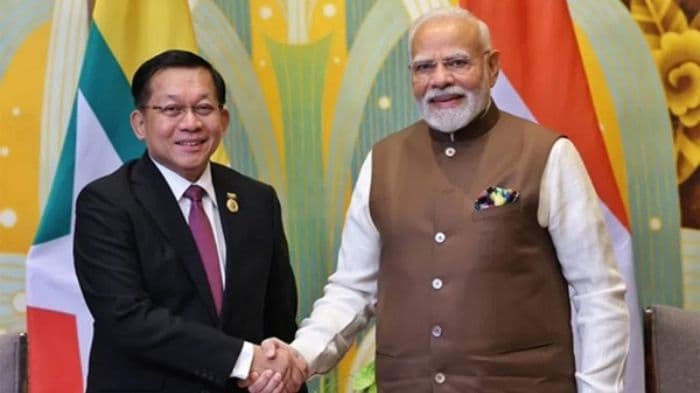
India has hosted Myanmar President Min Aung Hlaing on his first official foreign visit since assuming office in April, a move that has drawn criticism from refugee groups and democracy activists while highlighting New Delhi’s strategic interests in its eastern neighbour.
Min Aung Hlaing, who led the military coup that ousted the elected government of Aung San Suu Kyi in 2021 before later transitioning to the presidency, arrived in India for a five-day visit that includes meetings with Prime Minister Narendra Modi and other senior officials.

The visit also includes engagements in Bodh Gaya and discussions on trade, connectivity, border security and bilateral cooperation.
The visit is being viewed as a significant diplomatic step, as India has become the first country to host Min Aung Hlaing in his new role as president.
According to foreign policy experts, India's approach is shaped by multiple strategic concerns, including stability along the India-Myanmar border, the future of connectivity projects under its Act East policy and China's growing influence in Myanmar.
Projects such as the Kaladan Multi-Modal Transit Transport Project, the India-Myanmar-Thailand Trilateral Highway and the Sittwe port are considered important to New Delhi's regional strategy.
Myanmar shares a 1,643-kilometre border with India, and security concerns have intensified since the 2021 coup, with several ethnic armed organisations gaining control of areas near the frontier.
India has increasingly adopted a dual-track approach by engaging both Myanmar's government and armed groups that control territory along the border.
However, the visit has sparked criticism from Myanmar refugee communities and pro-democracy groups based in India. Refugees said they were “pained” to see what they described as the “mother of democracy” hosting a leader they accuse of overseeing widespread violence and repression.
Protest groups argued that welcoming Min Aung Hlaing risks legitimising a military leadership accused of serious human rights violations since the coup.
Myanmar’s parallel National Unity Government (NUG), formed by elected lawmakers removed after the military takeover, has also criticised international engagement with the junta leadership and called for greater support for democratic forces in the country.
Despite the criticism, Indian officials have argued that engagement with Myanmar is driven by practical security and geopolitical considerations. Experts noted that instability in Myanmar directly affects India’s northeastern states and that New Delhi cannot ignore developments in a neighbouring country with which it shares deep historical, cultural and strategic ties.
The visit comes at a time when India is looking to strengthen its engagement with Myanmar to advance key security and connectivity interests, while also responding to China's growing footprint in the neighbouring country.