


Bihar’s special revision exercise shows success in tracing voters through old rolls and family records; EC pushes states to adopt strategy ahead of pan-India SIR.
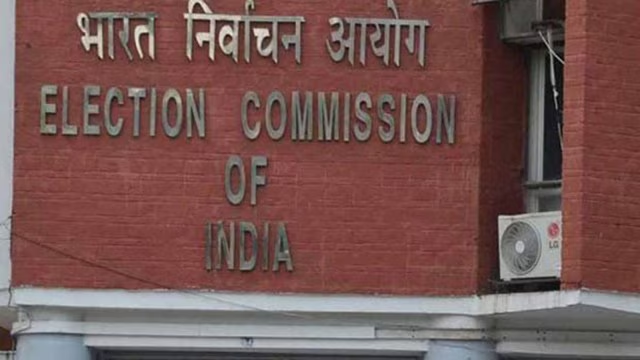
In a move that could reshape how India updates its voter lists, the Election Commission (EC) is looking to replicate Bihar’s Special Intensive Revision (SIR) model across the country after the state managed to link over 75% of its 7.89 crore electors to its 2003 electoral roll.
At a conference with Chief Electoral Officers (CEOs) on September 10, Chief Election Commissioner Gyanesh Kumar and Election Commissioners Sukhbir Singh Sandhu and Vivek Joshi highlighted Bihar’s experience as a benchmark. The state’s success, officials said, could ease the verification burden for voters and tighten the accuracy of electoral rolls ahead of the national rollout.

Bihar Chief Electoral Officer Vinod Singh Gunjiyal, in a detailed presentation, revealed that about 52% of existing electors were directly found on the 2003 roll, while another 25% were mapped through the “parivarik suchi” or family tree method, linking them as children or relatives of voters already present in that roll.
The EC’s June 24 order had made it mandatory for Bihar’s electors to submit fresh forms to remain on the rolls, with additional proof required for those added after 2003. Citizens born after July 1, 1987 were also asked to provide parental documents in line with the Citizenship Act, 1965. While the exercise was expected to re-establish nearly half the state’s electors, the family-tree mapping significantly expanded the verified pool.
“The Commission assessed the preparedness of CEO offices for the nationwide SIR exercise. Bihar’s strategies, challenges, and best practices were shared for replication,” the EC said in a late-evening statement.
Presentations from all state and UT CEOs followed, covering digitization of past rolls, current mapping status, and possible additions to the list of 11 documents currently permitted for verification.
While most CEOs offered no new suggestions, some proposed Aadhaar, the Electors Photo Identity Card (EPIC), or state-specific IDs. The EC has so far resisted including Aadhaar and EPIC, though the Supreme Court this week directed it to accept Aadhaar for Bihar’s SIR.
Bihar’s final roll is set for publication on September 30. The EC, however, is yet to fix a timeline for the nationwide exercise.
Singapore Management University’s Executive MBA enters global top 50 in Financial Times ranking

NUS launches clinical psychology program to expand Singapore’s mental healthcare workforce
DGT Partners with Medhavi Skills University to Expand Industry-Linked ITI Training
IIM Ahmedabad Opens Admissions for Second Batch of Blended MBA in Business Analytics and AI
Wits researchers develop light-powered neural network to decode complex signals
Singapore Management University’s Executive MBA enters global top 50 in Financial Times ranking
NUS launches clinical psychology program to expand Singapore’s mental healthcare workforce
Wits researchers develop light-powered neural network to decode complex signals
How China is expanding vocational education through undergraduate degrees, industry partnerships and financial aid

Singapore Institute of Technology launches new school for lifelong learning and career development

Singapore Management University’s Executive MBA enters global top 50 in Financial Times ranking
NUS launches clinical psychology program to expand Singapore’s mental healthcare workforce
DGT Partners with Medhavi Skills University to Expand Industry-Linked ITI Training
IIM Ahmedabad Opens Admissions for Second Batch of Blended MBA in Business Analytics and AI
Wits researchers develop light-powered neural network to decode complex signals
Singapore Management University’s Executive MBA enters global top 50 in Financial Times ranking
NUS launches clinical psychology program to expand Singapore’s mental healthcare workforce
Wits researchers develop light-powered neural network to decode complex signals
How China is expanding vocational education through undergraduate degrees, industry partnerships and financial aid
Singapore Institute of Technology launches new school for lifelong learning and career development
Copyright© educationpost.in 2026 All Rights Reserved.