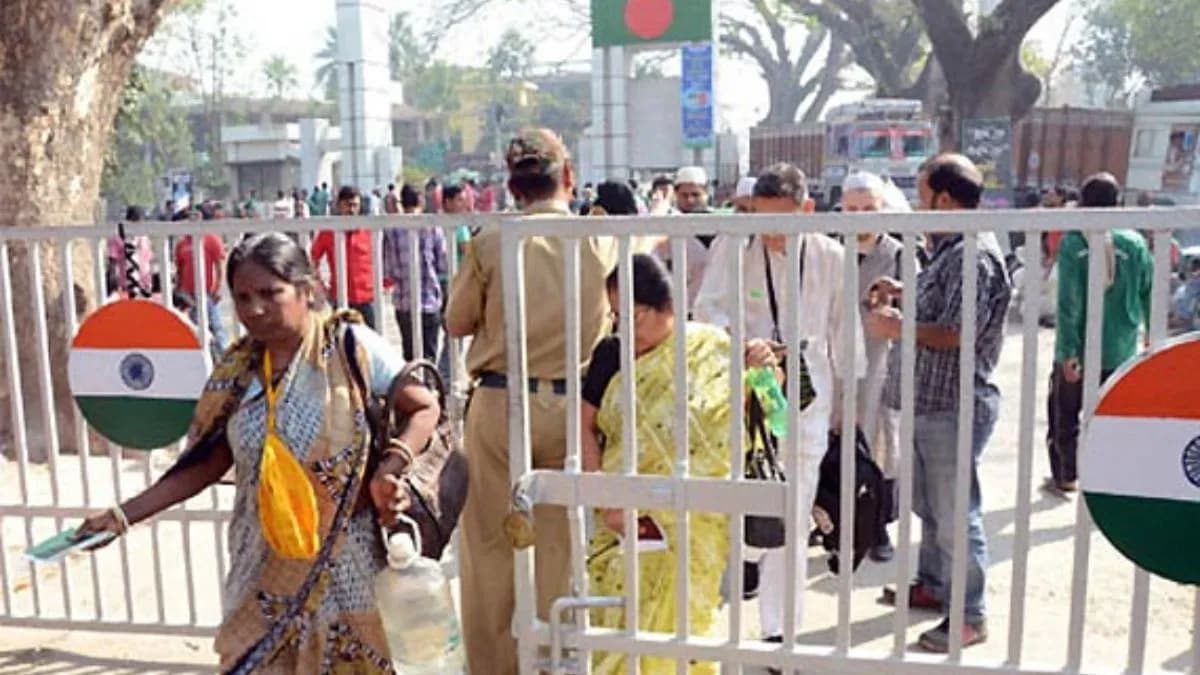
Fear, confusion and heartbreak are playing out at the Hakimpur border in West Bengal’s North 24 Parganas district, where dozens of undocumented Bangladeshi migrants have gathered over the past two days hoping to return to Bangladesh amid an intensified crackdown on illegal migrants.
Carrying bags, blankets and identity papers, families who spent years building lives in India are now waiting near the border, uncertain about what lies ahead.

At the Hakimpur border outpost, police have set up a registration desk to record the details of those arriving. Officials are verifying Bangladeshi documents and preparing a database before migrants are shifted to holding centres.
According to officials, records of more than 350 Bangladeshi nationals have been prepared since May 26.
Around 50 to 60 people were present at the border on May 28, many from Kolkata’s New Town, Hatiyara, Khardah, Dum Dum and Dankuni areas. Several admitted they had entered India illegally over the years through agents and middlemen in search of work and survival.
“We are poor people. That is why we came here,” said Salam Dali, a carpenter who claimed he entered India from Bangladesh’s Khulna district nearly five years ago after paying ₹8,000-10,000 to a middleman.
“The government told us to leave because we do not have documents. So now we are leaving,” he said while waiting at the border with his wife and child.
Many migrants described a sharp change in the atmosphere over recent months, with frequent police visits, document verification drives and fears of detention forcing families to leave.
Hidoy Mulla, born in 2003, said he grew up in Madhyamgram after his parents migrated from Bangladesh in 2001. He claimed local police repeatedly asked the family to produce proof of residence dating back to before 2002.
“I was born in 2003. My parents are completely uneducated. They don’t even know ABCD. How were they supposed to make documents?” he said.
Mulla said he possessed Aadhaar, PAN, ration card and school certificates, but his voter ID applications had been rejected multiple times.
“I grew up here. This culture is part of me. My parents feel they are returning to their country, but for us it feels like we are leaving our country and going somewhere else,” he said.
“What mistake did we make? The mistake was of our parents. They brought us here.”
He added that the family no longer had land, relatives or any support system left in Bangladesh.
“What will I do there? There is no friend circle, no future for me there,” he said.
Among those gathered near the border was a visually impaired family from Khardah — Mohammad Shamsur Rahaman, his wife Asiya Khatun and his brother Bilal — all of whom are blind and survived by begging on trains and streets in Kolkata.
“We are requesting the authorities to send us back immediately,” Rahaman said.
The family claimed they had lived in India for more than a decade and had obtained Aadhaar and other documents while staying in the Khardah area.
Another migrant, Mohammad Ali Munshi, who claimed he was born in India after his father crossed the border decades ago, said fear and pressure had left the family with no choice.
“I only had Aadhaar and ration card. I left everything behind because none of it is useful now,” he said.
One of the most striking accounts came from Mafuza Khatun, originally from Bangladesh’s Khulna district, who said she had voted in Indian elections for years.
She claimed Aadhaar and voter ID cards were arranged through local political and municipal channels.
“We voted here for years. Now our voter IDs have been cancelled,” she said.
“For the government, we are people from another country, so now we have to go back to Bangladesh.”
Several women at the border said they worked as domestic helpers, rag-pickers and labourers in Kolkata’s outskirts before being forced to vacate rented homes.
Many migrants admitted they had crossed into India illegally through agents operating on both sides of the border. Some said they were brought to India as children and barely remembered Bangladesh.
Authorities have shifted many arrivals from Hakimpur to temporary holding centres across North 24 Parganas district. The largest facility has been set up at Tentulia inside the Pather Saathi building, where officials said 116 Bangladeshi nationals are currently being housed.
Health department teams, cooks and police personnel have been deployed at the centre to manage food, medical care and security. Officials said additional holding centres are being prepared and those gathered at Hakimpur would eventually be “pushed back” to Bangladesh.
However, the pushback process, which reportedly continued till the night of May 27, has now been halted temporarily. Local sources suspect Bangladesh authorities may have stopped accepting undocumented migrants from India for the moment.
The Border Security Force has not officially commented on the development despite repeated attempts to seek clarification.