


Using drone-based 3D mapping and laboratory rock analysis, researchers are examining how Maharashtra’s ancient lava flows could support long-term carbon storage and climate change mitigation.
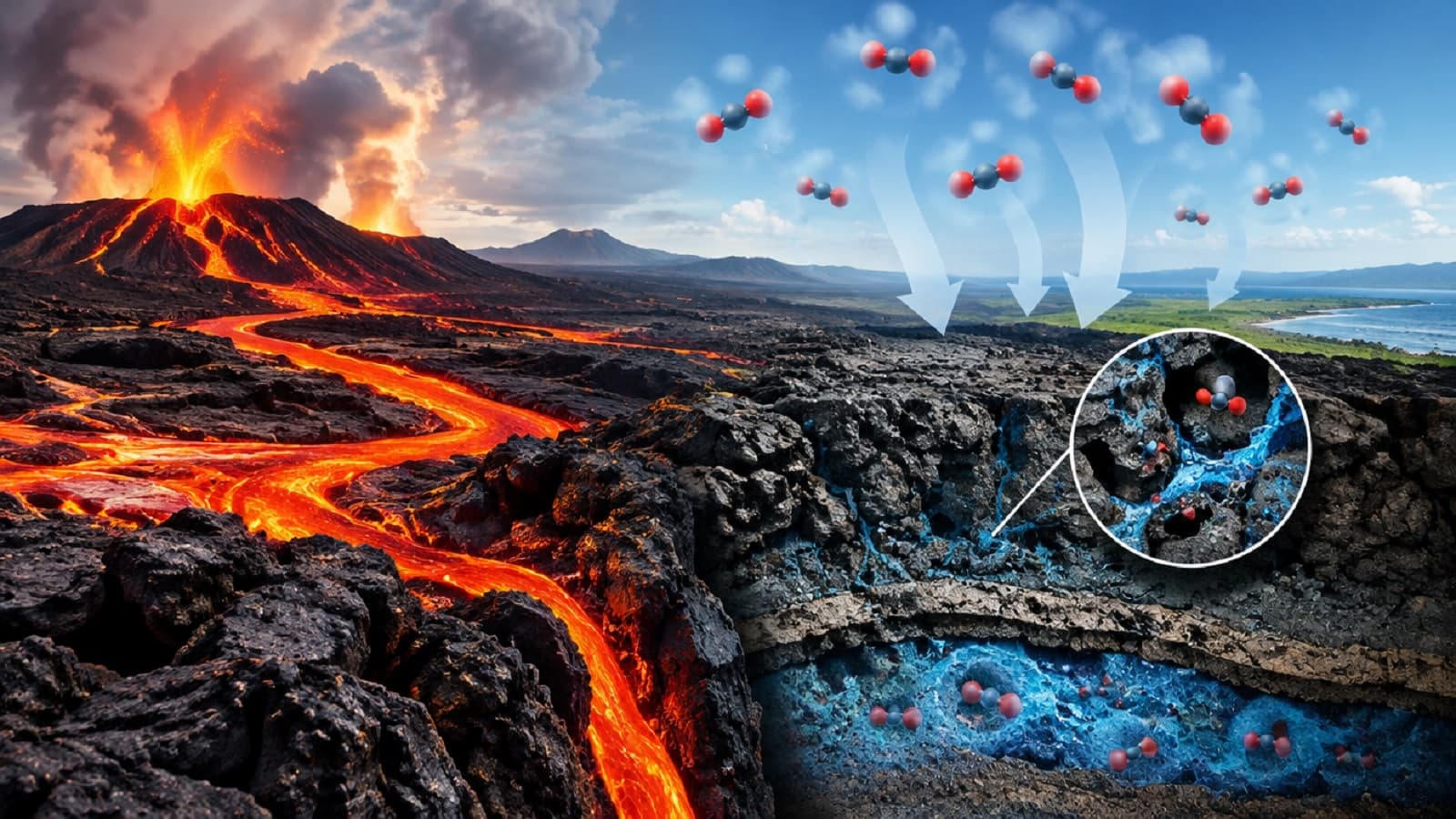
Researchers at the Indian Institute of Technology Gandhinagar (IITGN) are investigating whether ancient volcanic rocks in Maharashtra could provide a suitable geological setting for storing carbon dioxide (CO₂) underground. The study examines the structure, thickness and mineral composition of basalt formations to understand their potential for carbon capture and storage (CCS).
The research focuses on the Deccan Traps, an extensive volcanic province in western and central India formed by successive lava flows millions of years ago. Basalt, the principal rock type in these formations, contains minerals that can react with dissolved CO₂ and convert it into stable carbonate minerals under suitable conditions.

The research team studied seven basalt lava flows exposed at Kumbharli Ghat in Maharashtra’s Western Ghats. By analysing these surface formations, scientists aim to improve their understanding of comparable rock layers buried deep underground, where direct geological observations are more difficult.
The study, titled “Characterising the Architecture of Deccan Basalt Flows for Subsurface CO₂ Storage: A 3D Digital Outcrop Analogue Approach”, investigates how variations within individual lava flows could affect the movement and storage of fluids.
According to the researchers, basalt formations are not uniform. They contain different rock layers, fractures, pores, cavities and mineral deposits. These variations can influence how fluids travel through the rock and interact with its minerals, making detailed geological assessment essential before selecting potential CO₂ storage sites.
Professor Pankaj Khanna, Associate Professor in IIT Gandhinagar’s Department of Earth Sciences and Maritime Engineering, said that understanding the internal structure of individual lava flows is important for identifying formations that may be suitable for large-scale underground CO₂ injection.
The research uses drone-based photogrammetry to develop a three-dimensional digital model of exposed basalt formations. The technique combines photographs taken from different positions to reconstruct the landscape and map individual lava flows.
The researchers used the model to examine the boundaries, thickness and geometry of seven lava flows. They also conducted laboratory-based rock analyses to investigate variations in mineral composition and internal structure.
The approach provides detailed information about geological features that could influence the movement of CO₂-bearing fluids through comparable formations underground. Such data may help researchers develop more realistic geological models and improve assessments of potential storage sites.
The research team describes the work as the first drone-based photogrammetric study to quantitatively characterise individual Deccan basalt flows in this manner.
Carbon capture and storage involves capturing carbon dioxide from relevant emission sources or other processes and placing it in suitable long-term storage locations, including deep geological formations.
Basalt is attracting scientific interest because it contains calcium-, magnesium- and iron-bearing minerals that can react with dissolved CO₂. Under appropriate geological and chemical conditions, these reactions can form solid carbonate minerals, offering a potential route to long-term carbon storage.
However, the effectiveness of this process depends on several factors, including the availability of reactive minerals, the connectivity of pores and fractures, fluid movement and the chemical conditions within the rock.
The IITGN study highlights why the Deccan basalt formations need to be evaluated individually rather than treated as a single, uniform underground reservoir. Variations in rock structure could affect injection capacity, fluid pathways, storage potential and pressure development.
The datasets generated through the study could provide a foundation for further investigations into the Deccan Traps and similar basalt formations. Researchers may use the information to develop geological models and compare surface observations with data obtained from underground boreholes.
Lead author Debasmita Datta, a PhD researcher in IIT Gandhinagar’s Department of Earth Sciences, said the work could help scientists better understand and model basalt formations beneath the surface.
The study contributes to broader scientific efforts to investigate geological carbon storage as one of several approaches to reducing net greenhouse gas emissions. Nevertheless, additional research and site-specific assessments will be needed to establish the practical storage capacity, injection feasibility, long-term performance and safety of any proposed site in India.
By combining drone-based mapping with detailed rock analysis, the IIT Gandhinagar research provides a framework for evaluating the geological complexity of Deccan basalt and its potential role in future carbon storage strategies.

Magnitude 5.1 Earthquake Strikes Near Andaman and Nicobar Islands; No Immediate Reports of Damage
Earth’s life story may not have begun with comets, new study finds

Can India's Biggest Examinations Become Leak-Proof?
IIM Lucknow Launches MBA in Family Business 2027: Check Eligibility, Fees, Admission Dates

Less juggling for parents? Singapore to unite kindergarten learning and after-school care by 2030
Earth’s life story may not have begun with comets, new study finds
Can India's Biggest Examinations Become Leak-Proof?
Less juggling for parents? Singapore to unite kindergarten learning and after-school care by 2030
Bihar’s NMCH suspends 146 students over ragging: Wake-up call for medical colleges

Bihar Teacher Salary Scam 2026: ₹1.85 Crore Irregularities Detected in Three Districts

Magnitude 5.1 Earthquake Strikes Near Andaman and Nicobar Islands; No Immediate Reports of Damage
Earth’s life story may not have begun with comets, new study finds
Can India's Biggest Examinations Become Leak-Proof?
IIM Lucknow Launches MBA in Family Business 2027: Check Eligibility, Fees, Admission Dates
Less juggling for parents? Singapore to unite kindergarten learning and after-school care by 2030
Earth’s life story may not have begun with comets, new study finds
Can India's Biggest Examinations Become Leak-Proof?
Less juggling for parents? Singapore to unite kindergarten learning and after-school care by 2030
Bihar’s NMCH suspends 146 students over ragging: Wake-up call for medical colleges
Bihar Teacher Salary Scam 2026: ₹1.85 Crore Irregularities Detected in Three Districts
Copyright© educationpost.in 2026 All Rights Reserved.