


As cheating methods evolve from leaked question papers to AI-enabled wearables, India, South Korea and Russia illustrate the growing challenge of ensuring fair examinations and protecting students' trust in merit-based selection.
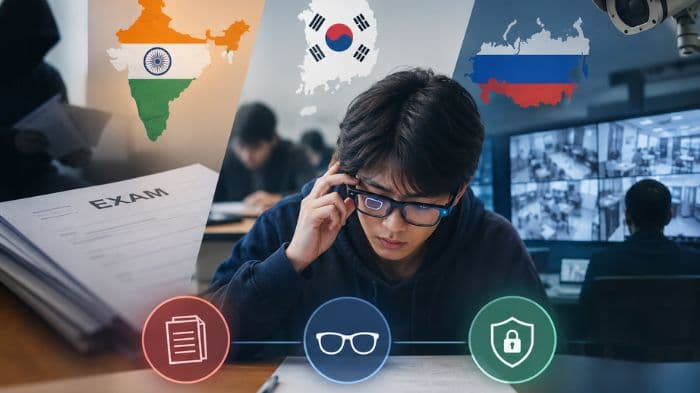
For students competing for limited university seats, an examination is supposed to offer a level playing field. But that promise becomes difficult to uphold when some candidates may gain access to questions in advance or use technology to obtain unauthorised assistance during a test.
Recent developments across India and South Korea have brought these concerns into focus, while Russia offers a comparison of how examination authorities use surveillance and other safeguards to protect high-stakes tests.

The methods differ, but the underlying problem is similar: examination systems must keep pace with the ways in which their rules can be circumvented.
India shows how a breach before an exam can undermine merit
In India, allegations involving competitive examination papers have raised questions about the security of confidential material and the reliability of admissions processes.
The National Eligibility-cum-Entrance Test Undergraduate (NEET-UG), which determines entry to undergraduate medical courses, has been at the centre of controversies over alleged paper leaks and examination irregularities. The CBI registered a case concerning alleged irregularities involving NEET-UG 2026, bringing renewed attention to the protection of examination material and the investigation of suspected wrongdoing.
The challenge with a paper leak is that the advantage may be secured long before candidates sit down to take the test. Strong invigilation at examination centres cannot, on its own, prevent a breach that occurs during the preparation, storage or distribution of question papers.
This makes accountability across the examination process essential, from safeguarding confidential documents to tracing how leaked material may have reached candidates.
South Korea highlights the risks posed by AI-enabled devices
A different vulnerability emerged in South Korea, where applicants were caught allegedly using AI-powered smart glasses during university entrance examinations.
At Yonsei University, an invigilator noticed a candidate switching from ordinary glasses to an AI-enabled pair during a mathematics essay test on Oct 10. A similar incident had been reported at the University of Seoul a week earlier.
These cases point to a challenge that conventional examination rules were not necessarily designed to address. Unlike a mobile phone, a pair of smart glasses can resemble an ordinary accessory while potentially incorporating cameras and connected AI features.
The response cannot rely solely on prohibiting phones and other familiar electronic devices. Institutions also need clear rules on wearable technology and inspection procedures that distinguish legitimate assistive devices from equipment used to gain an unfair advantage.
At the same time, safeguards must be applied fairly to students who genuinely require prescription glasses or other approved accessibility aids.
Russia offers a comparison in examination monitoring
Russia's Unified State Examination, used for school-leaving assessment and university admissions, provides another perspective on examination security.
Its safeguards include technical monitoring, video surveillance and public oversight. In June 2026, Russia's education regulator said it had not detected question-paper materials circulating online before that year's examinations.
That statement is specific to the regulator's reported findings; it does not establish that all forms of cheating have been eliminated.
Russia's example illustrates the role of monitoring systems in detecting violations, but surveillance alone cannot guarantee the integrity of an examination. Security measures must be supported by reliable procedures, consistent enforcement and credible investigations when suspected breaches occur.
The common challenge is preserving trust
Paper leaks, AI-enabled cheating and unauthorised recording require different preventive measures. Treating them as one problem risks overlooking where each breach occurs and how it can be addressed.
Examination authorities need to protect question papers before tests begin, restrict unauthorised devices during examinations and investigate credible allegations transparently. They must also ensure that penalties are proportionate and that candidates are not treated as guilty merely because an allegation has been made.
Ultimately, examination integrity is about more than preventing cheating. It is about ensuring that results remain credible to students, universities, employers and the public. As the methods of malpractice change, the systems designed to prevent them must change too.

Philippines audit agency flags lapses in CHEd scholarship programs

Singapore Management University’s Executive MBA enters global top 50 in Financial Times ranking

NUS launches clinical psychology program to expand Singapore’s mental healthcare workforce
DGT Partners with Medhavi Skills University to Expand Industry-Linked ITI Training
IIM Ahmedabad Opens Admissions for Second Batch of Blended MBA in Business Analytics and AI
Philippines audit agency flags lapses in CHEd scholarship programs
Singapore Management University’s Executive MBA enters global top 50 in Financial Times ranking
NUS launches clinical psychology program to expand Singapore’s mental healthcare workforce

Wits researchers develop light-powered neural network to decode complex signals
How China is expanding vocational education through undergraduate degrees, industry partnerships and financial aid

Philippines audit agency flags lapses in CHEd scholarship programs
Singapore Management University’s Executive MBA enters global top 50 in Financial Times ranking
NUS launches clinical psychology program to expand Singapore’s mental healthcare workforce
DGT Partners with Medhavi Skills University to Expand Industry-Linked ITI Training
IIM Ahmedabad Opens Admissions for Second Batch of Blended MBA in Business Analytics and AI
Philippines audit agency flags lapses in CHEd scholarship programs
Singapore Management University’s Executive MBA enters global top 50 in Financial Times ranking
NUS launches clinical psychology program to expand Singapore’s mental healthcare workforce
Wits researchers develop light-powered neural network to decode complex signals
How China is expanding vocational education through undergraduate degrees, industry partnerships and financial aid
Copyright© educationpost.in 2026 All Rights Reserved.